
What Is E-E-A-T in SEO and Why It Matters in 2026
There was a time when SEO was mostly about keywords and backlinks. You found the right phrases, built enough links, and Google rewarded you. That era is not entirely gone — but it has been overtaken by something much harder to fake: trust. Google has spent years making it clear that the content it wants to rank is content created by people who actually know what they’re talking about, have real experience with the topic, and can be verified as credible. The framework behind this shift is E-E-A-T. If you’re building a website in 2026 and you’ve never heard of it — this guide will change how you think about content entirely.
What Does E-E-A-T Stand For?
E-E-A-T stands for Experience, Expertise, Authoritativeness, and Trustworthiness. It’s a framework Google uses to evaluate the quality of web content. The concept lives inside Google’s Search Quality Rater Guidelines — a document Google provides to thousands of human evaluators around the world whose job is to assess whether search results are genuinely helpful.
Here’s what each letter actually means in practice:
E — Experience Has the person who wrote this content actually done the thing they’re writing about? Google added this first E in December 2022 specifically to distinguish between content written by someone with real first-hand involvement and content that merely summarises information found elsewhere.
A travel guide written by someone who has actually visited the destination reads differently from one assembled from other travel articles. A product review written by someone who has genuinely used the product contains details that a summary never would. In 2026, with AI-generated content flooding the web, experience is the signal that’s hardest to fake — and Google knows it.
E — Expertise Does the content creator have the knowledge, credentials, or professional background to speak with authority on this topic? Expertise is about formal or demonstrable knowledge — not just having an opinion, but being genuinely qualified to share it.
For a medical article, expertise means the content is written or reviewed by a qualified healthcare professional. For an SEO article, it means the writer has actual experience running SEO campaigns, not just reading about them. Google looks for expertise signals through the depth and accuracy of the content itself, author credentials, and the consistency of knowledge demonstrated across the site.
A — Authoritativeness Are you recognised as a credible source by others in your space? Authority is external — it comes from how other reputable sites talk about you, link to you, and reference your work. Backlinks from topically relevant authoritative sites, brand mentions in industry publications, and being cited as a source by others all build authoritativeness over time.
This is why a link from a relevant SEO blog carries more weight than a link from a random directory. Google cares about whether the right people in your niche consider you a credible voice.
T — Trustworthiness Of the four pillars, Google is explicit that Trust is the most important. In Google’s own words: “Trust is the most important member of the E-E-A-T family because untrustworthy pages have low E-E-A-T no matter how Experienced, Expert, or Authoritative they may seem.”
Trustworthiness covers factual accuracy, transparency about who you are, secure site infrastructure, honest disclosure of conflicts of interest, clear contact information, and whether your content could mislead or harm the people reading it.
Is E-E-A-T a Direct Ranking Factor?
This is the most common point of confusion around E-E-A-T — and it deserves a direct answer.
No — E-E-A-T is not a direct algorithmic ranking factor. Google does not assign a numeric E-E-A-T score to your pages that directly moves your position up or down.
But here’s where it gets important: the signals that E-E-A-T evaluates — author credibility, backlink quality, content accuracy, site transparency — absolutely are captured by Google’s algorithms. You cannot optimise for E-E-A-T directly. What you can do is build genuine quality that E-E-A-T-aligned signals naturally reflect. Over time, what Google’s human quality raters reward becomes what Google’s algorithm rewards. The feedback loop is real.
Think of E-E-A-T as the philosophy and the ranking signals as the implementation. If your site consistently demonstrates all four pillars, the signals that actually move rankings — quality backlinks, strong engagement, low bounce rates, positive brand mentions — will follow naturally.
Why E-E-A-T Matters More in 2026 Than Ever Before
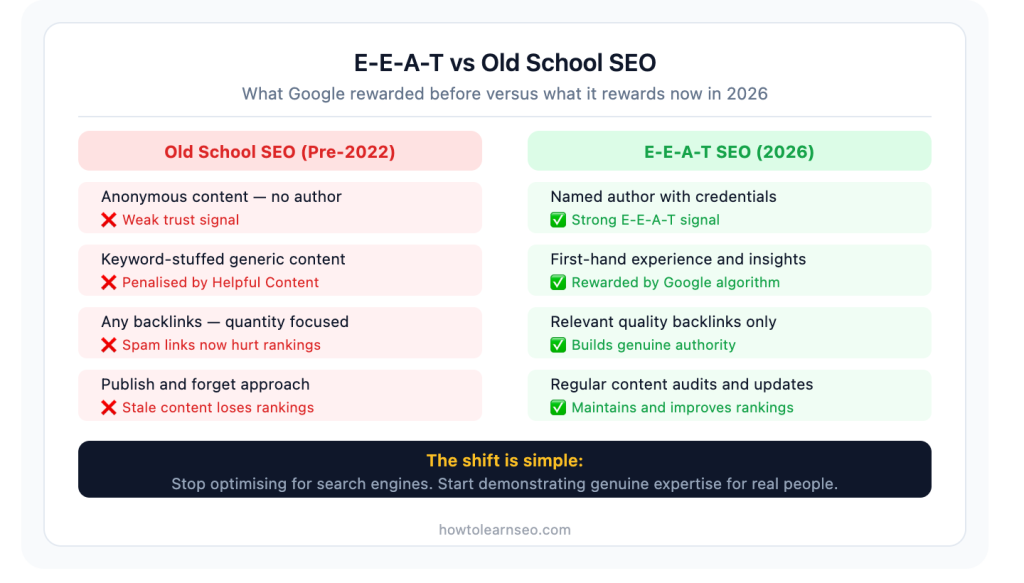
Three things happened in the last two years that made E-E-A-T the central battleground of SEO:
The AI content flood Millions of websites started publishing AI-generated articles at scale. Google responded by significantly strengthening its ability to detect thin, generic, unoriginal content — and demoting it. Sites that published hundreds of AI articles without genuine expertise or experience behind them lost enormous amounts of traffic in Google’s 2024 and 2025 core updates.
Google’s Helpful Content system Google’s algorithm now evaluates content at a site-wide level — not just page by page. If a significant portion of your site is low-quality, thin, or clearly written for search engines rather than people, it suppresses rankings across your entire domain. E-E-A-T is the framework that defines what “helpful content” actually means.
AI search and citation AI Overviews, ChatGPT Search, and Perplexity all evaluate source quality before deciding which sites to cite. The same signals that build E-E-A-T — authoritative backlinks, genuine expertise, transparent authorship — are exactly what AI systems look for when selecting sources. Strong E-E-A-T now earns you visibility in both traditional search results and AI-generated summaries.
E-E-A-T and YMYL Content
Google applies E-E-A-T most aggressively to what it calls YMYL content — Your Money or Your Life. These are topics where inaccurate or misleading information could genuinely harm the people reading it.
YMYL topics include:
- Medical and health advice
- Financial planning and investment
- Legal guidance
- News and current events
- Safety information
For YMYL content, Google’s standards are extraordinarily high. A personal finance article written by an anonymous blogger with no credentials will almost always rank below the same information published by a qualified financial professional with a verifiable background — regardless of how good the writing is.
For an SEO blog like howtolearnseo.com, YMYL standards are less intense since SEO advice doesn’t directly impact someone’s health or financial safety. But E-E-A-T still matters significantly — Google wants to see that the people writing about SEO actually know SEO.
How to Improve Your E-E-A-T Signals
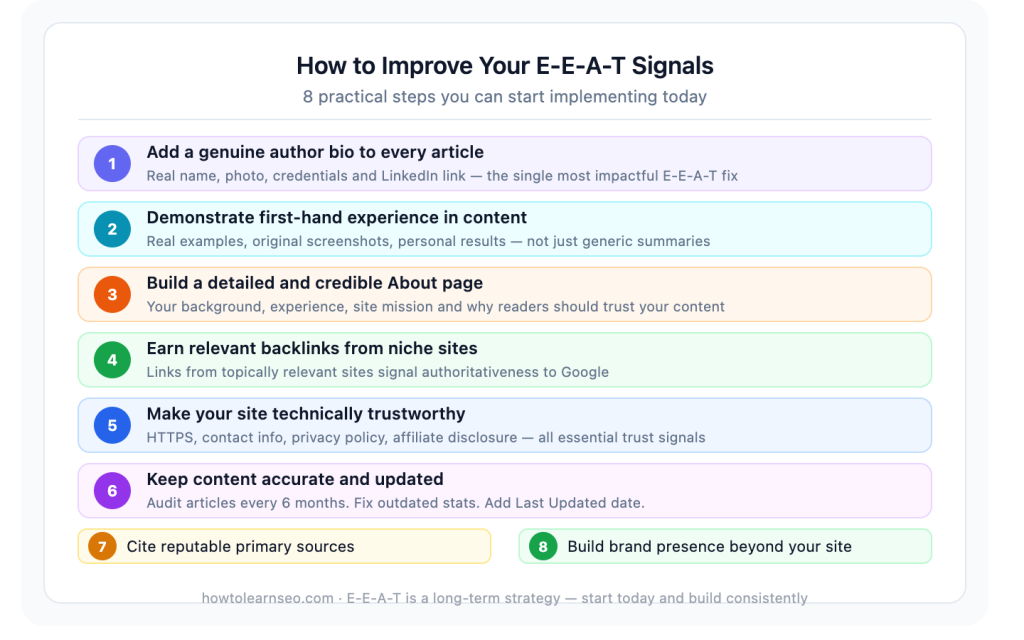
Here’s the practical side — what you can actually do to build stronger E-E-A-T across your site.
1. Add a Genuine Author Bio to Every Article
This is the single most impactful and most overlooked E-E-A-T improvement available to bloggers. Every article you publish should have an author bio that includes:
- Your real name
- A professional photo
- Your relevant credentials or experience — how many years you’ve worked in SEO, what roles you’ve held, what results you’ve achieved
- Links to your LinkedIn profile or other professional presence
Google’s quality raters look specifically for author information when evaluating content quality. An article published by “Admin” or with no author attribution at all is a weak E-E-A-T signal regardless of how well-written it is.
2. Demonstrate First-Hand Experience in Your Content
Generic information is everywhere. What separates high E-E-A-T content is the specific, first-hand details that only someone with real experience could know.
Instead of writing: “Keyword research is important for SEO.”
Write: “When I started targeting long-tail keywords with KD under 20, my articles began ranking within 6 to 8 weeks rather than the 4 to 6 months it took for more competitive terms.”
The second version contains information that proves the writer has actually done the thing. It’s more useful to readers and it’s a stronger E-E-A-T signal to Google. Add case studies, real examples, original screenshots, personal observations, and honest assessments based on what actually happened — not just what the theory says should happen.
3. Build a Credible About Page
Your About page is where Google’s quality raters and your readers go to verify who you are. A thin About page with two sentences and a stock photo sends weak trust signals. A detailed About page that explains your background, your expertise, your site’s mission, and why readers should trust your content sends strong ones.
For howtolearnseo.com, your About page should explain your years of experience in digital marketing, the clients and industries you’ve worked with, why you built this specific site, and what makes your SEO guidance reliable.
4. Earn Relevant Backlinks
Backlinks from topically relevant, authoritative sites in your niche are the primary external signal of authoritativeness. A link from a respected SEO publication tells Google that people who know SEO consider you a credible source.
Focus on earning links from sites that are genuinely relevant to your niche rather than chasing high DA links from unrelated domains. A link from an SEO-focused blog with DA 30 carries more E-E-A-T weight than a link from a general news site with DA 80 that has nothing to do with digital marketing.
5. Make Your Site Technically Trustworthy
Trust signals at the site level include:
- HTTPS — non-negotiable in 2026. Any site without a valid SSL certificate is flagged as insecure.
- Clear contact information — an email address, contact form, or business address tells Google and visitors that a real person is behind the site
- Privacy policy and terms of service — standard pages that legitimate sites always have
- Transparent disclosure — if you earn affiliate commissions, say so clearly. Google rewards transparency and penalises hidden commercial interests.
6. Keep Content Accurate and Updated
Factual errors are one of the fastest ways to damage trust signals. If Google’s quality raters find easily verifiable inaccuracies in your content, it damages your E-E-A-T across the board.
Audit your published articles periodically. Update statistics that have changed. Correct any information that has become outdated. Add a visible “Last Updated” date to articles you’ve refreshed — it signals to both readers and Google that the content is being maintained.
7. Cite Reputable Sources
Linking to authoritative primary sources — official Google documentation, peer-reviewed research, government data — strengthens your trustworthiness signals. It shows that your content is grounded in verifiable information rather than speculation.
For an SEO blog, citing Google’s own Search Quality Rater Guidelines, Google Search Central documentation, and recognised industry research is exactly the kind of source attribution that builds E-E-A-T.
8. Build Your Brand Presence Beyond Your Website
E-E-A-T isn’t just about what’s on your site. Google looks at your broader online presence — what others say about you across the web.
Build brand signals by:
- Being active and helpful in SEO communities on Reddit and LinkedIn
- Contributing to industry discussions on platforms your audience uses
- Getting mentioned in industry roundups and resource lists
- Building a consistent social media presence that reinforces your expertise
Brand mentions — even without a direct link — tell Google and AI systems that your brand is recognised in your niche. In 2026 this matters for both traditional rankings and AI citation visibility.
Common E-E-A-T Mistakes to Avoid
Publishing without author attribution — Anonymous content is a red flag for quality raters. Every article needs a named author with verifiable credentials.
Generic content that could have been written by anyone — If your content contains no first-hand insights, original examples, or unique perspective, it’s competing purely on keywords against sites with far more authority.
Ignoring your About page — A thin or missing About page is one of the easiest E-E-A-T signals to fix and one of the most commonly neglected.
Undisclosed affiliate relationships — Failing to disclose commercial interests damages trustworthiness. Always include a clear affiliate disclaimer on pages that earn commissions.
Outdated or inaccurate content — Information that was correct two years ago may be wrong today. Stale content that contradicts current best practices is a trust signal problem.
Hiding behind a brand name — Real humans with real credentials behind real content is what Google’s systems are increasingly designed to reward. The more transparent you are about who is writing your content and why they’re qualified, the stronger your E-E-A-T signals become.
Key Takeaways
- E-E-A-T stands for Experience, Expertise, Authoritativeness, and Trustworthiness — Google’s framework for evaluating content quality
- Trust is the most important of the four pillars — without it the others don’t matter
- E-E-A-T is not a direct ranking factor but the signals it evaluates absolutely influence rankings
- In 2026 with AI content flooding the web, genuine first-hand experience is the hardest signal to fake and the most valuable to demonstrate
- Author bios with real credentials are the single most impactful and most overlooked E-E-A-T improvement
- YMYL topics require especially strong E-E-A-T signals — Google holds health, financial, and safety content to very high standards
- Building E-E-A-T is a long-term strategy — it takes months to establish but produces rankings that are far more stable and durable than those built on technical optimisation alone
Frequently Asked Questions
Q1: What does E-E-A-T stand for in SEO? E-E-A-T stands for Experience, Expertise, Authoritativeness, and Trustworthiness. It’s a framework from Google’s Search Quality Rater Guidelines that defines the four dimensions human evaluators use to assess content quality. The acronym expanded from the original E-A-T when Google added “Experience” as a distinct pillar in December 2022, recognising first-hand knowledge as a separate quality dimension from formal expertise.
Q2: Is E-E-A-T a direct Google ranking factor? No. E-E-A-T is not a direct algorithmic ranking factor and Google does not assign a numeric E-E-A-T score to pages. It is a framework used by human Search Quality Raters whose aggregated feedback trains Google’s ranking systems over time. However, the signals E-E-A-T evaluates — author credibility, backlink quality, content accuracy, and site transparency — are absolutely captured by Google’s algorithm and do influence rankings.
Q3: How do I improve E-E-A-T for my website? The most impactful steps are adding genuine author bios with real credentials to every article, demonstrating first-hand experience through specific examples and original insights, building a detailed About page, earning backlinks from relevant authoritative sites, keeping content accurate and updated, citing reputable primary sources, and making your site technically trustworthy with HTTPS, clear contact information, and transparent disclosure of commercial relationships.
Q4: What is YMYL content and why does it affect E-E-A-T? YMYL stands for Your Money or Your Life — topics where inaccurate information could genuinely harm readers, including medical advice, financial guidance, legal information, and safety content. Google applies E-E-A-T standards most aggressively to YMYL content because the stakes of getting it wrong are highest. For non-YMYL topics like SEO, E-E-A-T still matters but the standards are applied less strictly.
Q5: How long does it take to build strong E-E-A-T? Building genuine E-E-A-T takes months rather than weeks. Immediate improvements like adding author bios and updating your About page can have relatively quick effects on how quality raters perceive your site. Broader authority signals — relevant backlinks, brand mentions, and external recognition — typically take six to twelve months of consistent effort to build meaningfully. E-E-A-T is a long-term strategy, not a quick fix, but the rankings it produces are more stable and durable than those built on technical optimisation alone.