Search engines no longer rank pages simply because they contain the right keywords. They rank pages because they match what the user is actually trying to achieve.
This underlying motivation behind a search is known as search intent. It is one of the most important SEO concepts to understand, especially for beginners. When content aligns with intent, rankings improve naturally. When it doesn’t, even well-optimized pages struggle to appear.
Understanding search intent helps you create content that search engines trust and users find genuinely useful.
What Is Search Intent?
Search intent (also called user intent) refers to the reason behind a search query.
When someone types a phrase into a search engine, they usually want to:
- learn something
- find a specific website
- compare options
- or complete an action
Search engines analyze this intent and choose results that best satisfy it.
Why Search Intent Matters in SEO
Search engines are designed to solve problems, not just retrieve information. If a page solves the user’s problem effectively, it is more likely to rank.
Search intent affects:
- which pages appear in results
- what type of content ranks
- how long users stay on a page
- whether users return to search results
Pages that consistently match intent tend to perform better over time.
How Google Determines Search Intent
Google uses multiple signals to understand intent, including:
- the wording of the query
- past user behavior
- query patterns
- search result engagement
- content formats that perform best
Over time, Google learns which types of pages users prefer for specific queries.
The Four Main Types of Search Intent
Search intent can be grouped into four main categories. Understanding these helps you choose the right content format.
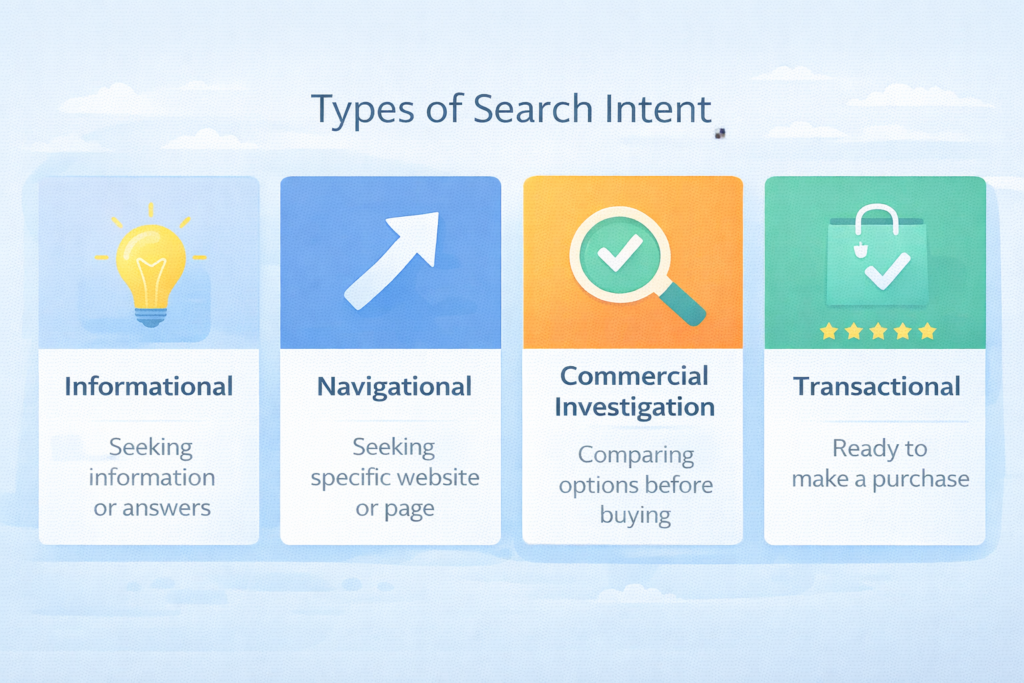
Informational Intent
The user wants information or an answer.
Examples:
- what is SEO
- how search engines work
- why internal linking matters
Content that works best:
- guides
- tutorials
- explanations
Navigational Intent
The user wants to reach a specific website or brand.
Examples:
- Google Search Console login
- YouTube homepage
Content that works best:
- official pages
- branded results
Commercial Investigation Intent
The user is comparing options before making a decision.
Examples:
- best SEO tools
- Ahrefs vs SEMrush
Content that works best:
- comparisons
- reviews
- detailed evaluations
Transactional Intent
The user is ready to take action.
Examples:
- buy SEO course
- sign up for keyword tool
Content that works best:
- product pages
- landing pages
- signup flows
How Search Intent Shapes Search Results
Search engines adapt results based on intent.
For the same keyword:
- informational intent shows guides
- commercial intent shows comparison pages
- transactional intent shows product pages
This is why ranking is impossible if content format doesn’t match intent.
How to Identify Search Intent for a Keyword
The simplest way to identify intent is to analyze search results.
Look at:
- the type of pages ranking
- content format (guides, lists, products)
- page titles and descriptions
Search results themselves reveal what Google believes users want.

Search Intent and Content Creation
Once intent is clear, content creation becomes easier.
Instead of asking:
“What keywords should I use?”
Ask:
“What problem is the user trying to solve?”
When content answers that question clearly, rankings often follow.
Search Intent vs Keywords
Keywords describe what users type.
Search intent explains why they type it.
Two keywords can look similar but have different intent. Optimizing only for keywords without intent often leads to poor performance.
Search Intent and SEO Basics Content
For SEO basics topics, intent is usually informational.
That means:
- clear explanations
- structured content
- helpful examples
- neutral, educational tone
Meeting informational intent builds trust and authority.
Common Search Intent Mistakes
Many pages fail because they:
- target transactional keywords with blog posts
- target informational queries with sales pages
- mix multiple intents in one article
- ignore what already ranks
Clarity beats over-optimization.
How Search Intent Connects to Rankings
Search intent affects:
- click-through rate
- dwell time
- pogo-sticking behavior
When users find what they expect, engagement improves — and so does ranking stability.
Key Takeaways
- Search intent explains why users search
- Google ranks pages that best satisfy intent
- There are four main types of search intent
- Matching content format to intent is critical
- Search intent is foundational to SEO success
FAQs
What is search intent in SEO?
Search intent is the purpose behind a user’s search query.
Why is search intent important for rankings?
Because Google prioritizes content that satisfies user needs.
How do I identify search intent?
By analyzing the current search results for a keyword.
Can one keyword have multiple intents?
Yes, but one intent usually dominates.
Does search intent change over time?
Yes, as user behavior and expectations evolve.