
If you’ve spent any time reading about SEO, you’ve probably come across the term domain authority — and probably wondered whether it actually matters or whether it’s just another number to obsess over. The honest answer is somewhere in the middle. Domain authority is genuinely useful as a benchmark for measuring your site’s SEO progress and comparing yourself against competitors. But it’s also one of the most misunderstood metrics in the industry, and chasing it the wrong way can pull your focus away from what actually moves the needle. This guide covers everything you need to know — what domain authority is, how it’s calculated, what counts as a good score, and exactly how to improve it.
What Is Domain Authority?
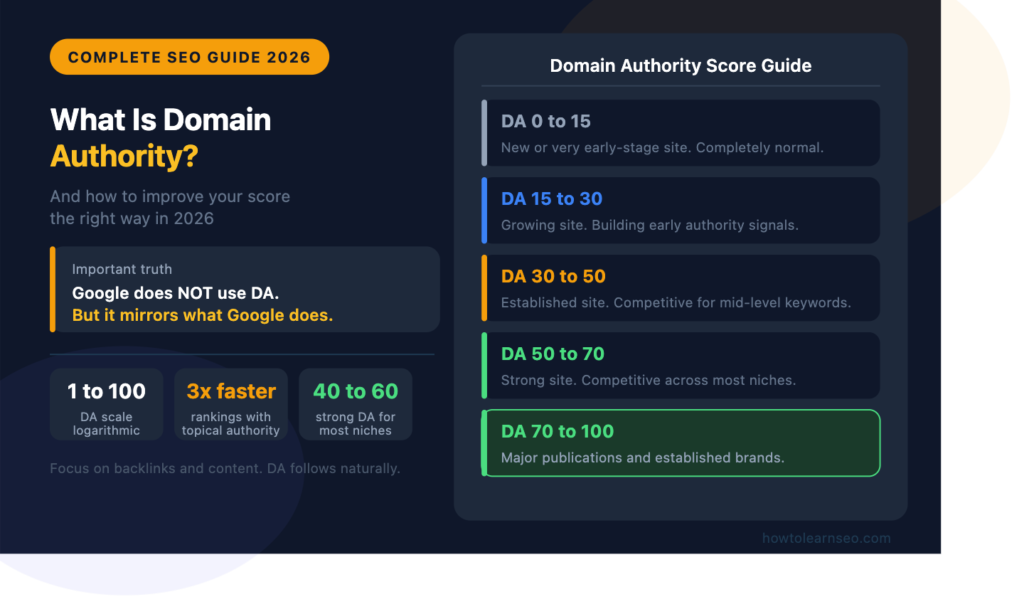
Domain Authority, often shortened to DA, is a predictive score created by Moz. It estimates how likely a website is to rank in search engine results compared to other websites. The score runs on a scale of 1 to 100 — the higher your score, the stronger your ranking potential is predicted to be.
The most important thing to understand about domain authority upfront is this: Google does not use Domain Authority as a ranking factor. DA is a third-party metric created by Moz, not a signal used in Google’s algorithm. However, the underlying factors that improve DA — quality backlinks, strong content, good technical SEO — are very much what Google does care about. That’s why DA correlates strongly with real-world ranking performance even though Google never touches the number itself.
Think of DA as a mirror reflecting your SEO health rather than a lever you pull to get rankings. When your SEO improves, DA improves as a byproduct.
Domain Authority vs Domain Rating vs Authority Score
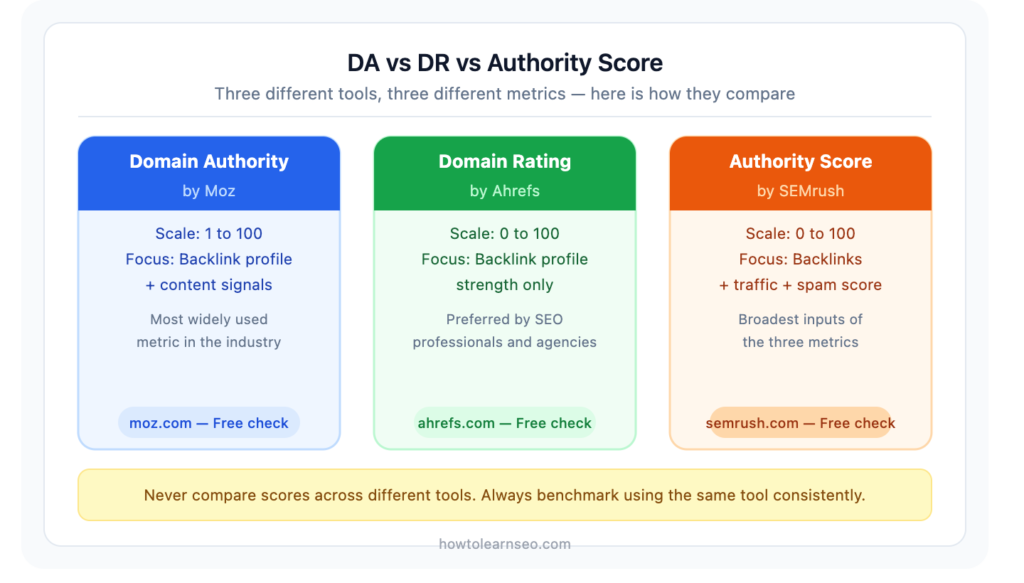
A common point of confusion is that different SEO tools use different names for similar metrics:
Domain Authority (DA) — Created by Moz. Ranges from 1 to 100. Based primarily on the quality and quantity of backlinks pointing to your domain. The most widely referenced authority metric in the industry.
Domain Rating (DR) — Created by Ahrefs. Also ranges from 0 to 100. Focuses specifically on the strength of a site’s backlink profile. Very similar concept to DA but calculated using Ahrefs’ own data and methodology.
Authority Score — Created by SEMrush. Combines backlink data with organic traffic signals and spam detection to produce a broader site quality estimate.
None of these are interchangeable — a score of 40 in one tool won’t match a score of 40 in another. Always benchmark against competitors using the same tool consistently.
How Is Domain Authority Calculated?
Moz calculates Domain Authority using a machine learning algorithm that evaluates dozens of factors, primarily focused on your backlink profile. The key inputs include:
Linking root domains — The number of unique websites linking to yours. Two links from the same domain count as one linking root domain. More unique linking domains means stronger authority.
Quality of linking sites — A single link from a DA 80 news publication is worth more than fifty links from low-quality directories. The authority of the sites linking to you directly affects your own score.
Total number of backlinks — Raw link count contributes, but quality always outweighs quantity.
Internal linking structure — How well your site’s own pages link to each other affects how authority flows throughout your domain.
One crucial thing to understand about DA is that it uses a logarithmic scale. This means improving from DA 10 to DA 20 is significantly easier than improving from DA 60 to DA 70. The higher your score, the harder each additional point becomes. New sites should expect to climb quickly at first, then see progress slow as they reach the 30 to 40 range.
What Is a Good Domain Authority Score?
This is where most beginners go wrong — they look up their DA score and compare it to a generic benchmark without considering context. A good DA score is relative to your niche and your specific competitors, not an absolute number.
Here’s a general framework:
| DA Score | What It Means |
|---|---|
| 0–15 | New or very early-stage site — normal for sites under 6 months old |
| 15–30 | Growing site — building early authority signals |
| 30–50 | Established site — competitive for mid-difficulty keywords |
| 50–70 | Strong site — competitive in most niches |
| 70–100 | Very high authority — major publications, established brands |
The number that actually matters is how your DA compares to the sites you’re trying to outrank. If your target keywords are dominated by sites with DA 25 to 35, a DA of 30 puts you in a competitive position. If you’re trying to outrank sites with DA 70 plus, you have a long road ahead regardless of your content quality.
Why Does Domain Authority Matter for New Websites?
For a new website like howtolearnseo.com, understanding DA helps you set realistic expectations and make smarter content decisions.
New websites almost always start at DA 1 or below. This doesn’t mean your content can’t rank — it means you need to be strategic about which keywords you target while you build authority. Low-competition, long-tail keywords are your best friend in the first six to twelve months precisely because you can rank for them without needing high domain authority.
As you publish consistently, earn your first backlinks, and build internal linking across your articles, your DA will begin climbing. Most new sites that follow good SEO practices reach DA 15 to 25 within their first year, and DA 30 to 40 within two years with sustained effort.
8 Proven Ways to Improve Your Domain Authority
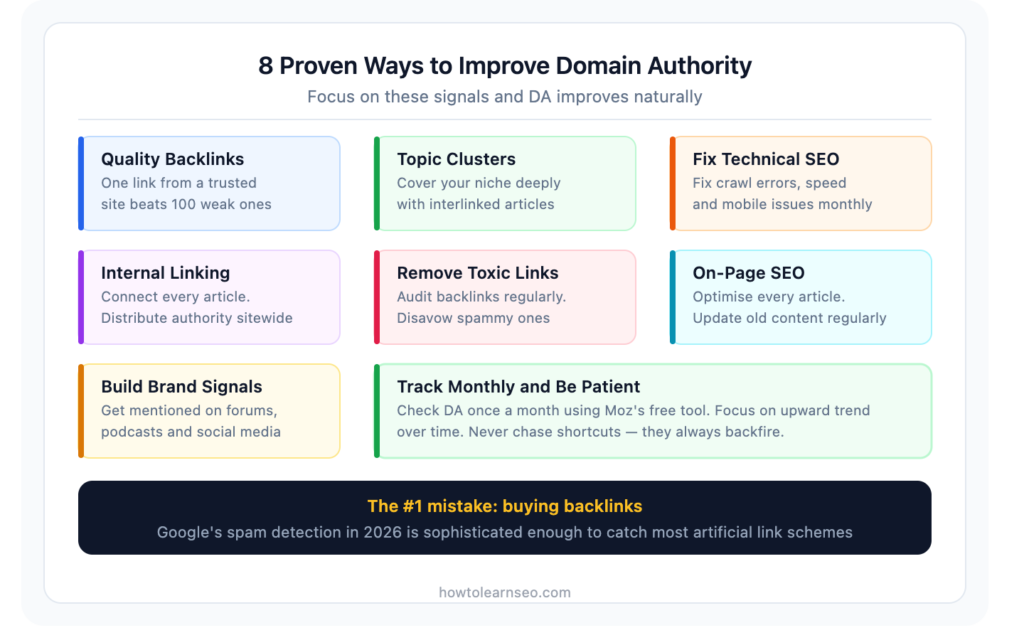
Here’s the honest truth — you don’t improve domain authority directly. You improve the underlying SEO signals that DA measures, and the score follows naturally. Here’s exactly how to do that:
1. Earn High-Quality Backlinks
Backlinks remain the single strongest driver of domain authority. But the emphasis in 2026 is firmly on quality over quantity. One link from a relevant, trusted site in your niche is worth more than a hundred links from random directories.
The best ways to earn quality backlinks:
Guest posting — Write a genuinely useful article for another blog in your niche. Include one natural link back to your site. Even two or three guest posts per month on relevant sites can meaningfully move your DA over time.
Create link-worthy content — Original research, comprehensive guides, unique data, and genuinely useful tools naturally attract links without you having to ask. An article that says “we analysed 500 keywords and here’s what we found” will earn far more natural links than a generic how-to post.
Digital PR — Getting your site mentioned in online publications, industry newsletters, and authority sites builds exactly the kind of high-DA links that move your score fastest.
Broken link building — Find pages on other sites that link to broken or dead content, then reach out suggesting your article as a replacement. Tools like Ahrefs and Mangools make finding these opportunities much easier.
Want to start building backlinks today? Here are 10 proven free strategies that work for any website.
2. Build Topical Authority Through Content Clusters
In 2026, sites that dominate search results aren’t just those with the most backlinks — they’re the ones that demonstrate genuine depth of expertise on a topic. Building a cluster of interlinked articles covering your niche from multiple angles signals topical authority to both search engines and the tools that calculate DA.
For howtolearnseo.com, this means having comprehensive coverage of keyword research, on-page SEO, technical SEO, link building, AI search, and SEO tools — all interlinked — rather than isolated posts on random topics. Sites focusing on topical authority first see ranking gains up to three times faster than those chasing DA alone.
3. Fix Technical SEO Issues
Technical problems actively suppress domain authority growth. A site with crawl errors, broken links, slow page speed, or poor mobile experience sends weak signals to search engines — and those weak signals show up in your DA.
Regular technical maintenance includes:
- Running a site audit in Google Search Console monthly
- Fixing any crawl errors or coverage issues immediately
- Checking for and fixing broken internal links
- Keeping page speed above 70 on mobile
- Ensuring all important pages are properly indexed
4. Strengthen Your Internal Linking
Internal links help search engine authority flow throughout your site. Every new article you publish should link to at least two or three existing articles, and your existing articles should be updated to link to new ones.
A well-structured internal linking network amplifies every backlink you earn — distributing the authority from your strongest pages across your entire domain rather than letting it sit on one page.
5. Remove or Disavow Toxic Backlinks
Not all backlinks help — some actively hurt. Spammy links from low-quality sites, link farms, and irrelevant directories can suppress your DA growth and potentially trigger Google penalties.
Use Google Search Console to audit your backlink profile periodically. If you find links from obviously spammy or irrelevant sites, you can disavow them using Google’s Disavow Tool. This tells Google to ignore those links when evaluating your site.
6. Improve Your On-Page SEO Consistently
Every article you publish is an opportunity to strengthen your domain’s overall content quality signals. Consistently well-optimised articles with proper titles, meta descriptions, headings, and keyword usage build a stronger content profile that supports authority growth.
Don’t just publish and forget. Go back to older articles periodically, update them with new information, improve their on-page optimisation, and add links to newer related articles.
7. Build Brand Signals
Search engines increasingly reward brands rather than anonymous websites. Brand mentions, even without a direct link, contribute to authority over time. Getting your site mentioned on podcasts, in social media posts, on forums like Reddit and Quora, and in industry communities all build the kind of brand signals that support long-term DA growth.
8. Be Patient and Track Progress Monthly
Domain authority does not increase overnight. Even with a solid strategy, meaningful DA growth typically happens over months, not weeks. The logarithmic scale means visible improvement requires sustained consistent effort.
Track your DA monthly using a free tool like Moz’s domain authority checker. Don’t check daily — you’ll drive yourself mad. Monthly tracking gives you a clear picture of upward trend over time, which is what you’re actually managing.
How to Check Your Domain Authority for Free
You can check your domain authority without paying for any tools:
Moz Free Domain Analysis — Go to moz.com/domain-analysis, enter your domain, and see your DA score, top linking domains, and ranking keywords for free.
Ahrefs Free Website Authority Checker — Go to ahrefs.com/website-authority-checker, enter your domain, and see your DR score and referring domain count for free.
MozBar Chrome Extension — Install the free MozBar extension and see DA scores for any website you visit directly in your browser — including your competitors’.
Common Domain Authority Mistakes to Avoid
Obsessing over the number — DA is a means to an end, not a goal in itself. Sites with DA 25 outrank sites with DA 50 regularly because content quality and search intent match matter more for individual keyword rankings.
Buying backlinks — Purchased links from link farms and PBNs might temporarily boost your DA, but they carry significant risk of Google penalties. In 2026, Google’s link spam detection is sophisticated enough to identify most artificial link schemes. The risk is never worth it.
Ignoring your competitors’ DA — Your DA score only means something in context. Always compare it against the DA of sites ranking for your target keywords, not against generic benchmarks.
Expecting fast results — DA growth is slow by design. The metric rewards sustained, legitimate SEO effort over time. If you’re seeing dramatic DA increases in a short period, it’s worth checking whether those gains came from quality sources.
Key Takeaways
- Domain Authority is a third-party metric created by Moz — Google does not use it as a ranking factor
- DA ranges from 1 to 100 on a logarithmic scale — progress gets harder the higher you go
- A good DA score depends entirely on your niche and competitors, not a universal number
- The strongest driver of DA is earning quality backlinks from relevant, trusted websites
- Building topical authority through content clusters improves DA faster than chasing individual links
- Technical SEO health, internal linking, and brand signals all contribute to DA growth
- New sites typically reach DA 15 to 25 in their first year with consistent SEO effort
- Track DA monthly — not daily — and focus on upward trends over time
Frequently Asked Questions
Q1: Is domain authority a Google ranking factor? No. Domain Authority is a third-party metric created by Moz and is not used by Google in its ranking algorithm. However, the factors that improve DA — quality backlinks, strong content, good technical SEO — are closely aligned with what Google does evaluate. This is why high-DA sites tend to rank well, even though DA itself is not the cause.
Q2: How long does it take to improve domain authority? Meaningful DA growth typically takes three to six months of consistent SEO work to become visible. New sites climbing from DA 1 to DA 15 to 20 can achieve this within six to twelve months with regular publishing and early backlink building. Progress slows significantly above DA 40 as the logarithmic scale makes each additional point harder to earn.
Q3: What is the difference between Domain Authority and Domain Rating? Domain Authority is Moz’s metric, while Domain Rating is Ahrefs’ equivalent. Both measure the strength of a site’s backlink profile on a scale of 0 to 100, but they use different data sources and methodologies. Scores between the two tools won’t match exactly — a site with DA 35 might have a DR of 28 or 42 depending on how each tool’s algorithm evaluates the same backlinks.
Q4: Can I improve domain authority without backlinks? Backlinks are the strongest driver of DA, but they’re not the only one. Improving technical SEO, strengthening internal linking, publishing consistent high-quality content, and building topical authority all contribute to DA growth. For new sites in their first six months, focusing on these foundational signals while actively pursuing your first few quality backlinks is the most effective approach.
Q5: What is a good domain authority for a new website? A new website with a DA of 1 to 10 is completely normal in the first few months. Rather than focusing on reaching a specific number, new sites should compare their DA against the sites currently ranking for their target keywords. If your target keywords are ranked by sites with DA 20 to 30, building to that range is your practical near-term goal.