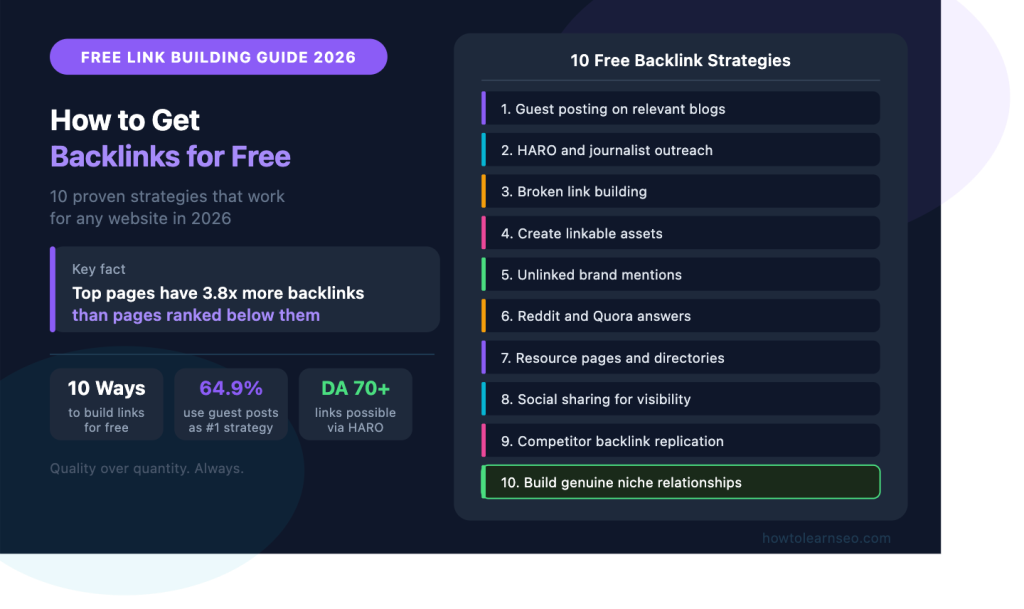
Backlinks are one of the strongest ranking signals in SEO — pages that rank at the top of Google have on average 3.8 times more backlinks than pages ranking in positions two through ten. The challenge for most new websites and bloggers is that quality backlink building seems expensive, time-consuming, or reserved for sites that already have authority. None of that is true. This guide covers ten proven strategies to get backlinks for free in 2026 — no paid link schemes, no spam, no shortcuts that will get your site penalised. Just legitimate, effective methods that work for sites at any stage.
Why Backlinks Still Matter in 2026
Before diving into strategies, it’s worth understanding why backlinks remain so important despite all the changes in SEO over recent years.
When another website links to yours, Google treats it as a vote of confidence. The more quality votes you accumulate — especially from trusted, relevant sites in your niche — the more authority your domain builds. That authority helps all your pages rank better, not just the ones receiving direct links.
In 2026 backlinks matter for two reasons instead of one. They still influence traditional Google rankings — but they also influence AI search. When AI systems like ChatGPT, Perplexity, and Google’s AI Overviews decide which sources to trust and cite, the sites that appear across multiple reputable contexts earn more citations. Backlinks help train the internet to associate your brand with specific topics — which is exactly what AI search engines look for when selecting sources.
Quality always matters more than quantity. One backlink from a DA 60 relevant industry blog is worth more than a hundred links from random low-quality directories. Keep that principle in mind throughout every strategy below.
Strategy 1: Guest Posting
Guest posting is the most widely used and consistently effective free backlink strategy available. The concept is simple — you write a high-quality article for another website in your niche, and in return you include a link back to your own site within the content or author bio.
According to research, 64.9% of link builders use guest posting as their primary backlink strategy. Done correctly, a single well-placed guest post on a relevant, authoritative site can deliver more SEO value than dozens of lower-quality links.
How to do it:
Find relevant blogs in your niche by searching Google for terms like "write for us" + SEO or "guest post" + SEO blog. Look for sites with a DA of at least 20 to 30 that publish content your audience would read.
Pitch a specific article idea that genuinely adds value to their audience — not a topic they’ve already covered. Write the best article you’ve produced, include one natural contextual link back to a relevant page on your site, and avoid over-optimising the anchor text.
What to avoid: Low-quality blogs that exist purely for guest posts, excessive backlinks in a single article, or pitching the same topic to multiple sites simultaneously.
Strategy 2: HARO and Journalist Outreach
HARO — which stands for Help a Reporter Out — connects journalists writing articles with expert sources who can contribute quotes and insights. When a journalist uses your response, you typically receive a backlink from the publication they’re writing for.
The value of HARO backlinks is extraordinary. Responses that get accepted regularly earn links from major publications with DA scores well above 70 — the kind of links that are nearly impossible to earn any other way for free.
In 2026, similar platforms have emerged alongside HARO including Qwoted and ProfNet. Using all three gives you more opportunities to land high-authority links consistently.
How to do it:
Sign up at helpareporter.com, qwoted.com, and profnet.com. Set up alerts for queries in your niche. When a relevant query appears, respond quickly — journalists often receive dozens of pitches and typically use the first few strong responses.
Keep your response concise, lead with your most useful insight immediately, and include a brief one-sentence credential establishing why you’re a credible source. A response that immediately answers the question gets selected far more often than one that buries the insight after three paragraphs of introduction.
Strategy 3: Broken Link Building
Broken link building is one of the most underused free backlink strategies available — especially for newer sites. The idea is to find links on other websites that point to dead pages, then reach out suggesting your own relevant content as a replacement.
This works because website owners genuinely want to fix broken links on their site — you’re doing them a favour while earning a backlink in return.
How to do it:
Find relevant articles in your niche using Google, then check them for broken links using the free Chrome extension Check My Links. When you find a broken link, verify you have a relevant article that covers the same topic.
Reach out to the site owner with a polite, brief email:
“Hi, I was reading your article on [topic] and noticed the link to [broken URL] is no longer working. I recently published a guide on the same topic that might work as a replacement — [your URL]. Happy to help if it’s useful.”
Keep it short and genuinely helpful. Don’t mention SEO or backlinks — frame it entirely as helping them fix a problem on their site.
Strategy 4: Create Linkable Assets
Some content formats naturally attract backlinks without any outreach at all — because other writers and bloggers reference them when creating their own content. These are called linkable assets.
The most effective linkable asset formats in 2026:
Original research and data — Conduct a survey, analyse publicly available data, or compile statistics in your niche. When other writers need to cite a statistic, they link to the source. Even a small original study can earn dozens of natural links over time.
Comprehensive ultimate guides — A definitive resource that covers a topic more thoroughly than anything else available becomes a reference point people link to naturally.
Free tools and calculators — If you can build or commission a genuinely useful free tool relevant to your niche, it will attract links for years. Even a simple calculator or checklist template can earn consistent backlinks.
Statistics roundup pages — Compile the most useful current statistics in your niche into one page. Writers constantly search for statistics to cite and link to — a well-maintained statistics page becomes a permanent magnet for free backlinks.
Strategy 5: Unlinked Brand Mentions
As your site and brand become more known, other websites will start mentioning you without always linking to you. Every unlinked mention is a free backlink opportunity waiting to be claimed.
How to find them:
Set up a free Google Alert at google.com/alerts for your site name, blog name, and your own name. Every time your brand is mentioned online, you’ll receive an email notification.
When you find an unlinked mention, reach out to the site owner with a brief, friendly message thanking them for the mention and asking if they’d be willing to add a link. Since they already know about you and chose to mention you, many will be happy to add the link — the conversion rate on these requests is significantly higher than cold outreach.
Strategy 6: Answer Questions on Reddit and Quora
Reddit and Quora are two of the highest-traffic platforms on the internet, and both allow you to include links to relevant content in your answers — as long as those links genuinely add value to the discussion.
The important distinction here is between helpful contributions and spam. A link dropped into an answer that genuinely expands on what you’ve written is valuable to readers and will stay up. A link that exists purely for the backlink will be removed by moderators.
How to do it:
Search Reddit and Quora for questions directly related to your articles. Write a genuinely helpful, detailed answer — one that stands on its own merit even without the link. Then reference your article naturally at the end: “I wrote a more detailed guide on this if you want to go deeper — [URL]”.
Focus on subreddits and Quora topics with engaged communities in your niche. For an SEO blog, communities like r/SEO, r/bigseo, and r/juststart are excellent starting points.
Strategy 7: Get Listed in Resource Pages and Directories
Many websites in every niche maintain resource pages — curated lists of the best tools, guides, and references for their audience. Getting your site listed on these pages earns a backlink and often sends referral traffic as well.
How to find them:
Search Google for terms like SEO resources + "useful links", SEO beginner guide + "recommended reading", or best SEO blogs 2026. Look for pages that list multiple external resources and appear to be actively maintained.
Reach out to the site owner with a brief pitch explaining your resource and why it would add value to their list. Keep the email short and specific — reference the actual page you found and explain exactly what your resource covers.
For business-related sites, getting listed in reputable general directories like Google Business Profile, Bing Places, and industry-specific directories also builds early authority without any cost.
Strategy 8: Internal Content Promotion and Social Sharing
While social media links are typically nofollow — meaning they don’t pass direct ranking authority — they serve a crucial indirect purpose in backlink building. Social sharing puts your content in front of more people, and more visibility means more chances of someone with a relevant website linking to it naturally.
Every article you publish should be shared on:
- Your personal LinkedIn profile
- Relevant Facebook groups in your niche
- Twitter/X with relevant hashtags
- Pinterest for visual content
- Any communities or forums where your target audience spends time
The goal isn’t the social link itself — it’s expanding the reach of your content to increase the chance of it being discovered and linked to by someone who runs a relevant website or blog.
Strategy 9: Competitor Backlink Replication
Your competitors have already proven that certain websites will link to content like yours. Analysing their backlink profiles reveals a list of sites that are already receptive to linking in your niche — which is far more efficient than searching for link opportunities from scratch.
How to do it for free:
Use Ahrefs’ free website authority checker or the free version of Moz’s Link Explorer to check your top competitors’ backlink profiles. Look for the types of sites linking to them — guest post opportunities, resource pages, directories, or mentions in roundup articles.
For each link type you identify, ask: can I replicate this? If a competitor is listed in a relevant directory you’re not in, submit your site. If they published a guest post on a site that accepts contributors, pitch that site yourself.
Strategy 10: Build Genuine Relationships in Your Niche
The most sustainable free backlink strategy of all isn’t a tactic — it’s building genuine relationships with other creators, bloggers, and website owners in your niche. People naturally link to people they know, respect, and trust.
Practical ways to build these relationships:
Comment genuinely on other blogs — Leave thoughtful, substantive comments on articles in your niche. Not “great post!” — but a genuine addition to the conversation that shows you read and engaged with the content.
Mention and link to other creators in your articles — When you reference someone else’s work, tell them. A brief email saying “I referenced your article on X in my latest guide — thought you’d like to know” starts a relationship without asking for anything.
Collaborate on content — Co-author an article, participate in a roundup post, or contribute to a collaborative resource. These naturally result in backlinks while building connections that pay dividends for years.
Engage on social media — Follow, share, and genuinely engage with other creators in your niche on LinkedIn, Twitter/X, and in relevant communities.
What NOT to Do: Backlink Mistakes to Avoid
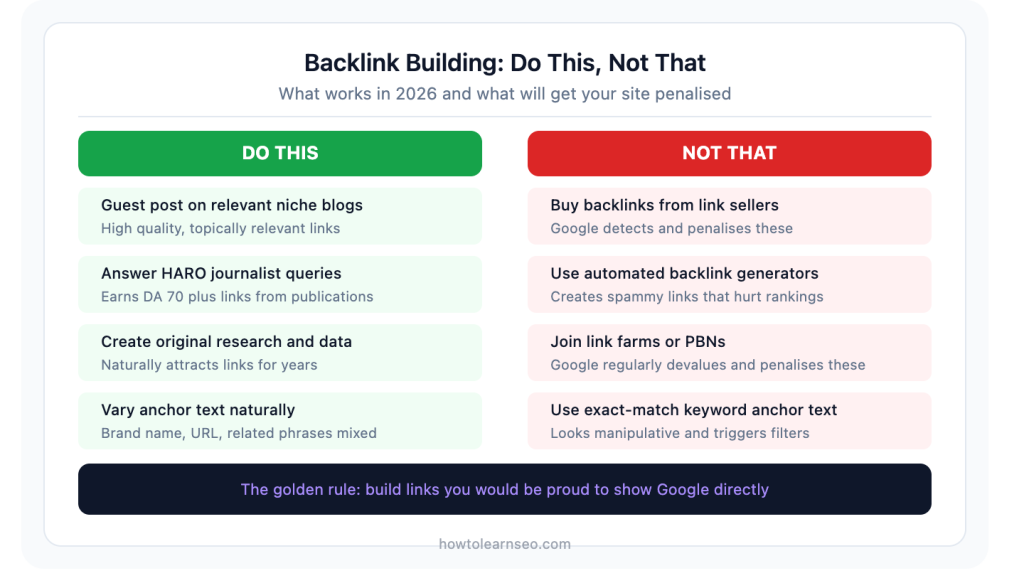
Buying backlinks — Google’s link spam detection in 2026 is sophisticated enough to identify most purchased links. The risk of a manual penalty is real and the recovery is painful. Never worth it.
Using automated backlink generators — Tools that claim to create hundreds of backlinks automatically produce low-quality, spammy links that can actively harm your site’s standing with Google.
Participating in link farms or PBNs — Private blog networks are networks of sites created purely to sell links. Google identifies and devalues these regularly, and sites caught using them face significant penalties.
Over-optimising anchor text — Using your exact target keyword as anchor text for every backlink looks manipulative. Vary your anchor text naturally — use your brand name, URL, related phrases, and generic terms alongside keyword-rich anchors.
How Long Does It Take to See Results?
Backlinks typically take a few weeks to several months before producing noticeable improvements in rankings. Search engines need to crawl and evaluate new links before their authority is passed.
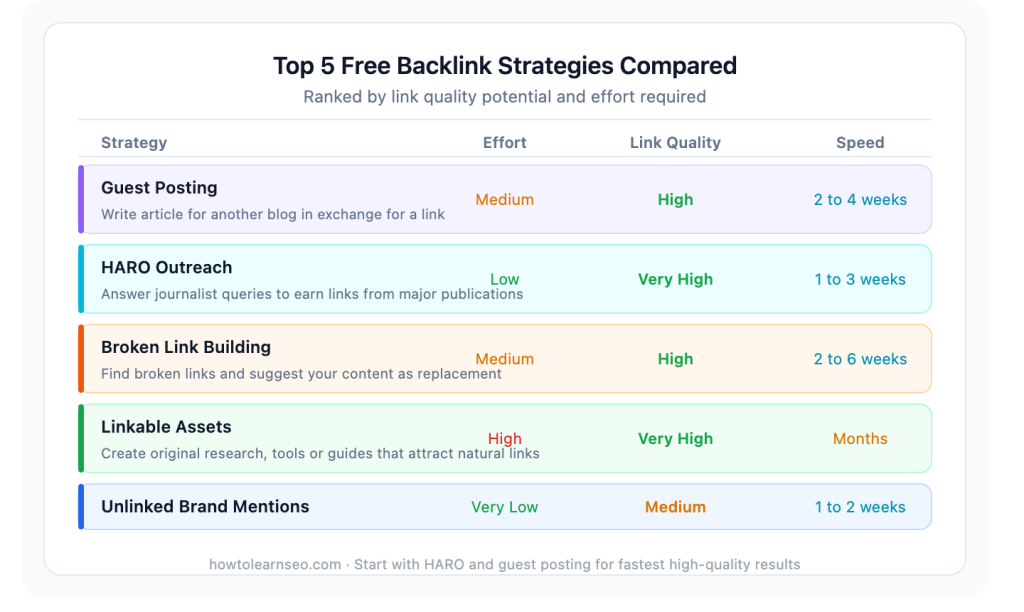
Quick wins like converting unlinked mentions and broken link replacements can show results in as little as two to four weeks. Content-based strategies like creating linkable assets and waiting for natural links can take months before significant numbers accumulate.
The key is consistency — building five to ten quality backlinks per month every month will compound over time into an authority profile that becomes very difficult for competitors to overcome.
Key Takeaways
- Backlinks remain one of the strongest ranking signals in SEO — pages in the top positions have on average 3.8 times more backlinks than those below them
- In 2026 backlinks also influence AI search visibility — they train AI systems to associate your brand with specific topics
- Quality always beats quantity — one link from a relevant DA 60 site beats a hundred low-quality directory links
- Guest posting and HARO outreach are the two most effective free strategies for building high-authority backlinks quickly
- Broken link building is underused and highly effective — find broken links on relevant sites and suggest your content as a replacement
- Linkable assets like original research and comprehensive guides attract natural backlinks without outreach
- Never buy backlinks or use automated tools — the risk of Google penalties is never worth any short-term gain
- Consistency matters — five to ten quality backlinks per month compounds into significant authority over time
Frequently Asked Questions
Q1: What are backlinks and why do they matter for SEO? Backlinks are links from one website pointing to another. They matter for SEO because Google treats them as votes of confidence — the more quality backlinks your site earns from trusted, relevant sites, the more authority it builds. That authority helps your pages rank higher across all your target keywords. In 2026 they also influence how AI search engines like ChatGPT and Google’s AI Overviews decide which sources to cite.
Q2: Can I really get high-quality backlinks for free? Yes. Guest posting, HARO journalist outreach, broken link building, and creating linkable assets are all completely free and consistently produce high-quality backlinks. They require time and effort rather than money — but the links they produce are just as valuable as paid placements and carry none of the penalty risk.
Q3: How many backlinks do I need to rank on Google? There is no specific number. What matters is the quality and relevance of your backlinks relative to the sites competing for the same keywords. A new blog targeting low-competition keywords can rank with five to ten quality backlinks. Competing for high-volume, competitive keywords against established sites with hundreds of backlinks requires a much longer-term link building effort.
Q4: What is the best free backlink strategy for a new website? For a brand new website, the most effective starting strategies are guest posting on relevant blogs in your niche and answering questions on Reddit and Quora with genuine, helpful responses. Both produce real backlinks relatively quickly and help establish your brand’s presence in your niche simultaneously. As your site grows, add HARO outreach and broken link building to your monthly routine.
Q5: Are social media links counted as backlinks for SEO? Social media links are almost always nofollow — they don’t pass direct ranking authority the way dofollow backlinks do. However, they serve an important indirect role by increasing the visibility of your content, which leads to more people discovering and naturally linking to it from their own websites. Social sharing is worth doing consistently for this indirect effect, even though the links themselves don’t directly improve rankings.