
Getting to Google’s first page is the goal behind almost every SEO effort — and for good reason. Over 90% of all clicks go to results on page one, which means page two might as well not exist for most websites. The challenge is that in 2026, Google’s algorithm has become significantly smarter and more demanding. The shortcuts, keyword tricks, and thin content strategies that worked five years ago no longer move the needle. What does work is a structured, quality-first approach built around what Google actually rewards today. This guide walks you through everything you need to do — in the right order — to earn and hold a first page ranking.
What Google Actually Rewards in 2026
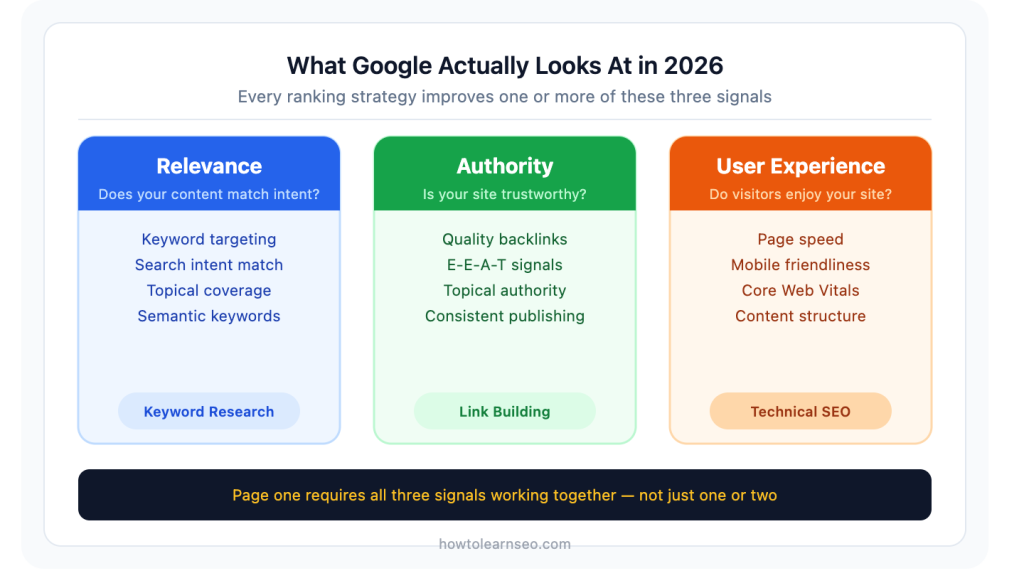
Before diving into tactics, it helps to understand the three core signals Google uses to decide which pages deserve page one:
Relevance — Does your content match what the searcher is actually looking for? This covers keyword targeting, search intent alignment, and topical coverage.
Authority — Is your site trustworthy and credible? This is built through quality backlinks, E-E-A-T signals, and consistent publishing over time.
User Experience — Do visitors enjoy using your site? This covers page speed, mobile friendliness, content structure, and Core Web Vitals performance.
Every strategy in this guide improves one or more of these three signals. When all three are strong simultaneously — that’s when first page rankings appear and hold.
Step 1: Target the Right Keywords
Keyword research is the foundation of every successful ranking strategy. If you target the wrong keywords — ones that are too competitive for your current authority level — you can do everything else perfectly and still never reach page one.
Target long-tail keywords first
Long-tail keywords are search phrases of four or more words with specific intent and lower competition. A new or growing website cannot realistically compete for “SEO tips” — that’s dominated by Ahrefs, Moz, and Backlinko with decade-long authority profiles. But “SEO tips for a brand new WordPress blog” is a different story entirely.
Long-tail keywords also convert better. Someone searching “SEO tips” might be casually curious. Someone searching “how to do on-page SEO for a new blog in 2026″ has a specific problem and is actively looking for a solution.
Understand search intent before writing anything
Every keyword has an intent behind it — what the searcher actually wants to accomplish. There are four types:
- Informational — the searcher wants to learn something
- Navigational — the searcher wants to find a specific website
- Commercial — the searcher is comparing options before making a decision
- Transactional — the searcher wants to buy or sign up for something
Before writing any article, check what Google already ranks at position one for your target keyword. If all the top results are how-to guides, write a how-to guide. If they’re comparison articles, write a comparison. Mismatching your content format with the dominant intent for that keyword is one of the fastest ways to guarantee you never reach page one — regardless of how good the content is.
Find keywords where you can actually win
Use free tools like Google Keyword Planner, Google’s People Also Ask boxes, and Google’s related searches section at the bottom of results pages to identify keyword opportunities. Look for questions that have decent search volume but where the current top-ranking results are thin, outdated, or don’t fully answer the question. Those are your fastest wins.
Step 2: Create Content That Genuinely Deserves to Rank
Google’s Helpful Content system — rolled out and significantly strengthened between 2024 and 2025 — is specifically designed to filter out content written for algorithms rather than people. In 2026, you cannot separate great writing from great SEO anymore.
Cover the topic completely
A page that comprehensively answers every aspect of the searcher’s question will always outperform a page that partially covers the topic. Before publishing, ask yourself: is there any follow-up question a reader might have after reading this that I haven’t answered? If yes, answer it.
Pages ranking in the top three positions for informational queries average between 1,400 and 2,500 words — not because length itself is a ranking factor, but because genuinely thorough coverage of a topic naturally produces longer content.
The foundation of ranking is knowing how to write SEO-friendly blog posts that satisfy both readers and search engines.
Demonstrate real expertise
Google’s E-E-A-T framework — Experience, Expertise, Authoritativeness, Trustworthiness — evaluates whether the person or organisation behind the content actually knows what they’re talking about. In 2026, with AI-generated content flooding the web, genuine human expertise has become more valuable and more visible in rankings than ever before.
One of the strongest long-term ranking strategies is building your E-E-A-T signals.
Show your expertise through real examples, first-hand observations, original data where possible, and an author bio that establishes genuine credentials. Content that clearly comes from someone who has actually done the thing they’re writing about consistently outperforms generic information available everywhere.
Structure content for readability and extraction
Google doesn’t just rank content — it extracts answers from it for featured snippets and AI Overviews. Structure your articles with clear H2 and H3 headings, short paragraphs, bullet points where relevant, and direct answers at the start of each section. This improves both readability for human visitors and extractability for Google’s AI systems.
Step 3: Master On-Page SEO
On-page SEO is entirely within your control and has a direct, measurable impact on rankings within days of implementation. Every page you publish should be fully optimised before it goes live.
Title tag — Include your primary keyword as close to the beginning as possible. Keep it under 65 characters. Make it compelling — power words, numbers, and the current year all improve click-through rate, and click-through rate is a user signal Google monitors.
Meta description — Not a direct ranking factor, but a well-written meta description significantly improves click-through rate. Include your keyword naturally and give a clear, compelling reason to click. Keep it between 140 and 155 characters.
H1 heading — One per page, includes the primary keyword, matches or closely mirrors the title tag.
URL slug — Short, keyword-rich, lowercase with hyphens. Get it right before publishing and never change it after the page is indexed.
First 100 words — Mention your primary keyword naturally within the first paragraph to signal the topic clearly to Google early.
Internal links — Link to two or three relevant existing articles on your site using descriptive anchor text. Internal links pass authority between pages and help Google understand your site’s topical structure.
Image alt text — Every image needs a descriptive alt text that includes a keyword where natural. Never leave alt text blank.
Step 4: Build a Topic Cluster Around Your Core Subject
One of the most powerful ranking strategies available in 2026 is building a topic cluster — a group of interlinked articles that cover a subject from multiple angles. Sites that publish ten deeply interconnected articles on the same topic consistently outrank sites with one great article on that topic.
Here’s why: when Google sees multiple well-written, interlinked articles covering keyword research, on-page SEO, backlinks, technical SEO, and ranking strategies — all on the same domain — it recognises that domain as a genuine authority on SEO. That topical authority lifts rankings for all pages in the cluster, not just the best individual article.
For howtolearnseo.com, every article published is building this cluster. Each new article on an SEO subtopic strengthens the authority of all the others. This is why consistency matters so much — the compounding effect of a well-built topic cluster is one of the most durable ranking advantages available.
How to build a topic cluster:
- Identify your core pillar topic — the broadest, highest-volume keyword in your niche
- Write a comprehensive pillar article covering the topic at a high level
- Build cluster articles around specific subtopics — each one going deep on a narrower aspect
- Link every cluster article to the pillar and link the pillar to every cluster article
- Update internal links as new cluster articles are published
Step 5: Fix Your Technical SEO Foundation
Even the best content won’t rank if your website has technical problems that prevent Google from properly crawling, indexing, or loading your pages.
New to technical SEO? Our complete technical SEO beginner’s guide covers everything you need to know.
Core Web Vitals
Google’s Core Web Vitals are confirmed ranking factors. The 2026 targets are:
- LCP (Largest Contentful Paint) under 2.5 seconds — how fast the main content loads
- INP (Interaction to Next Paint) under 200 milliseconds — how quickly the page responds to user actions
- CLS (Cumulative Layout Shift) under 0.1 — how visually stable the page is as it loads
Over 53% of mobile users abandon a page that takes more than three seconds to load. A slow website doesn’t just rank lower — it actively loses visitors before they’ve read a single word. Use Google’s free PageSpeed Insights to check your score and identify what’s slowing your pages down.
Mobile optimisation
Google uses mobile-first indexing — meaning it evaluates the mobile version of your site first when deciding rankings. Over 60% of searches happen on mobile. A site that looks and works perfectly on desktop but performs poorly on mobile will rank below its potential regardless of content quality.
Indexing and crawlability
Check Google Search Console regularly for crawl errors, coverage issues, and pages that aren’t being indexed. A page Google can’t access can never rank — no matter how good the content is.
Step 6: Earn Quality Backlinks
Backlinks remain one of Google’s top three ranking factors. Pages at the top of search results have on average 3.8 times more backlinks than those ranking below them.
In 2026 the emphasis is firmly on quality over quantity. One link from a relevant, trusted site in your niche is worth more than fifty links from random directories. The most effective free backlink strategies for new and growing sites are guest posting on relevant blogs, answering journalist queries through platforms like HARO, and creating genuinely linkable content like original research, comprehensive guides, and useful tools.
What to avoid: buying backlinks, using automated link building tools, or participating in link farms. Google’s spam detection is sophisticated enough to identify most artificial link schemes, and the penalty risk is never worth any short-term gain.
Step 7: Track, Analyse and Improve
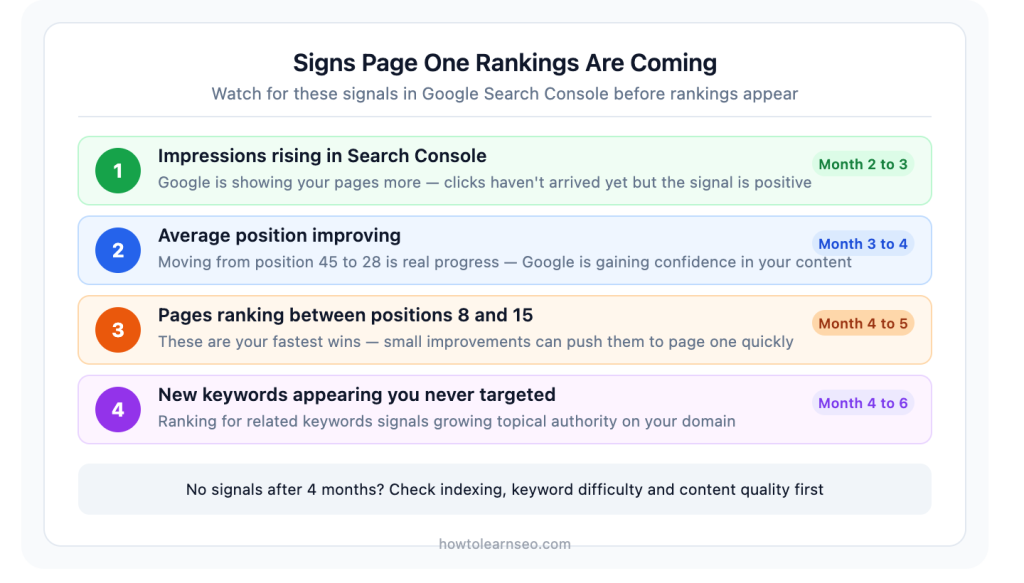
Ranking on Google’s first page isn’t a one-time achievement — it’s an ongoing process. Sites that hold top rankings consistently are the ones that track their performance and keep improving.
Set up your tracking from day one:
- Google Search Console — tracks keyword rankings, impressions, clicks, and technical issues
- Google Analytics 4 — tracks visitor behaviour, time on page, and which content drives the most engagement
- Rank tracking — pick your 10 most important target keywords and track their positions monthly
What to monitor:
- Are impressions growing month over month? This is the first sign SEO is working
- Are click-through rates above 2%? If not, title tags and meta descriptions need improvement
- Are any pages ranking between positions 8 and 15? Those are your fastest win opportunities — small improvements to content or on-page SEO can push them to page one
- Is organic traffic trending upward consistently? Slow, steady growth is exactly what success looks like in months two through six
Update existing content regularly
Content decay is real. Articles that ranked well in 2024 gradually lose positions as competitors publish fresher, more comprehensive content. Audit your published articles every six months. Update statistics, add new sections, improve on-page optimisation, and refresh internal links. Updating existing content often produces faster ranking improvements than publishing brand new articles.
How Long Does It Take to Reach Page One?
For low-competition long-tail keywords on a growing site, first-page rankings can appear within four to eight weeks. For moderately competitive keywords, expect three to six months of consistent publishing and optimisation. For highly competitive keywords in authority-heavy niches, twelve months or more is realistic.
The most important thing to understand is that every article you publish, every backlink you earn, and every technical improvement you make compounds over time. A site that publishes consistently for twelve months and builds its topic cluster methodically will almost always reach page one for its target keywords — the question is simply when, not whether.
Key Takeaways
- Google ranks pages based on three signals: relevance, authority, and user experience — every strategy in this guide improves one or more of these
- Target long-tail, low-competition keywords first — build early wins that compound into larger authority
- Content must match search intent exactly — wrong format means no rankings regardless of quality
- E-E-A-T signals matter more in 2026 than ever — demonstrate genuine expertise throughout your content
- On-page SEO is entirely in your control and directly impacts rankings within days of implementation
- Topic clusters — interlinked articles covering a subject from multiple angles — build topical authority that lifts all your pages
- Core Web Vitals are confirmed ranking factors — target above 70 on mobile PageSpeed Insights
- Quality backlinks remain one of the top three ranking factors — earn them legitimately through guest posting, HARO, and linkable content
- Track progress monthly in Search Console and GA4 — update existing content regularly to prevent ranking decay
Frequently Asked Questions
Q1: How long does it take to rank on Google’s first page? For low-competition long-tail keywords, first-page rankings can appear within four to eight weeks with well-optimised content. For moderately competitive keywords, three to six months is realistic with consistent publishing. Highly competitive keywords in authority-heavy niches typically require twelve months or more of sustained SEO effort. New sites also go through a Google Sandbox period where rankings are suppressed while Google evaluates the domain’s credibility.
Q2: What is the most important factor for ranking on Google’s first page? No single factor determines first-page rankings — it’s the combination of relevant content that matches search intent, a clean technical foundation, and quality backlinks that together produce consistent page one positions. That said, content quality and search intent alignment are the starting point everything else builds on. Even perfect technical SEO and strong backlinks won’t get a page to rank if the content doesn’t genuinely answer what the searcher is looking for.
Q3: Can a new website rank on Google’s first page? Yes — but strategy matters enormously. New websites with zero authority cannot compete for high-volume competitive keywords. However, by targeting low-competition long-tail keywords with well-optimised, genuinely helpful content, new sites regularly reach page one within four to twelve weeks. Building a topic cluster around a focused niche and earning first backlinks consistently accelerates this significantly.
Q4: Does page speed affect Google rankings? Yes. Page speed is a confirmed Google ranking factor through Core Web Vitals. Pages that load slowly rank lower and also lose visitors before they engage with the content. Google’s targets are LCP under 2.5 seconds, INP under 200 milliseconds, and CLS under 0.1. Use Google’s free PageSpeed Insights tool to check your score and fix the issues it identifies.
Q5: How do I know if my SEO is working before I reach page one? Rising impressions in Google Search Console is the clearest early signal that your SEO is working — it means Google is showing your pages more frequently even if clicks haven’t come yet. Improving average position, new keywords appearing that you didn’t specifically target, and consistent monthly traffic growth are all positive indicators that page one rankings are approaching.