An AI translation SEO checklist helps an editor decide whether a translated article preserves the source’s meaning, serves its intended readers and is ready to publish. Review the translation against an approved source, have a proficient target-language reviewer resolve errors, then check the complete WordPress preview and language links. Fluent wording alone is not evidence of accuracy.
This workflow reviews one article and its publication package. Use the international SEO guide for market selection and multilingual site architecture.
Quick Answer
Approve an AI-assisted translation only when meaning, factual claims, local terminology, metadata and reader actions have passed review. Hold it if a consequential claim changes or no suitable language reviewer is available. Google’s generative AI content guidance calls for manual fact-checking and review, including titles, descriptions, structured data and image alternatives.
Key Takeaways
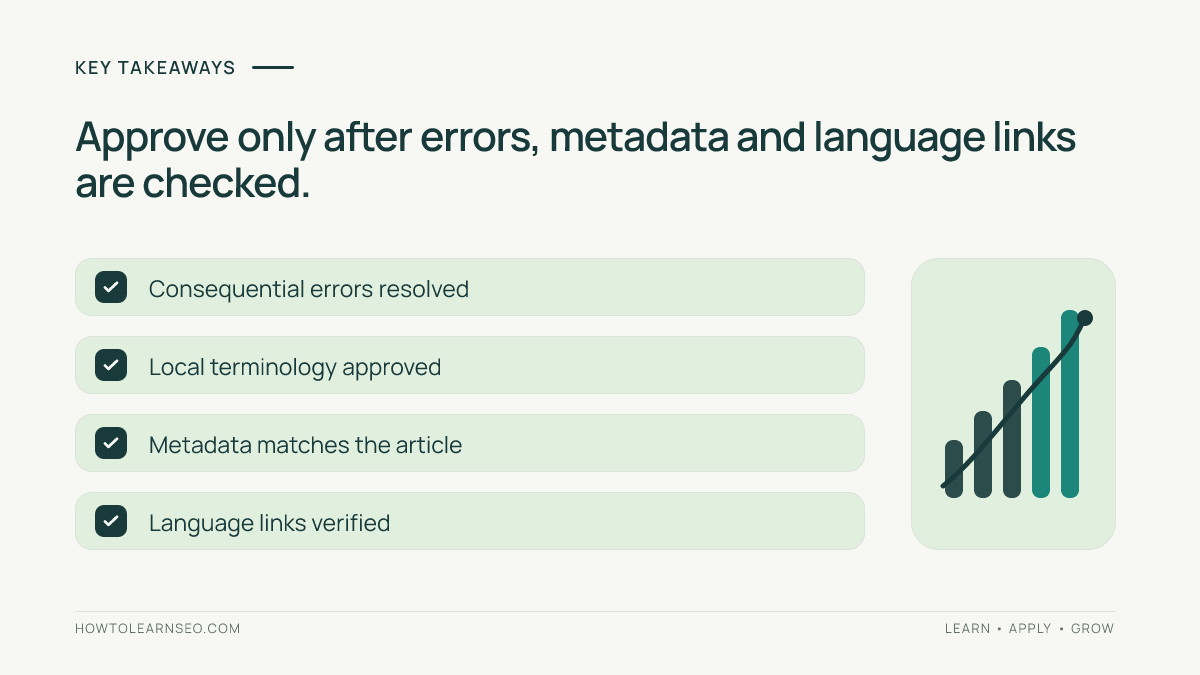
- Check fidelity to the approved source before polishing style.
- Localize examples and instructions without inventing market-specific facts.
- Record errors, corrections and approval against a source revision.
- Separate translation quality from technical eligibility and measured visibility.
Prepare the Source and Reviewer
Collect the approved article, source links, target language and region, terminology list, WordPress preview access and responsible reviewer. Keep unpublished customer details out of translation tools unless their use is authorized. For consequential medical, legal or financial statements, involve the appropriate subject specialist as well as a language reviewer.
Create a review sheet with section identifier, source passage, translated passage, issue, severity, correction and approval. Define three decisions: approve, revise or hold. Treat reversed instructions, altered quantities and unsupported claims as blockers; minor style preferences can wait until meaning is secure.
Freeze the source revision during review. If it changes, identify the affected passages and reopen their approval. The source-audit workflow helps resolve evidence gaps in the original before they spread into another language.
Apply the AI Translation SEO Checklist
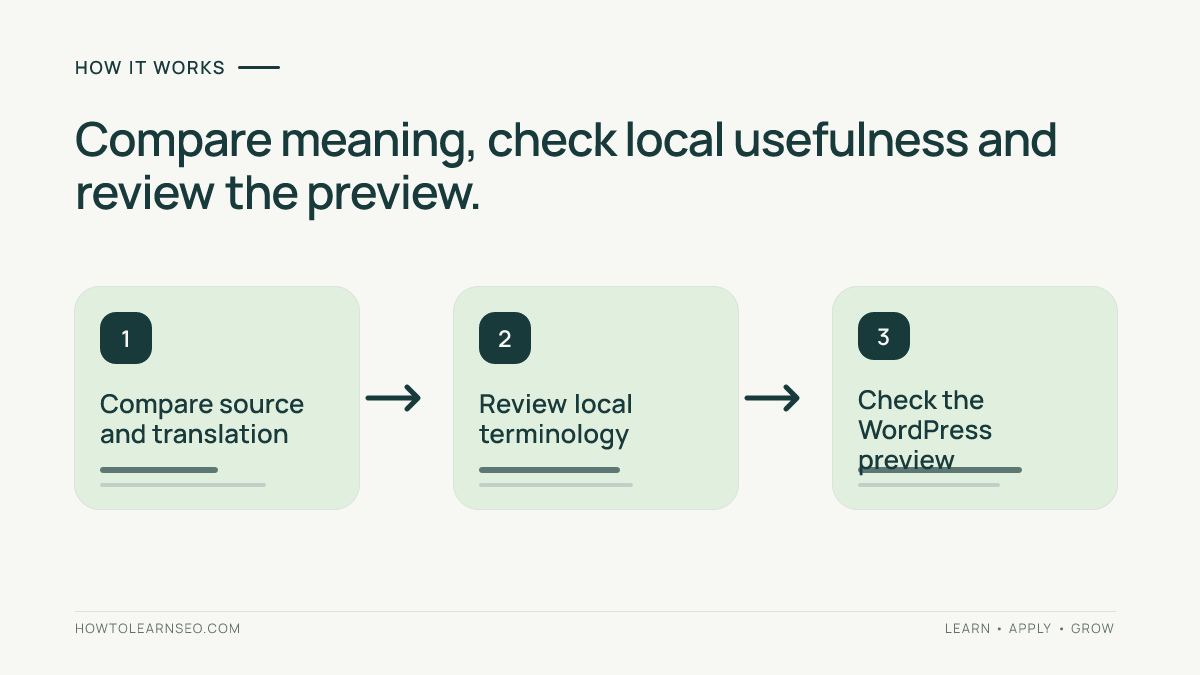
1. Compare meaning section by section
Place source and target passages side by side. Check negation, conditions, exceptions, quantities, dates, units, product names and the strength of recommendations. Confirm that “may” has not become “will,” a possible explanation has not become a diagnosis and an example has not become a reported result.
Give the translation tool an explicit instruction: preserve uncertainty, named entities, quantities and source links; flag ambiguous wording instead of resolving it by invention. Process manageable sections so the reviewer can trace each output to its input. This is a production aid, not an independent verification method.
Ask the reviewer to explain disputed meaning in the source language and record the final decision. Back-translation can reveal a suspicious change, but a second AI output cannot certify that the first translation is correct. Read the target-language article directly.
2. Check local usefulness and terminology
Have the reviewer read the translation without consulting the source first: can a reader complete the task? Then compare it with the original. Replace unnatural literal phrases with appropriate local terms while preserving scope. Record approved terminology so later articles use it consistently.
Verify local units, date formats, interface labels, examples and calls to action. If a product or service is unavailable in the target market, explain that limitation or hold the affected recommendation. Do not convert currencies using an invented rate, fabricate local expertise or silently change policies.
Keep citations beside the claims they support. A source in another language can remain useful; label its language when that helps readers. Do not substitute a locally written page that fails to support the claim merely to make every link match.
3. Review the complete WordPress preview
Use your existing multilingual workflow to open the translated article’s preview. WordPress’s multilingual handbook describes several implementation models, so there is no universal translation button or plugin-specific sequence to follow.
Check the title, headings, tables, captions, image labels, alt text, buttons, byline and metadata. Review desktop and mobile for broken characters, clipped labels and incorrect text direction. Images containing source-language instructions need a reviewed translated equivalent or a clear text explanation nearby.
Confirm that internal links lead to the intended article. Use a genuine localized equivalent when one exists; otherwise give readers a truthful route to the available source. Do not fabricate translated URLs. Follow the site’s AI disclosure policy without claiming human checks that did not happen.
Verify Language URLs Before Release
Google recommends separate URLs for language versions in its multilingual guidance. Confirm that the approved translation has its planned URL and that the language selector reaches the equivalent article.
Have the technical owner check crawl access, indexing directives, canonicals and alternate-language references. Google’s localized-version documentation requires fully qualified alternate URLs and reciprocal references; each language version should include itself. Hreflang describes a relationship between versions, not translation quality. Translating only navigation while leaving the main article unchanged does not create a fully translated article.
Illustrative Review and Repair Example
Imagine an English tutorial is translated for French-speaking readers in Canada. These fictional English renderings show meaning changes; they are not actual French translations or test results.
| Approved source | Suspect rendering | Required repair |
|---|---|---|
| Inclusion is not guaranteed. | Inclusion is guaranteed. | Restore the negative and recheck related promises. |
| Review after 14 days. | Review after 14 months. | Restore the interval and audit other quantities. |
| The example is illustrative. | Our customer achieved this result. | Remove invented experience and restore the example label. |
| Availability varies by market. | Available throughout Canada. | Verify availability or preserve the limitation. |
The reviewer records the affected sections, corrections and source revision, then checks the repaired passages in context. Approval remains on hold until every blocker is resolved.
Troubleshooting and Measurement
- Reviewers disagree: resolve meaning against the source and local usage; record the chosen term.
- Preview differs from the review sheet: check whether a plugin regenerated text or the source changed.
- Only menus are translated: complete the article before treating it as a finished language version.
- Metadata contradicts the body: repair the whole publication package and repeat approval.
After release, verify the public page and record its date. Review Search Console performance by page and country after 14 and 28 days without assuming those windows guarantee meaningful samples. Track reader corrections and task completion alongside traffic.
For identifiable assistant visits, Google’s GA4 channel definitions use AI Assistant with medium ai-assistant. Visits, crawler requests and observed citations are different measures. Google AI Overviews and AI Mode traffic belongs to Organic Search; do not relabel unexplained Direct visits as AI exposure.
Google’s AI features guidance requires supporting pages to be indexed and eligible for a Search snippet. No special translation schema or training-bot access guarantees inclusion. Passing this checklist establishes editorial readiness, not AI visibility.
Frequently Asked Questions
Can an AI translation be published without language review?
For this workflow, hold publication until someone proficient in the target language reviews it. Fluent output can conceal changed conditions, omissions or invented claims. If that review is unavailable, the article has not passed acceptance.
Is back-translation enough to approve an article?
No. It can help identify suspicious passages, but it may preserve or introduce errors. A qualified reviewer should read the target text, compare important passages with the approved source and resolve disagreements.
Should keywords be translated word for word?
No. Check how the target audience describes the task and use appropriate local terminology. Preserve the reader’s intent without forcing literal phrases or claiming search demand that has not been measured.
Does hreflang prove that a translation is accurate?
No. It identifies alternate language or regional versions for Google. It does not validate meaning, factual accuracy or usefulness. Technical checks and editorial review must pass independently.
Will a reviewed translation earn AI citations?
No guarantee exists. Review improves accuracy and reader usefulness, while discovery and selection depend on the system and query. Measure actual citations separately from traffic and avoid presenting technical eligibility as inclusion.
Conclusion
Use this AI translation SEO checklist to compare meaning, validate local usefulness and approve the complete WordPress package. Keep a dated review record, resolve every consequential error and verify the public version after release.