
An audit of sources for AI search content checks whether every important factual claim is supported by evidence that is current, relevant, and easy for a reader to verify. It also separates sourced facts from your own examples, experience, and analysis. The goal is trustworthy content—not a formula that guarantees citations in Google AI Overviews, AI Mode, ChatGPT, or any other system.
This workflow shows you how to build a claim register, choose evidence, repair weak citations, and document future reviews.
Quick Answer: What Should a Source Audit Check?
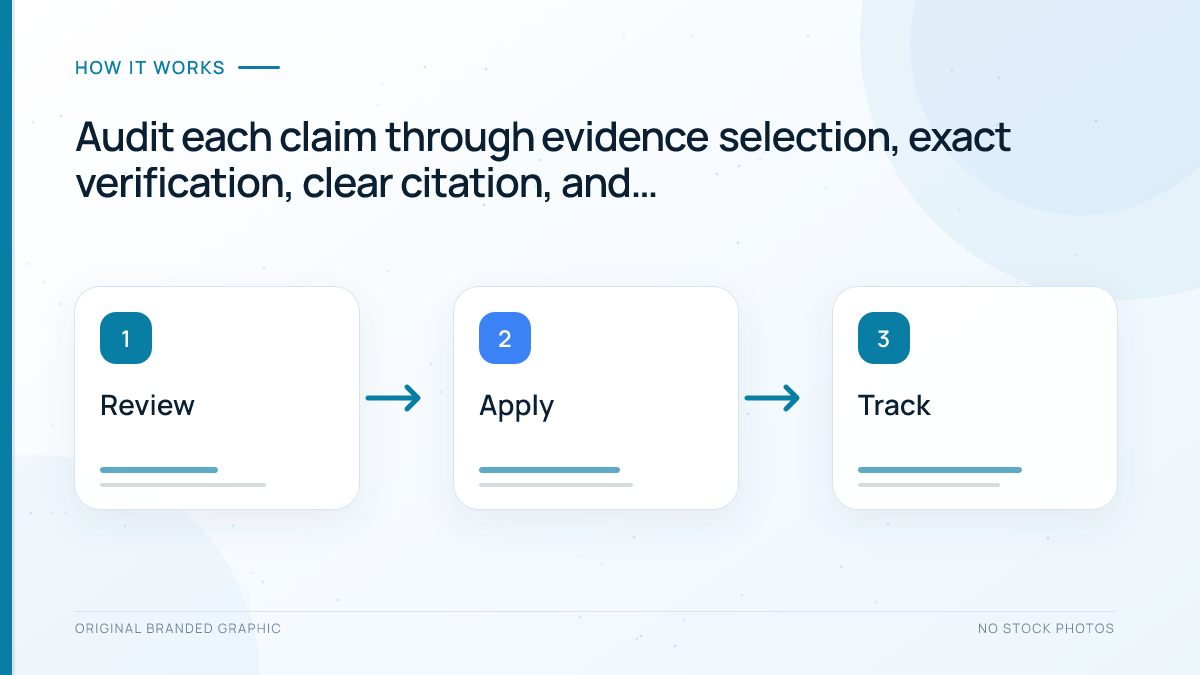
For each claim, ask: Is evidence necessary? Is the best available source primary? Does it support the exact wording? Is it current enough? Can readers reach it from a descriptive link near the claim? Then add original explanation or an example.
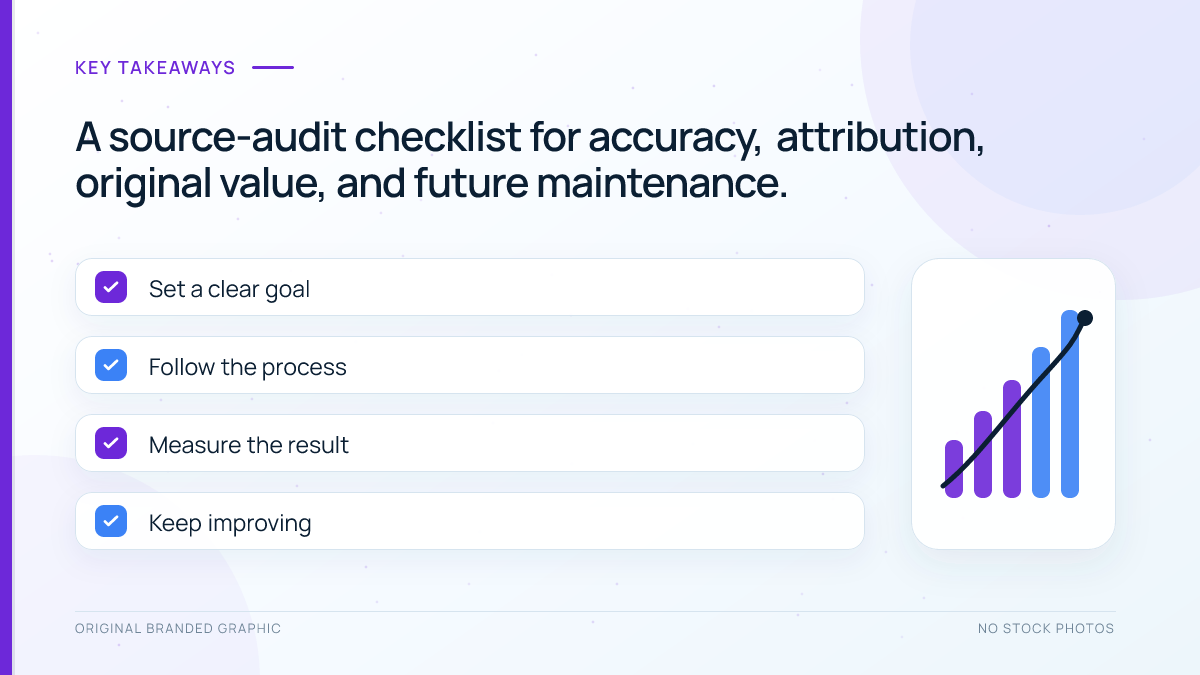
Key Takeaways
- Audit claims, not merely the number of external links.
- Prefer official documentation, standards, original research, and first-party data for claims those sources can prove.
- A source must support the exact statement, including its scope, date, and limitations.
- Attribution does not replace original analysis or examples.
- Strong sourcing improves trust and fact-checking, but it cannot guarantee ranking or AI citation.
What This Audit Covers
| Layer | Question | Typical problem |
|---|---|---|
| Claim | What exactly is being asserted? | Vague or absolute wording |
| Evidence | What can verify it? | A secondary article cites another secondary article |
| Placement | Can the reader connect claim and source? | A references list with no claim-level links |
| Original value | What does this page add? | A rewrite of official documentation |
| Maintenance | When should it be checked again? | Time-sensitive guidance with no review trigger |
Google’s people-first content guidance asks about clear sourcing, original information, additional value, and easily verified errors. These are editorial questions, not a ranking checklist.
Prerequisites
- The final or near-final article, including tables and FAQs
- A spreadsheet with columns for claim, source, status, owner, and review trigger
- Access to the original documents, datasets, or product documentation you plan to cite
- A defined audience and publication date
How to Audit Sources for AI Search Content Step by Step
1. Build a claim register
Record claims that a reasonable reader may want to verify. Prioritize statistics, dates, product behavior, high-stakes statements, quotations, standards, and claims about search platforms. Common knowledge, labeled opinions, and transparent examples may not need external evidence.
Copy the precise wording into the register. “Source for schema” is vague; a complete claim can be checked against a specific policy.
2. Match each claim to the best source type
| Claim | Preferred evidence |
|---|---|
| How a Google feature works | Current Google documentation |
| What a standard requires | The standard or its governing body |
| A research finding | The original paper and methodology |
| Your performance result | Your own dated export and disclosed method |
| A practical recommendation | Reasoning, limitations, and supporting evidence |
Product documentation can explain product rules, but it cannot prove your implementation improved revenue. A dataset may show correlation without causation. Use evidence only for what it demonstrates.
3. Verify exact support, scope, and freshness
Open the source instead of trusting a snippet. Find the supporting section, then check its publisher, date, market, sample, definitions, and exceptions. Do not rewrite “eligible” as “will appear.”
For example, Google’s AI features guidance says an eligible supporting page must be indexed and able to appear in Search with a snippet. It also says there are no extra technical requirements and that inclusion is not guaranteed. A claim that special AI schema guarantees visibility would therefore fail this audit.
4. Put descriptive links near the supported claim
Use anchor text that tells readers what they will open, and place the link in the paragraph containing the claim. A separate references section can still be helpful, but it should not force readers to guess which source supports which statement.
Ordinary editorial links do not need nofollow. Google’s outbound-link guidance uses sponsored for paid placements and ugc for user-generated links. Disclose commercial relationships.
5. Add original value after the evidence
Explain what the source means for the task. Add a worked example, decision rule, calculation, or discovered limitation. Google warns against summarizing sources without adding substantial value.
For related editorial foundations, see our guides to writing clear AI-safe content, structuring content for Google AI features, and understanding E-E-A-T.
6. Check authorship and structured data
Confirm that the byline and author information are truthful. Do not invent credentials or imply firsthand testing that did not happen. If the page uses structured data, compare it with the visible article. Google’s structured data guidelines require markup to represent visible content and do not guarantee a rich result. Our schema markup guide explains the implementation basics.
Illustrative Worked Example
Imagine an article draft contains the three claims below. This example is fictional and demonstrates editorial decisions; it is not a test result.
| Draft claim | Audit finding | Repair |
|---|---|---|
| “FAQ schema guarantees AI citations.” | Unsupported and absolute | State that no special schema is required and no format guarantees inclusion; link to Google’s AI-feature guidance. |
| “We tested 100 sites and saw a 40% lift.” | No dataset, method, or real test exists | Delete the fabricated result. Replace it with a clearly illustrative example or genuine documented data. |
| “Review facts regularly.” | Sensible but not actionable | Add triggers: product-documentation change, broken source, policy update, or scheduled review for time-sensitive claims. |
The repair tells readers what is documented, what remains uncertain, and what to do.
Troubleshooting Common Source Problems
- The primary source is unavailable: use the strongest accessible source, disclose the limitation, and avoid wording stronger than the evidence.
- Authoritative sources disagree: compare dates, definitions, geography, and methods; disclose the disagreement.
- A link is broken: look for the publisher’s new canonical URL or an official archive. Do not replace it with an unrelated page.
- The claim changes frequently: narrow the statement, include the relevant date, and create a review trigger rather than promising permanent accuracy.
- The article has many citations but little value: add interpretation and a task-specific example, or remove background that does not help the reader.
Limitations
A source audit cannot prove that a page will rank, appear in an AI answer, or earn a citation. It also cannot replace subject-matter review for high-stakes topics. Some AI systems may use information without sending an identifiable visit, while generated answers and linked sources can vary. If you measure visibility, keep those observations separate using a defined workflow such as our free AI search visibility tracker.
Conclusion
To audit sources for AI search content, verify the exact claim, choose evidence suited to that claim, link it clearly, add original value, and document when it should be reviewed. This creates content that readers can check and editors can maintain without pretending that citations are guaranteed.
Frequently Asked Questions
Does every factual sentence need an external source?
No. Prioritize claims that are specific, consequential, disputed, time-sensitive, or not common knowledge. Clear examples and your own disclosed observations may not require external links. The audit should help readers verify important statements, not interrupt every sentence with a citation.
Are primary sources always better than secondary sources?
Primary sources are usually best for their own rules, data, or findings. A reliable secondary source may be better for context, comparison, or explaining a complex paper. Use the source that supports the exact claim, and check whether it accurately represents the original evidence.
Do external links reduce SEO authority?
A normal editorial link to useful evidence is not something to avoid merely to conserve authority. Use descriptive anchors and qualify paid or user-generated links appropriately. The more important editorial risk is linking to weak evidence that does not support your wording.
How often should source audits be repeated?
Use risk-based triggers instead of one universal schedule. Recheck a claim when the cited policy, interface, study, price, law, or product behavior changes. Evergreen definitions may need less frequent review, while rapidly changing platform instructions should be checked before major updates.
Will better sourcing make AI systems cite my page?
No guarantee exists. Clear sourcing can improve trust, accuracy, and reader verification, while original examples can make a page more useful. Selection still depends on the system, query, index eligibility, relevance, and other factors that publishers do not control on demand.