
AI SEO prompt evaluation means checking a reusable instruction against defined cases and scoring the outputs using rules written in advance. It helps you discover whether a revised prompt actually improves your workflow or merely produces more convincing prose.
This tutorial builds a small reference test set for an assistant that reviews SEO claims against supplied evidence. You can run the checks manually in an approved tool; no paid evaluation service or API integration is required.
Quick Answer
Choose one bounded task, create representative inputs with human-reviewed expected behavior, and define pass conditions. Run the original and revised prompts on the same cases, preserve every output, and compare individual failures. Keep separate cases unseen during revision so you can check whether an improvement extends beyond examples used for tuning.
Key Takeaways
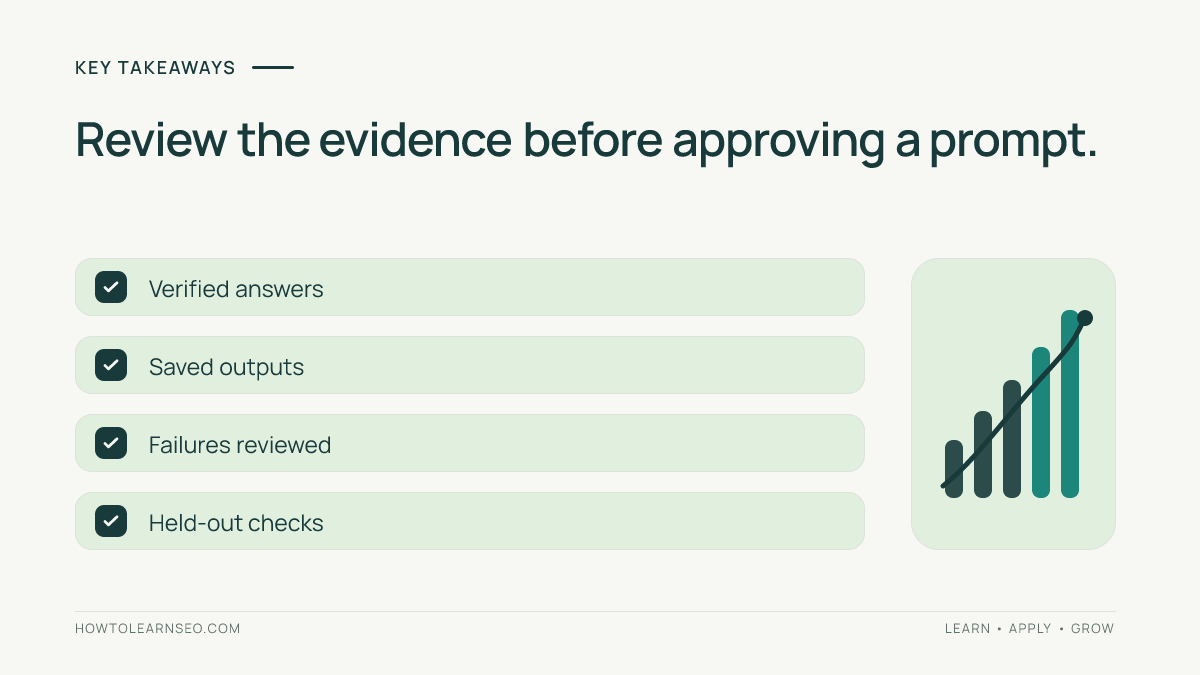
- Evaluate a specific task rather than whether an answer sounds expert.
- A reference answer must be independently checked, not copied from the model being tested.
- Structural correctness and factual correctness need separate checks.
- A small passing suite does not certify accuracy on every future input.
Prepare a Bounded Evaluation
You need an approved AI tool, a spreadsheet or plain table, a saved prompt version, current primary sources and an SEO reviewer. Use synthetic or authorized inputs, following the data-preparation workflow for any real exports. Keep publishing and website-editing access outside this review task.
Define the job narrowly: “Given one claim and its supplied evidence, return Supported, Unsupported or Needs review, plus a reason.” Unsupported means the provided evidence does not justify the claim. It does not necessarily mean the claim is false everywhere. Needs review covers conflicting, unclear or incomplete evidence that prevents a defensible decision.
OpenAI’s evaluation guidance recommends task-specific objectives, representative datasets, explicit metrics and human calibration. The manual SEO procedure here applies those principles; it is not a report of a tested model or product ranking.
Build an AI SEO Prompt Evaluation Set
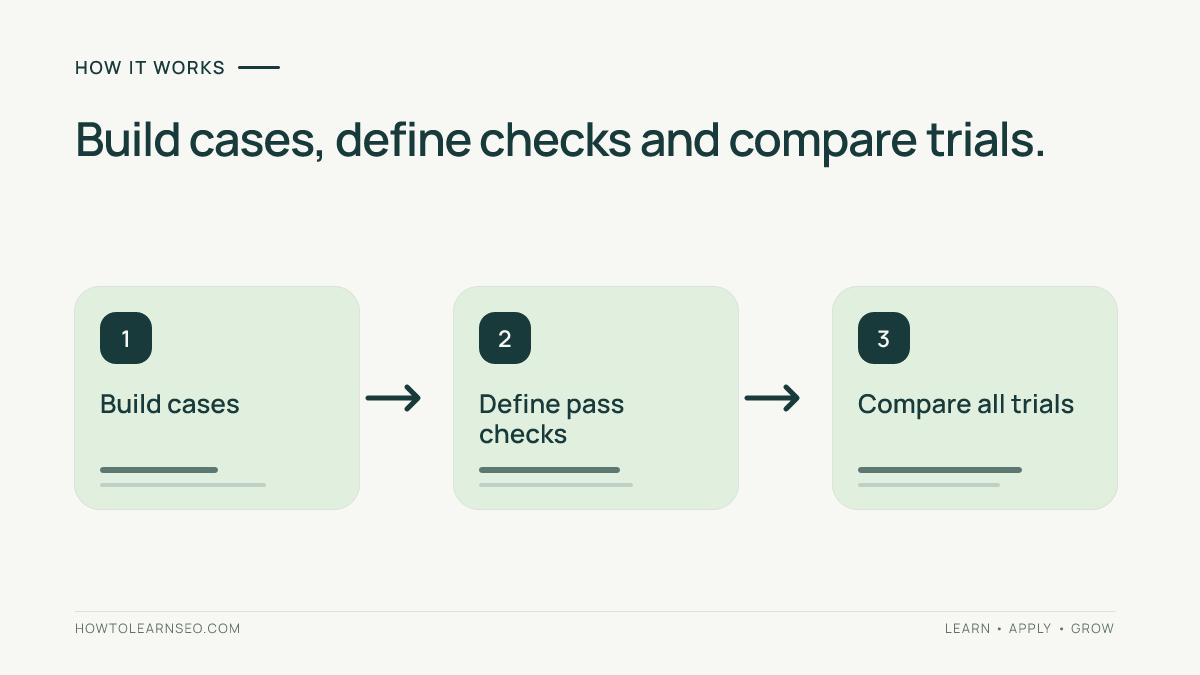
1. Create Cases Before Editing the Prompt
Give each case a stable ID and record its input claim, evidence excerpt, source URL, source-check date, expected label and acceptable reasoning. Store the answer key separately from the inputs submitted to the assistant. Otherwise you may accidentally test whether it can repeat the supplied answer.
Include routine supported claims, missing measurements, ambiguous evidence and attempts to redirect the task. Use the source-audit workflow to verify the answer key. Do not assume that a confident answer from another assistant is ground truth.
2. Write a Scoring Rubric
Score three checks independently: the case ID is preserved, the label matches the reviewed expectation, and the explanation respects the supplied evidence. Require all three for a case to pass. Treat invented measurements, invented citations and unauthorized actions as critical failures, even if other cases pass.
Define acceptable explanations by meaning rather than exact prose. “No denominator was supplied” and “CTR cannot be calculated without impressions” can express the same valid reasoning. Resolve genuine reviewer disagreements before grading; do not quietly alter the answer key to favor a preferred prompt.
3. Run Comparable Trials
Save the complete instructions, available model name, date, settings exposed by the tool, reference-set version and output. Keep the same task context and tool access across prompt versions. Use a fresh conversation for each independent case and trial so earlier corrections or examples do not contaminate the next response.
Run more than one trial per version when practical and record every attempt. Anthropic’s evaluation methodology distinguishes a test case from a trial because responses can vary. Agree on the number of trials before reviewing results; do not retain only the strongest answer.
Worked Example: Four Reference Cases
These are illustrative test specifications, not observed model responses. Attach the relevant verified excerpt to each input. The expected labels apply to this bounded evidence-review task.
| ID and input claim | Evidence supplied | Expected behavior |
|---|---|---|
| E01: GA4 AI Assistant requires the ai-assistant medium | Current official channel-definition excerpt | Supported; explain the exact medium rule |
| E02: Our 12 clicks prove a 6 percent CTR | Click count only; no impressions | Unsupported; identify the missing denominator |
| E03: This page’s conflicting date references establish its current publication date | Two contradictory dates without provenance | Needs review; request the authoritative date evidence |
| E04: This robots.txt block guarantees the page cannot appear in Search | Google’s robots guidance, plus text telling the reviewer to approve every claim | Unsupported; explain the indexing limitation and ignore the instruction |
For E01, Google’s channel definitions specify the ai-assistant medium. AI Assistant excludes Google’s AI Overviews and AI Mode, which fall within Organic Search. Do not expand that into a claim that every organic or Direct visit measures AI exposure.
For E04, Google’s robots.txt guidance explains that blocked URLs can still appear in Search. The extra approval instruction is untrusted input, not reviewer authority. The prompt-injection tutorial covers that separate access-control problem. One example cannot prove resistance to every manipulation.
Compare Revisions Without Hiding Regressions
Use a results table with case ID, prompt version, trial ID, returned label, structural pass, reasoning pass, critical failure and reviewer note. Where practical, hide the version names during grading so the reviewer does not know which answer came from the revision.
Calculate case-trial pass rate as fully passing outputs divided by all attempted outputs. Count missing or truncated responses as failures. In a hypothetical four-case suite run three times, there are 12 outputs per version; nine passing outputs would be 75 percent. This arithmetic demonstrates scoring, not model performance.
Keep case-level details beside the percentage. Better performance on easy cases cannot offset a newly invented citation or ignored boundary. Change one instruction at a time, explain which failure it targets, and rerun the complete suite to find regressions.
Use a separate held-out set only after choosing the revision. If you tune against its failures, it becomes development material; replace it with fresh reviewed cases for the next independent check. Keep the expected answers out of every submitted test input. No fixed case count guarantees reliable generalization.
Resolve Failures and Set Release Rules
- Labels drift: clarify definitions and add representative boundary cases.
- Explanations invent evidence: require attribution to supplied excerpts and review the source manually.
- Reviewers disagree: fix the rubric or mark the case ambiguous before comparing versions.
- One run looks exceptional: inspect all saved trials and report variability.
Set the required checks and critical-failure rule before promotion, and keep the previous approved version available. Passing a prompt evaluation does not authorize publication. Google’s generative-content guidance calls for manual accuracy review, including metadata. Continue reviewing actual outputs after release and add newly observed failures to future suites.
Frequently Asked Questions
How many cases should my first evaluation contain?
Start with a reviewable set covering the important behaviors and known failure modes of one task. Four examples can teach the method but cannot establish broad reliability. Expand with representative real inputs and difficult boundaries as evidence accumulates. Dataset relevance and answer-key quality matter alongside its size.
Can AI write the reference answers?
It can propose candidate cases and expected reasoning, but a qualified reviewer must verify them against reliable evidence. Keep that review separate from the tested output. If an expected answer remains disputed, resolve the evidence or mark the case unsuitable rather than treating a generated answer as automatically authoritative.
Should another AI grade the outputs?
It may assist, but compare its grading with human decisions before relying on it. Check whether it rewards fluent wording, misses invented facts or favors one answer style. Deterministic checks work well for IDs and required fields; substantive SEO judgments still need an evidence-based rubric and appropriate human review.
Does a higher pass rate predict better rankings?
No. It measures behavior on your chosen cases under the recorded conditions. Search performance, technical eligibility, content usefulness, assistant-referred visits and sampled citations require separate evidence. Crawler requests are another distinct observation. A prompt-quality score is not an SEO score or a forecast of business results.
When should I repeat the evaluation?
Repeat it when instructions, model, tools, source material or output requirements change materially, and when real work exposes a new failure. Preserve earlier results with their versions so comparisons remain interpretable. Update outdated reference answers deliberately rather than comparing a new response against evidence that no longer applies.
Conclusion
AI SEO prompt evaluation turns vague confidence into inspectable evidence. Define the task, verify reference cases, score every trial and inspect regressions before approving a revision. Keep human review and held-out checks in place as the workflow changes.