
An SEO measurement plan connects a new website’s business goals to measurable search outcomes. Choose meaningful conversions, confirm analytics and Search Console work, establish a dated baseline, then review visibility, landing-page engagement and qualified outcomes consistently. Document each metric’s source, owner, interpretation and next action. Do not confuse a rise in impressions with more customers. A useful plan tells you what changed, whether the change matters, and what to investigate next.
Quick Answer
An SEO measurement plan connects a new website’s business goals to measurable search outcomes. Choose meaningful conversions, confirm analytics and Search Console work, establish a dated baseline, then review visibility, landing-page engagement and qualified outcomes consistently. Document each metric’s source, owner, interpretation and next action. Do not confuse a rise in impressions with more customers. A useful plan tells you what changed, whether the change matters, and what to investigate next.
Key Takeaways
Start with a business outcome, not a dashboard. Separate leading indicators such as index coverage and search impressions from outcomes such as enquiries or purchases. Validate tracking with controlled tests before trusting reports. Compare equivalent date ranges and segment branded versus nonbranded demand when feasible. Keep a change log so you can distinguish site edits from seasonal shifts. Record limitations, especially missing consented analytics data and Search Console reporting delays.
Set the scope before choosing metrics
Write down the site’s purpose, intended audience, geographic market and the actions that represent success. A local consultancy may care about qualified enquiry forms and phone calls; an online shop may prioritize completed purchases and revenue. An educational publisher may monitor newsletter registrations or another explicitly chosen engagement outcome. These are different reader journeys and should not share an identical success scorecard. Decide whether the first reporting period covers a full domain, a country section or a specific service group. Choose one reporting owner and a monthly review date.
Define the measurement questions
Turn each goal into a question that can be answered with evidence. For example: Are priority service pages discoverable? Are relevant nonbranded searches beginning to show those pages? Do organic visitors complete the intended enquiry action? Which pages need technical attention? These questions prevent a report from becoming an unrelated collection of charts. Write a decision rule beside each question: if a priority page remains excluded from indexing after checks, investigate its technical state; if organic visits increase without conversions, inspect landing-page relevance and the conversion journey. Treat these rules as prompts for investigation, not automatic diagnoses.
Build a small metric dictionary
For every metric, record its plain-language definition, data source, segment, review frequency, owner and known limitations. Search Console clicks are visits initiated from Google Search results as reported by Search Console; they are not identical to GA4 sessions. Search Console impressions represent appearances in eligible search results, not people who noticed your brand. GA4 organic-search sessions use its own attribution and reporting rules. A form-submit event is only a conversion proxy if the event actually fires after a successful submission. Keep these definitions alongside the dashboard so future editors do not silently change what the numbers mean.
Prepare the website and access
Confirm that the website has stable canonical URLs, accessible navigation, useful page titles and a working production environment. Verify ownership in Google Search Console and install GA4 through the site’s approved implementation method. Give access only to people who need it. Create a spreadsheet with columns for page group, business goal, primary conversion, tracking method, baseline date and review owner. Avoid uploading personal customer details into a shared reporting sheet. If the website is still blocked from search engines during staging, remove that block only when launch is authorized and verify the live response.
Verify Search Console and index coverage
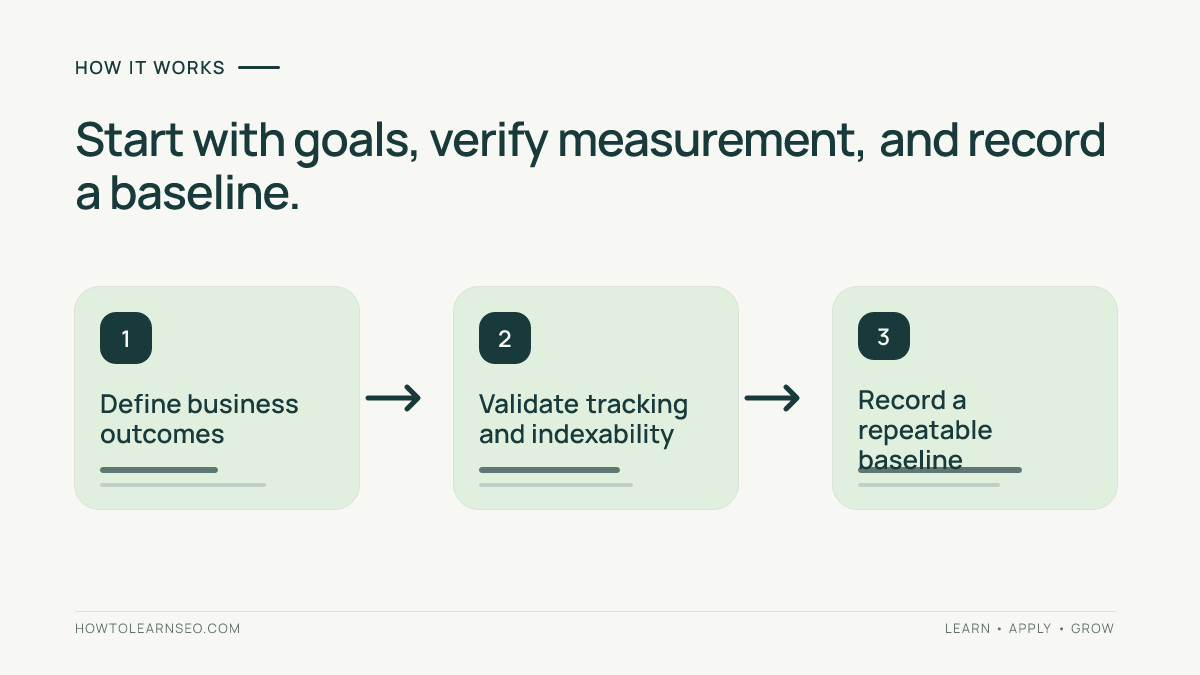
Use the official Search Console getting-started guidance to confirm the correct property and access. Inspect representative important URLs with URL Inspection, distinguishing discovered, crawled and indexed states. An XML sitemap helps discovery but does not guarantee indexing. If a page is excluded, examine the reported reason and the page itself before making changes. Record whether a canonical points to another URL and whether the page can be reached through internal navigation. The site’s Search Console beginner guide offers background, but always verify actual URL states in the current property.
Test GA4 collection and conversions
Follow the official GA4 setup documentation for the site’s measurement configuration. Open a test page and use Realtime or DebugView as appropriate to check that expected events arrive. Submit a test enquiry with a clearly marked noncustomer identity, then verify that the success event fires once after genuine completion, not simply when someone clicks the button. Confirm the event’s key-event designation if the business uses it as a conversion measure. Check cookie-consent behavior and document where reporting is incomplete. Use the GA4 beginner guide for terminology before interpreting channel reports.
Create a baseline that can be repeated
Choose a baseline date and save the website’s current index status, organic landing pages, Search Console performance and validated key events. A new site may have nearly zero search activity; that is a legitimate baseline, not evidence that the implementation failed. Annotate launch dates, migrations, analytics changes and content releases. Compare the same length of time and equivalent filters on every review. Never present a percentage growth figure from zero as meaningful. Instead, report absolute changes and the period in which the observations occurred. The new-website SEO guide can help distinguish launch tasks from subsequent performance evaluation.
Build a practical monthly scorecard
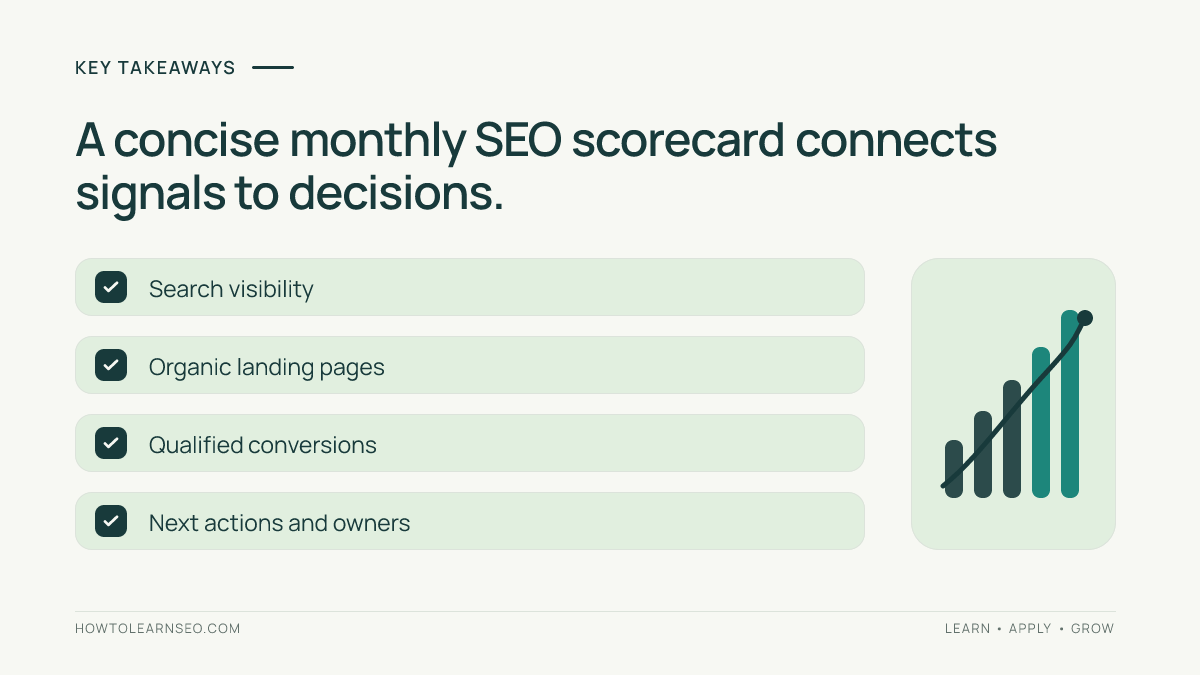
Create one table or worksheet with five rows: technical availability, index coverage, search visibility, organic landing-page traffic and verified business outcomes. Add columns for baseline, current value, change, confidence, likely explanation, next action and responsible person. Keep Search Console and GA4 figures in separate rows rather than adding them together. For priority pages, annotate the target audience and intended action. Include a small narrative describing what the evidence does and does not show. A concise scorecard reviewed consistently is more useful than dozens of unmaintained widgets.
Worked example: a new three-service website
Imagine a newly launched bookkeeping business with three service pages and one contact form. The owner wants qualified consultations, not merely traffic. The measurement plan lists each service URL, its relevant search intent and the same verified enquiry-success event. On launch day, the analyst confirms all three URLs return usable pages, checks their index status and sends one test form. Suppose the next monthly report shows 120 Search Console impressions, 9 clicks, 7 GA4 organic sessions and 1 successful test event but no genuine enquiries. These figures are invented for illustration, not observed results. The rule is to exclude test events from business outcomes and investigate whether relevant pages are gaining impressions. The expected output is a scorecard showing emerging search exposure, no proven customer conversions and specific next checks. Verification means reopening the source reports with the same dates and filters and confirming the form event logic. If one page is not indexed, handle its technical diagnosis separately rather than assuming the content is weak.
Interpret the signals without overclaiming
If impressions rise while clicks stay flat, examine query relevance, search-result presentation and position distribution before rewriting titles. If clicks rise but GA4 organic sessions do not, check measurement configuration, consent, attribution and date boundaries. If visits rise but enquiries do not, inspect page promises, calls to action, form usability and the quality of traffic. These are competing explanations, not proven causes. Search Console’s performance-report documentation explains the metrics and filtering options. For an adjacent diagnostic method, consult the CTR analysis tutorial.
Review changes and assign next actions
Hold a short monthly review with the site owner, content lead and whoever maintains analytics. Start with the business outcome, then trace backwards through organic visits, search visibility and technical availability. Assign at most a few high-confidence next steps, each with an owner and verification date. Examples include repairing a broken form confirmation, improving a page that answers the wrong query intent, or investigating a genuinely excluded priority URL. Keep an SEO change log with the exact page, date, hypothesis and expected signal. Review whether the change had the intended effect only after a suitable observation period.
Avoid misleading comparisons
Do not compare one full month with a partial month without labeling it. Avoid combining branded and nonbranded query changes when a marketing campaign may have shifted brand demand. Search Console queries can be anonymized or omitted, and reported totals need not equal the sum of visible query rows. GA4 and Search Console use different data models and time boundaries. Small samples are especially volatile on new sites. Where evidence is sparse, write “insufficient data” and retain the observation rather than inventing a conclusion. The SEO audit guide provides a separate diagnostic workflow when a metric flags a problem.
What success looks like after the first quarter
By the end of three reporting cycles, a functioning measurement plan should provide consistent definitions, validated tracking, a record of important pages and a short list of decisions made from evidence. Success does not require a particular number of rankings or conversions. It requires the ability to answer what happened, what remains uncertain and what the team will do next. Retire metrics that never affect a decision, and add new ones only when the website’s business model demands them. Keep archived scorecards so definitions and comparisons remain auditable.
Frequently Asked Questions
How soon should a new website measure SEO?
Set up measurement before launch and validate it immediately after launch. Search performance may take time to accumulate, so early reviews should emphasize tracking quality and important page accessibility.
Can Search Console clicks be compared directly with GA4 sessions?
No. They use different definitions, attribution methods and processing rules. Compare trends within each system and investigate discrepancies instead of expecting identical totals.
Which SEO metric matters most for a service business?
Verified qualified enquiries are usually more useful than raw traffic, provided the form or call tracking is reliable. Search visibility remains a supporting diagnostic metric.
What if Search Console shows no impressions?
Check property selection, dates, indexability and the status of important URLs. A newly launched site may simply lack enough search exposure to generate reportable impressions.
Should test form submissions count as conversions?
Test events are useful for implementation checks but should not be counted as genuine business outcomes. Label or exclude them in the reporting method.
How often should an SEO measurement plan change?
Review results monthly, but change definitions only when the business goal or measurement method genuinely changes. Document every change to preserve historical comparability.
Conclusion
An SEO measurement plan should make decisions clearer, not merely produce more charts. Validate collection, keep a repeatable baseline, connect organic search to genuine business outcomes and record uncertainty. Revisit the scorecard regularly, act on a small number of well-supported findings and document what changed.