To build a seasonal Pinterest content calendar for website traffic, match recurring audience needs with helpful website pages, create distinct Pins for each reader job, schedule them around planning behavior, and verify outcomes using outbound clicks and website analytics.
Quick Answer
A seasonal Pinterest content calendar connects upcoming search interests to useful website pages, original Pin creatives, publication dates, and measurement checkpoints. Start with your audience’s recurring planning moments, research relevant phrases, prepare genuinely helpful landing pages, then schedule fresh Pins with enough lead time to learn from results. There is no universal number of weeks before a season that guarantees reach. Work backward from when your readers begin planning, not merely from the holiday itself.
Key Takeaways
Treat the calendar as a website traffic plan rather than a quota of Pins. Choose seasonal topics that fit your site’s expertise, distinguish early research from last-minute decisions, and send every Pin to a page that fulfills its promise. Record the URL, search intent, creative angle, publication date, and measurable outcome together. Review outbound clicks and relevant website sessions rather than impressions alone. Retire or revise seasonal ideas that do not serve a useful reader need.
Choose Seasons Your Website Can Actually Serve
Start with a list of occasions that change what your audience needs. A website teaching SEO might cover pre-holiday ecommerce landing-page audits, annual content planning, or seasonal reporting. It should not publish unrelated gift guides simply because those subjects trend on Pinterest. Relevance protects the reader experience and makes your content hub coherent. For each candidate, write down the audience, the decision they face, and the page that could help them complete it. If you cannot describe a meaningful page, do not create the Pin yet.
Separate recurring calendar events from temporary trends. Recurring events include annual shopping periods, school planning cycles, and yearly business planning. Temporary trends may rise and disappear before a small site can publish a genuinely useful article. Pinterest Trends can provide directional insight into searches where available, but its relative trend information is not a guaranteed traffic forecast or an exact monthly search-volume estimate. Consult the Pinterest Trends tool and document the market, term, and observation date when reviewing a signal.
A good seasonal opportunity has three elements: a real audience question, a helpful existing or planned website page, and a distinct visual concept. If any element is missing, place the idea in a research backlog rather than filling the calendar with weak content. This also reduces the temptation to create multiple near-identical pages for minor keyword variations.
Research the Search Journey, Not Just the Holiday
People searching before a seasonal event may be exploring possibilities, comparing approaches, or preparing to act. Those stages require different Pins and sometimes different landing pages. For example, a website owner planning a holiday campaign might first search for a content calendar template, later look for a landing-page checklist, and finally seek a way to measure campaign referrals. Those are different tasks; a single vague article is unlikely to serve all three equally well.
Build a small keyword worksheet with columns for phrase, likely intent, audience, landing page, and supporting visual. Use Pinterest search suggestions as qualitative clues, then follow a consistent Pinterest keyword research workflow. Do not interpret suggestion order as an exact ranking or volume measurement.
Cluster similar phrases under one strong reader job. A phrase such as “holiday ecommerce SEO checklist” and a longer variation about preparing holiday category pages might belong to one comprehensive guide. Separate a genuinely different task, such as analyzing seasonal referral sessions, into another article.
Review last year’s site analytics if available, but distinguish historical visits from Pinterest demand. An old Google Search spike can suggest a useful topic without proving that Pinterest users will search for it. Use observations as hypotheses and validate them after publishing.
Build the Calendar Backward from Reader Demand
Create one row per unique Pin concept, not one row per recycled image. Include event, planning stage, audience question, target page URL, primary phrase, Pin headline, creative format, intended publication date, owner, status, and review date. A simple spreadsheet is sufficient.
Work backward from the point when the reader needs the answer. If the page teaches a complex preparation process, its discovery window may start well before the event. A last-minute troubleshooting page may be more useful near the deadline. These are editorial judgments, not official Pinterest timing rules.
Give each row a clear next action: research, write page, review page, design Pin, check destination, publish, or analyze. Mark dependencies explicitly. A Pin should not be marked ready merely because its graphic exists. Its headline, description, destination, and mobile page experience all need review.
Coordinate Pins with Pinterest board planning. A seasonal board can help readers understand the collection, but do not create a new board for every tiny variation. Use descriptive board names that accurately reflect the Pins saved there.
A Reproducible Example: One Campaign, Three Reader Jobs
Imagine a small SEO education site planning a hypothetical year-end ecommerce preparation campaign. Its audience is independent store owners. The team has one useful landing page: a detailed holiday category-page audit checklist. The example numbers below are planning assumptions, not observed Pinterest results.
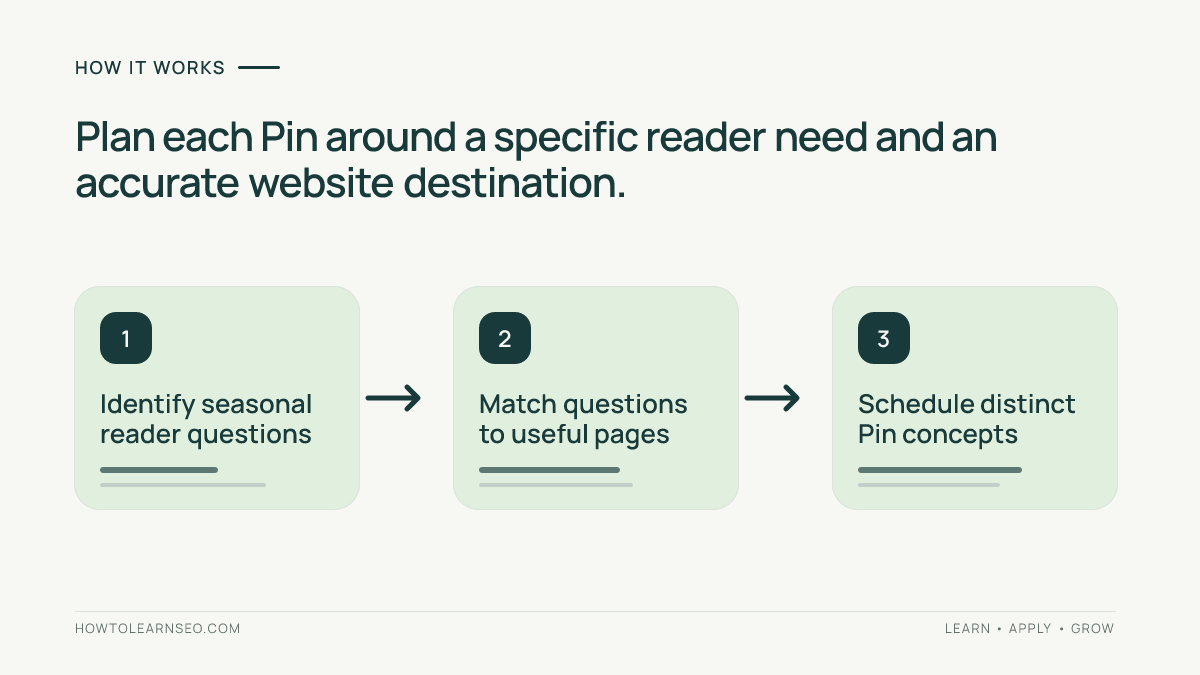
Input: the event is an end-of-year retail planning period; the page explains how to inspect category-page copy, navigation, internal links, and product availability. The team identifies three reader jobs: planning early, auditing an existing page, and checking a page before promotion. It drafts three distinct Pin concepts, each with a different promise while linking to the same guide only when the guide genuinely answers that promise.
Decision: publish the early-planning creative first, then test an audit-focused checklist creative, and later a concise pre-launch review creative. Avoid making all three look like the same image with a different background. One could use a calendar diagram, another a checklist, and another a before-and-after information layout.
Expected output: a calendar with three scheduled concepts, one verified landing URL, distinct descriptions, and review dates. The expected output is an organized experiment, not a promised number of clicks. Verification: open each published Pin, confirm the link reaches the intended page on mobile, then inspect outbound clicks in Pinterest Analytics and relevant sessions in GA4 after data becomes available.
Edge case: if the page is revised and its URL changes, update the destination before scheduling more creatives. If the article cannot satisfy a late-stage searcher’s question, create a genuinely useful section or choose a more appropriate existing page rather than mislabeling the Pin. If one creative has impressions but no outbound clicks, inspect the promise and destination fit before assuming the topic has no demand.
Design Distinct Pins Without Manufacturing New Pages
A fresh creative should offer a materially different way to understand the same helpful resource. For a checklist article, one Pin might emphasize the sequence of actions, another the mistakes to avoid, and a third the finished audit outcome. Each visual should stand alone when seen outside your website.
The headline and destination must agree. A Pin promising a downloadable template should not send readers to a page without that template. A Pin promising a five-step checklist should lead to a clearly identifiable five-step process.
Use testing fresh Pin designs to compare genuinely different concepts while keeping the landing-page task consistent. Do not change every variable at once and then claim that a particular font or posting hour caused the outcome. Small sites may have too little data for confident conclusions.
Keep image rights and brand accuracy in mind. Original diagrams and licensed assets are safer than copying other creators’ Pins. Avoid misleading claims, fake scarcity, or guarantees of ranking and traffic.
Set Up Measurement Before You Publish
Create a consistent UTM naming scheme for the destination URLs when it is appropriate for your tracking setup. For example, use utm_source=pinterest, utm_medium=organic_social, and a descriptive utm_campaign for the seasonal initiative. Add utm_content only when it helps distinguish creative variants.
A tagged link might point to /holiday-category-audit/?utm_source=pinterest&utm_medium=organic_social&utm_campaign=year_end_audit&utm_content=checklist_pin. This is an illustrative URL pattern, not a live campaign. Check that the landing page loads and canonicalizes appropriately; UTM parameters should not create unintended indexable duplicates.
Follow the tracking Pinterest visits in GA4 tutorial to inspect acquisition reporting. Pinterest outbound clicks and GA4 sessions are not identical metrics: click counts can differ from recorded sessions because of consent choices, loading failures, repeat visits, reporting differences, and other factors. Compare directional patterns rather than demanding exact numerical equality.
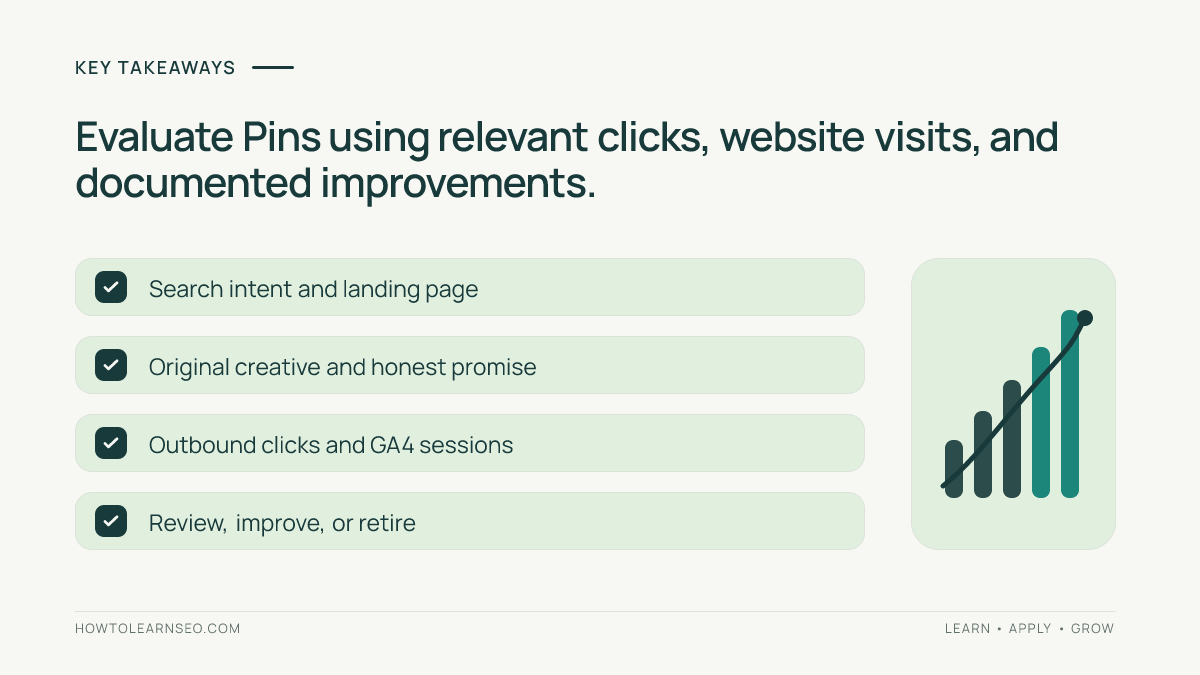
Define success in advance. A useful metric pair is outbound clicks plus engaged visits to the relevant page. If your website has a meaningful conversion event, include that too. Avoid choosing winners from impressions alone.
Review the Calendar Without Chasing Vanity Metrics
Schedule a review after the Pins have had a reasonable observation window for your account. Look for a combination of impressions, outbound clicks, landing-page sessions, and useful on-site actions. Record the observation dates because a Pin published yesterday cannot fairly be compared with one published weeks earlier.
When impressions are low, first inspect topic relevance, discoverability, and whether the creative clearly communicates its purpose. When impressions are present but clicks are weak, inspect the headline, visual promise, and call to action. When clicks are present but sessions or engagement are weak, inspect page speed, consent and analytics setup, mobile experience, and destination relevance.
Decide whether to keep, revise, or retire each concept. Keep useful evergreen Pins that remain accurate; revise outdated promises and pages; retire concepts that no longer match a real reader need. Avoid deleting content solely because it did not perform immediately. Keep notes about changes so future comparisons remain interpretable.
For next year’s cycle, retain the worksheet and replace assumptions with observations. Note which topics attracted qualified visitors, which lead times were practical, and which page improvements mattered. A repeatable calendar becomes valuable through documented learning, not through filling every date with a Pin.
Common Calendar Mistakes and Their Fixes
The first mistake is choosing the occasion before identifying the audience problem. Fix it by writing the reader’s task in plain language and checking that your website can solve it. The second is confusing posting frequency with quality. Fix it by preparing fewer distinct Pins that lead to complete, trustworthy pages. The third is using the same generic creative for several intents.
Another mistake is treating Pinterest Trends as a precise traffic forecast. Use it as directional research alongside your own audience observations. Likewise, do not claim that one posting time or fixed lead time works for every site. Test timing against the stage at which your audience plans to act.
Finally, teams often measure only saves or impressions. Those may describe attention on Pinterest, but a website-traffic campaign needs to track actual visits and useful behavior. Document measurement gaps honestly.
Pin-Ready Summary and Publishing Checklist
Pin-ready hook: “Plan seasonal Pinterest Pins around the questions your website actually answers—not just the holidays on the calendar.” A second distinct hook is: “One useful landing page, three reader jobs, three clear Pin concepts.” These are creative ideas to develop later, not Pins already created or scheduled.
Before publishing, confirm the audience task, relevant keyword, accurate destination page, readable original visual, truthful headline, descriptive Pin text, working mobile URL, consistent tracking, and review date. Keep a single source of truth for the calendar so editorial, design, and analytics changes do not become disconnected. If a deadline moves, update both the Pin schedule and the linked content’s relevance.
Frequently Asked Questions
How early should I publish seasonal Pinterest Pins?
Start when your intended readers begin researching the task, then test different lead times. No universal number of weeks guarantees Pinterest distribution or website visits.
Can multiple seasonal Pins link to one article?
Yes, when each Pin accurately represents a distinct useful angle covered by the same landing page. Avoid misleading promises or near-identical repetitive creatives.
Do I need Pinterest Trends to make a calendar?
No. Pinterest Trends can add directional research where available, but audience questions, relevant website pages, and your own performance records are enough to begin.
Should every seasonal idea become a new blog post?
No. Update a strong existing page when it already serves the intent. Create a new page only when a separate reader task requires substantial unique value.
Which metric matters most for a website traffic campaign?
Track Pinterest outbound clicks alongside attributed website sessions and meaningful on-site actions. Impressions and saves alone do not establish qualified website traffic.
What if a Pin receives clicks but GA4 shows fewer sessions?
Check tracking parameters, consent settings, redirects, page loading, and reporting windows. Platform click counts and analytics sessions use different measurement methods.
Conclusion
A useful seasonal Pinterest content calendar is a coordinated plan for relevant pages, truthful creatives, and measured visitor outcomes. Begin with one campaign, document its assumptions, and refine the next cycle using what you can actually observe.