
Something changed in Google search results that most website owners noticed — and many didn’t know how to respond to. A large blue box now sits at the very top of many search results pages, above every organic listing, answering the user’s question before they even see a single link. That’s Google AI Overviews. And in 2026, appearing in that box is one of the most valuable things your content can achieve. This guide explains exactly what AI Overviews are, why they matter for your site, and the specific steps you can take to become one of the sources Google’s AI trusts enough to cite.
What Are Google AI Overviews?
Google AI Overviews are AI-generated summaries that appear at the top of search results for many queries. They are powered by Google’s Gemini AI model, which reads multiple high-ranking web pages and synthesises their content into a single, direct answer — complete with links back to the sources it used.
Unlike featured snippets which pull content from a single page, AI Overviews combine information from several sources and present it as a conversational, synthesised response. Users get a fast, comprehensive answer without clicking multiple links.
AI Overviews were first introduced as the “Search Generative Experience” (SGE) in 2023, officially launched in the United States in May 2024, and have since expanded to over 100 countries. By 2026 they appear in over 50% of all Google search results — with question-based, how-to, definition, and comparison queries triggering them at significantly higher rates.
Why AI Overviews Matter for Your Website
Here’s the honest picture on what AI Overviews mean for website owners:
The concern: AI Overviews sit above position one in organic results. When a user gets their answer directly in the overview, they may never click through to any website. According to research, when an AI Overview appears for a keyword, clicks on the first organic result drop by an average of 58%.
The opportunity: Being cited as a source inside an AI Overview is enormously valuable. Even if not every user clicks through, your brand name and link appear at the top of the most visible space in Google search. Users who do click through from an AI Overview citation are higher quality visitors — Google’s own data shows they spend more time on site after clicking from an overview.
The bigger picture: AI Overviews don’t always come from position one. Research from Ahrefs found that 31% of AI Overview citations come from pages ranking between position 11 and 100, and another 31% come from pages not in the top 100 at all. This means a well-structured page on a newer or lower-authority site can appear in AI Overviews — even before it reaches page one in traditional rankings.
That’s a significant opportunity for bloggers and content creators who focus on the right signals.
What Queries Trigger AI Overviews?
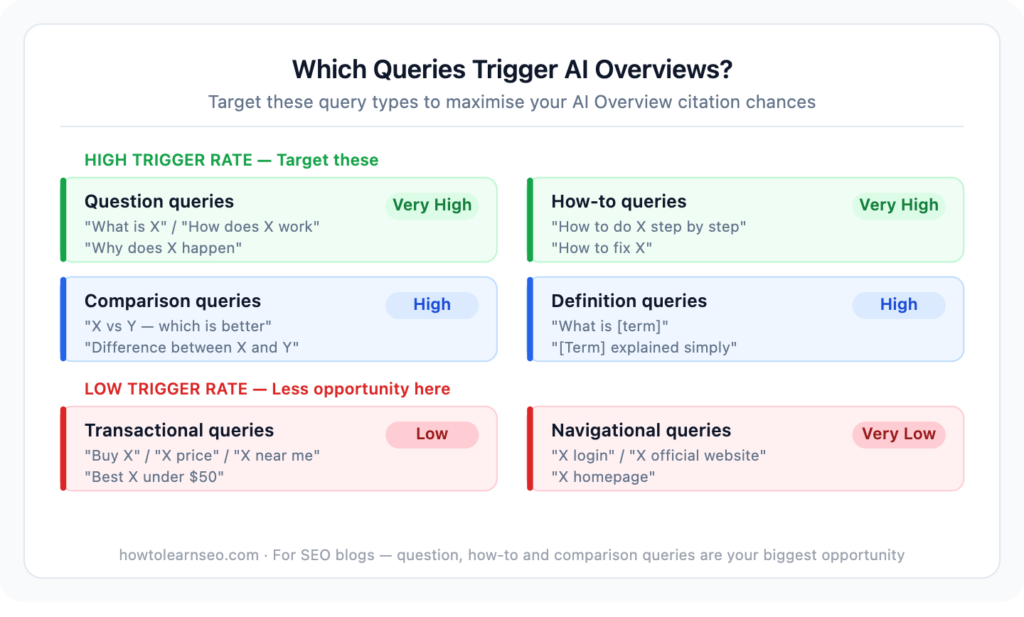
Not every search triggers an AI Overview. Understanding which query types do is essential for targeting the right content:
Highest trigger rates:
- Question-based queries — “how does X work”, “what is X”, “why does X happen”
- How-to queries — “how to do X step by step”
- Definition queries — “what is the difference between X and Y”
- Comparison queries — “X vs Y — which is better”
- Research queries — complex multi-part questions
Lower trigger rates:
- Transactional queries — “buy X”, “X price”, “X near me”
- Navigational queries — “login to X”, “X official website”
- Very short one-word searches
For an SEO blog like this one, the vast majority of target keywords — how-to guides, definitions, comparisons, tutorials — fall squarely in the highest trigger rate category. That’s both a challenge and a significant opportunity.
How Google Selects Sources for AI Overviews
Google hasn’t published a complete list of what determines AI Overview citation. But through extensive research and analysis, a clear picture has emerged:
The content must be indexed and eligible to appear in search This is Google’s stated requirement — no special files, no extra markup needed beyond standard SEO. If your page is indexed and following Google’s search guidelines, it’s technically eligible.
Answer-first structure is heavily favoured Google’s AI looks for content that answers the question immediately and directly. A page that buries its answer under three paragraphs of introduction is a weaker candidate than one that states the answer in the first one or two sentences after a heading. The test is simple — can you read the first sentence under each H2 heading and get a useful answer? If yes, your structure is working.
Topical authority matters more than single-article quality. Sites that have published multiple related articles, all interlinked and covering a topic from various angles, earn more AI Overview citations than sites with a single great article. Google’s AI treats topical depth as a trust signal — it wants to cite sources that genuinely know their subject.
Content freshness is a real factor. Research from Seer Interactive found that 85% of AI Overview citations came from content published within the last two years, with 44% from 2025 alone. This doesn’t mean you need to publish constantly — it means keeping your most important articles updated with current data, statistics, and information matters significantly.
E-E-A-T signals affect citation likelihood. Experience, Expertise, Authoritativeness, and Trustworthiness all influence whether Google’s AI trusts your content enough to cite it. Author bios with real credentials, original examples, cited statistics, and links to primary sources all strengthen these signals.
AI Overviews favour sites with strong E-E-A-T signals — here is how to build them.
List-based and structured formatting gets cited more Analysis of over 141,000 AI Overviews found that 78% use list-based formatting, with unordered lists appearing in 61% of them. Structured, scannable content with clear bullet points and numbered steps is significantly more likely to be extracted and cited.
How to Optimise Your Content for AI Overviews
Here are the specific, actionable steps to maximise your chance of appearing as a cited source:
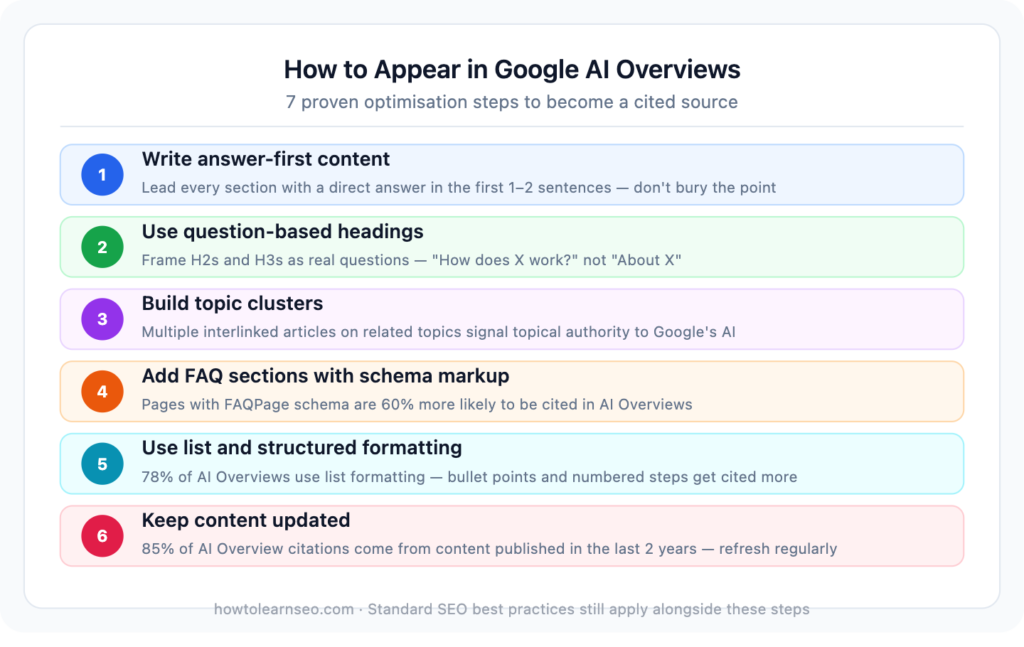
1. Write Answer-First Content
Every section of your article should lead with a direct answer, not an introduction. Don’t make the AI — or your reader — hunt for the point.
Weak structure:
“There are many factors that affect how websites rank in Google. Over the years, SEO has evolved significantly. Experts have studied this extensively and found that…”
Strong structure:
“Google ranks websites based on three primary factors: content quality, backlinks, and page experience. Here’s how each one works…”
The second version gives Google’s AI something it can extract and cite immediately.
2. Use Question-Based Headings
Reframe your H2 and H3 headings as questions your audience actually asks. Instead of “Our SEO Strategy”, use “What Is the Best SEO Strategy for a New Blog?”
This mirrors how AI Overviews are assembled — they respond to questions. Headings phrased as questions signal to Google’s AI that your content directly addresses the query.
3. Build Topic Clusters Around Your Subject
One good article rarely wins AI Overview citations consistently. A cluster of interlinked articles that cover a topic from multiple angles sends a much stronger topical authority signal.
For howtolearnseo.com, this means having articles on what SEO is, how search engines work, keyword research, on-page SEO, backlinks, technical SEO, and topic clusters — all interlinked — rather than isolated standalone posts.
4. Add FAQ Sections to Every Article
Pages with FAQ schema markup are 60% more likely to be cited in AI Overviews compared to pages without structured data. Every article should end with a properly structured FAQ section covering the most common questions about the topic.
Question-based searches are 84% more likely to trigger an AI Overview — and FAQ sections directly feed that demand.
5. Keep Your Content Updated
Since freshness is a meaningful citation signal, audit your most important articles quarterly. Update outdated statistics, refresh examples, and add a visible “Last Updated” date. Even meaningful minor updates can shift AI citation balance in your favour.
6. Strengthen Your E-E-A-T Signals
Add a proper author bio with real credentials to every article. Link to primary sources — official documentation, research papers, industry studies — rather than just other blogs. Include original examples, personal observations, and first-hand experience where possible.
Google’s AI favours content that demonstrates genuine human expertise, not generic information that could have been written by anyone.
7. Fix Technical Crawlability Issues
Google states clearly that a page must be indexed and crawlable to be eligible for AI Overview citation. Check Google Search Console for any crawl errors, indexing issues, or coverage problems affecting your key pages. A page Google can’t properly access can never be cited — regardless of how good the content is.
What NOT to Do
A few common mistakes that reduce your AI Overview citation chances:
Don’t use nosnippet tags on content you want cited — Adding a nosnippet meta tag tells Google not to use your content in any snippet, including AI Overviews. Only use this on pages you genuinely don’t want extracted.
Don’t write vague, hedging content — AI systems skip content that qualifies everything with “it depends” without ever reaching a clear answer. Be direct.
Don’t rely on a single article — Topical authority across a cluster of articles consistently outperforms a single great article in AI Overview citation rates.
Don’t ignore freshness — A well-written article from three years ago with outdated statistics will often lose AI Overview citations to a slightly less polished article with current data.
Tracking Your AI Overview Appearances
Google Search Console tracks AI Overview appearances within the standard Performance report under the “Web” search type. Monitor your impressions and clicks there to see whether your content is being cited.
You can also search for your target keywords directly in Google and look for whether your site appears as a cited source in the AI Overview that loads. This manual check is the quickest way to verify whether your optimisation efforts are working.
Key Takeaways
- Google AI Overviews are AI-generated summaries appearing at the top of over 50% of Google searches in 2026, powered by Google’s Gemini model
- They cite sources from multiple websites — including pages not ranking in the top 10 organically
- Answer-first content structure is the single most important optimisation for AI Overview citation
- Question-based headings, FAQ sections, and list formatting significantly increase citation likelihood
- Pages with FAQ schema are 60% more likely to appear in AI Overviews
- Topical authority — multiple interlinked articles covering a subject thoroughly — matters more than any single article
- Content freshness is a meaningful signal — keep key articles updated with current data
- Standard SEO best practices still apply — no special files or markup beyond good SEO is required
Frequently Asked Questions
Q1: What are Google AI Overviews? Google AI Overviews are AI-generated summaries powered by Google’s Gemini model that appear at the top of search results for many queries. They synthesise information from multiple web pages into a direct answer, with links back to the cited sources. They appear in over 50% of all Google searches in 2026.
Q2: Do I need to rank number one to appear in Google AI Overviews? No. Research shows that 31% of AI Overview citations come from pages ranking between positions 11 and 100, and another 31% come from pages outside the top 100 entirely. Content structure, topical authority, and answer clarity matter independently of ranking position. A well-structured article on a newer site can appear in AI Overviews before reaching page one.
Q3: How do I optimise content to appear in Google AI Overviews? The most effective optimisations are: writing answer-first content that leads each section with a direct answer, using question-based H2 headings, adding FAQ sections with schema markup, building topic clusters of interlinked articles, keeping content updated with current data, and strengthening E-E-A-T signals through author bios and primary source citations.
Q4: Do AI Overviews hurt website traffic? They can reduce clicks for simple queries where users get their answer without clicking through. However, being cited as a source in an AI Overview still drives meaningful traffic — and the users who do click through tend to be higher quality, spending more time on site. For complex queries requiring deeper reading, AI Overview citations can be net positive for traffic.
Q5: Does schema markup help with AI Overview appearances? Yes significantly. Pages with FAQ schema markup are 60% more likely to be cited in AI Overviews compared to equivalent pages without structured data. Adding FAQPage schema to your FAQ sections is one of the highest-leverage technical optimisations available for AI Overview visibility.