
Every day, over 8.5 billion searches happen on Google alone. Behind every one of those searches is a decision about which websites appear at the top — and which ones never get seen at all. That decision is shaped entirely by SEO. If you’ve ever wondered why some websites dominate Google while others with equally good content sit buried on page four, this guide will answer that question completely. No jargon, no fluff — just a clear, honest explanation of what SEO is, how it works in 2026, and what you actually need to do to make it work for your site.
What Is SEO?
SEO stands for Search Engine Optimisation. It is the process of improving your website so it appears higher in organic — meaning unpaid — search results on Google, Bing, and other search engines.
The goal is simple: when someone searches for a topic related to your site, you want your page to show up as close to the top as possible. The higher you rank, the more people see your site, click through, and read your content.
Unlike paid advertising, organic visits do not carry a per-click media charge, although SEO still requires time, expertise and ongoing maintenance. The time needed varies by discovery, indexing, competition and execution; our guide to how long SEO takes explains the milestones and the Search Console evidence to watch.
In 2026 the definition has expanded slightly. SEO is no longer just about ranking in Google’s traditional blue links. It now includes being cited in Google’s AI Overviews, appearing in AI-powered search engines like ChatGPT and Perplexity, and showing up across voice search, YouTube, and other platforms where people search for information. The core principle remains the same though — make your content the most useful, trustworthy answer available.
Why Does SEO Matter?
Here are a few numbers that put the importance of SEO into perspective:
- 68% of all online experiences begin with a search engine
- The number one organic result on Google gets nearly 40% of all clicks for that keyword
- 75% of users never scroll past the first page of results — if you’re not there, you’re essentially invisible
- 94% of user clicks go to organic results rather than paid ads
What these numbers mean in practice is straightforward — if your website isn’t ranking on page one for the topics your audience is searching, you’re missing the vast majority of potential traffic, regardless of how good your content is.
How Do Search Engines Work?
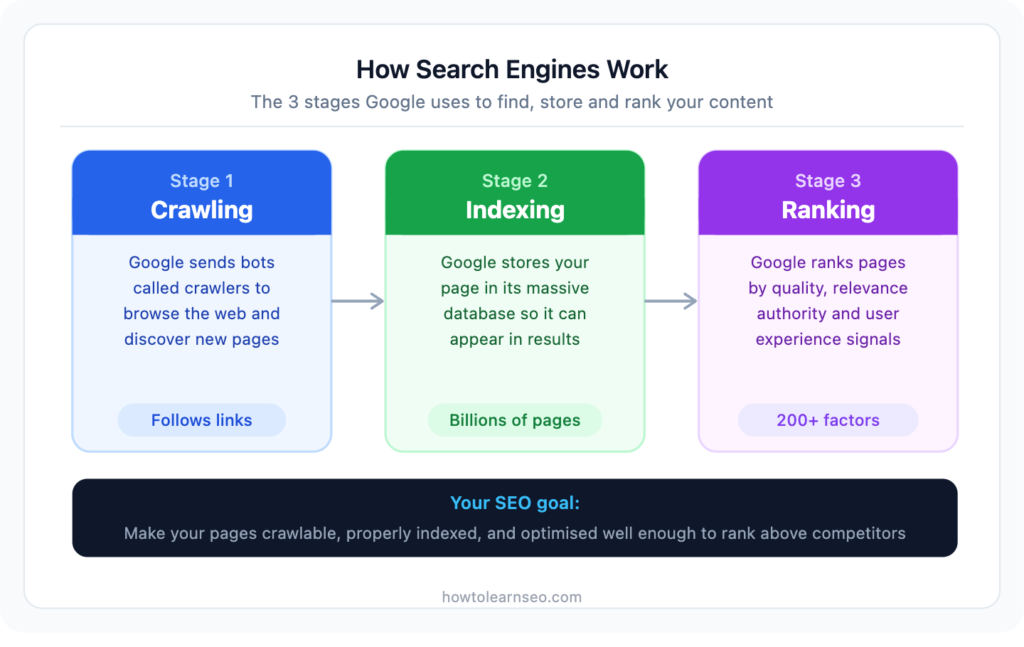
Before optimising for search engines, it helps to understand what they’re actually doing. Search engines like Google operate in three stages:
Crawling Google uses automated programs called crawlers — sometimes called spiders or bots — to browse the internet continuously, following links from page to page and discovering new content. When you publish a new article, Google’s crawlers eventually find it and read its contents.
Indexing Once a page is crawled, Google stores it in its index — an enormous database of billions of web pages. Only indexed pages can appear in search results. If your page isn’t indexed, it simply doesn’t exist as far as Google is concerned.
Ranking When someone performs a search, Google’s algorithm evaluates every relevant indexed page and ranks them in order of usefulness. This evaluation considers hundreds of factors — content quality, page speed, backlinks, user experience, and many more — to determine which pages deserve the top positions.
Your job as a website owner is to make sure your pages are crawlable, properly indexed, and optimised well enough to rank above your competitors for the keywords your audience is searching.
The 4 Types of SEO Every Beginner Must Know
SEO isn’t one single thing — it’s a combination of four distinct areas that work together:
1. On-Page SEO
On-page SEO refers to everything you do directly on your web pages to help search engines understand your content and help readers have a great experience.
Learning how to write SEO-friendly blog posts is one of the most practical skills you can build as a beginner.
This includes:
- Using your target keyword naturally in the title, headings, and content
- Writing clear, helpful meta titles and meta descriptions
- Structuring your content with proper H2 and H3 headings
- Adding descriptive alt text to images
- Using internal links to connect related articles
On-page SEO is entirely in your control and is the best starting point for any beginner. Every article you publish should be optimised for on-page SEO before it goes live.
2. Off-Page SEO
Off-page SEO covers everything you do outside your website to build its authority and credibility. The most important off-page signal is backlinks — links from other websites pointing to yours.
When a reputable site links to your content, Google treats it like a vote of confidence. The more quality backlinks you have, the more trustworthy your site appears, and the better it ranks. Building backlinks takes time, but it’s one of the most powerful ranking factors available.
3. Technical SEO
Technical SEO focuses on the behind-the-scenes elements of your website that affect how well Google can crawl and index your content. A technically broken site will never rank well, no matter how good the content is.
Want a complete beginner’s breakdown of all the technical elements? Read our full technical SEO guide.
Key technical SEO factors include:
- Page loading speed — slow sites rank lower
- Mobile friendliness — over 60% of searches happen on mobile
- SSL certificate — your site must use HTTPS
- XML sitemap — helps Google discover all your pages
- Crawl errors — broken links and redirect issues block Google from reading your content
4. Local SEO
Local SEO is specifically for businesses that serve customers in a physical location or a defined geographic area. It focuses on appearing in location-based searches like “SEO agency near me” or “best coffee shop in Delhi.”
If you’re running a purely online blog or affiliate site, local SEO is less relevant — but it’s essential knowledge for anyone building SEO for a local business.
The Most Important SEO Ranking Factors in 2026
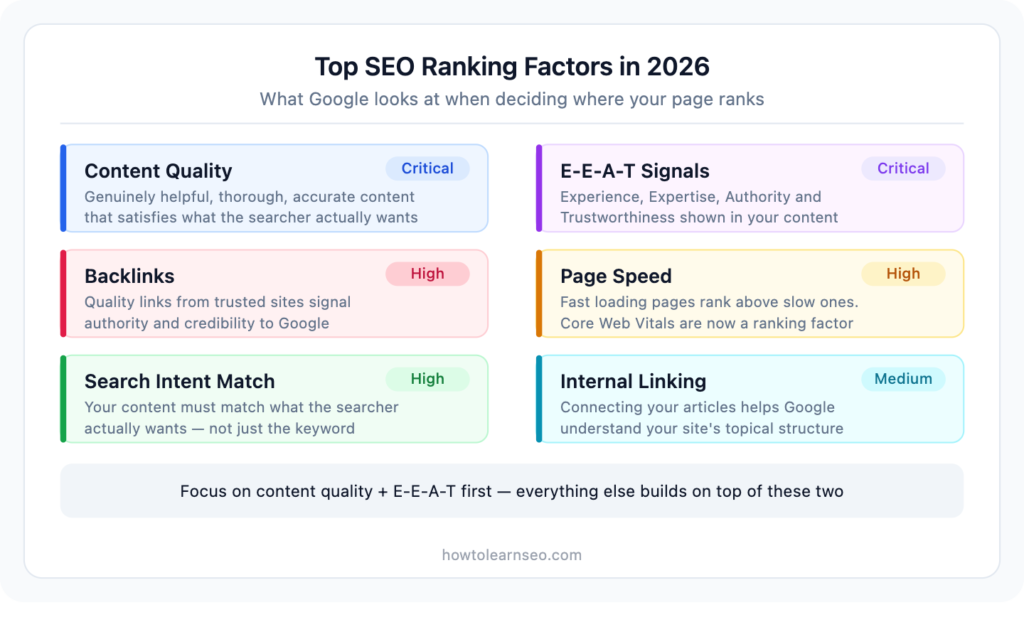
Google’s algorithm uses hundreds of signals to rank pages. These are the ones that matter most for a new blogger or website owner in 2026:
Content Quality and Helpfulness Google’s entire mission is to return the most helpful result for every search. Content that genuinely answers the searcher’s question thoroughly, accurately, and clearly will always have an advantage. In 2026 with the flood of AI-generated content online, genuinely helpful human expertise is more valuable than ever.
E-E-A-T (Experience, Expertise, Authoritativeness, Trustworthiness) Google evaluates not just what you say but who is saying it. Demonstrating real experience and expertise through your content — using examples, sharing genuine insights, and showing you actually know your topic — is a significant ranking signal. Adding an author bio with relevant credentials helps tremendously.
Want to understand how Google evaluates content quality? Read our full E-E-A-T guide.
Backlinks Links from other reputable websites remain one of the strongest ranking signals. Quality matters far more than quantity — one link from a trusted industry blog is worth more than fifty links from random directories.
Page Experience and Core Web Vitals Google measures how fast your pages load, how quickly they become interactive, and how visually stable they are as they load. These metrics — known as Core Web Vitals — directly affect rankings. A slow, clunky site will always rank below a fast, smooth one with similar content.
Search Intent Match Every search query has an intent behind it — the searcher wants to learn something, buy something, find a specific website, or compare options. Google ranks pages that best match the intent of the searcher. Writing a sales page for a keyword where people want an educational guide — or vice versa — is a fundamental mismatch that no amount of optimisation will overcome.
Internal Linking How you connect your own articles together signals to Google which pages are most important and helps it understand the relationship between your content. A strong internal linking structure distributes authority across your site and helps newer articles rank faster.
SEO in 2026 — What’s Changed
SEO in 2026 looks meaningfully different from what it was even two years ago. A few shifts worth understanding:
AI Overviews have changed what ranking means Google now shows AI-generated summaries at the top of many search results pages. For many queries, users get their answer without clicking any link. This doesn’t make SEO less important — it makes it different. The goal now is not just to rank but to be cited as a source inside those AI summaries. Well-structured, clearly written content with direct answers is most likely to earn that citation.
Search everywhere optimisation People no longer search exclusively on Google. They search on YouTube, TikTok, Reddit, ChatGPT, Perplexity, and more. A strong SEO strategy in 2026 considers all of these surfaces — not just Google rankings.
AI content has raised the quality bar The web is now flooded with AI-generated content. Google has responded by more aggressively rewarding content that demonstrates genuine human experience, expertise, and originality. This is actually good news for bloggers who take their content seriously — the bar for ranking has been raised for everyone.
Zero-click searches are growing More searches are being answered directly in Google’s results without any clicks to websites. This makes targeting keywords where users need more depth — tutorials, reviews, comparisons — more valuable than ever.
How to Start with SEO — Your First Steps
If you’re completely new to SEO, here’s where to start:
Step 1 — Set up Google Search Console This is the single most important free tool available. It shows you which keywords your site ranks for, how many impressions and clicks your pages get, and whether Google has any issues crawling your site. Set this up before anything else.
Step 2 — Install an SEO plugin If your site runs on WordPress, install Rank Math or Yoast SEO. These plugins guide you through on-page optimisation for every article you publish, making it much easier to get the basics right.
Step 3 — Start with keyword research Before writing any content, research what your target audience is actually searching for. Use free tools like Google Keyword Planner or AnswerThePublic to find keywords with real search volume. Target long-tail keywords with lower competition first.
Step 4 — Create genuinely helpful content Write content that thoroughly answers your target keyword. Cover the topic better than what’s already ranking. Use clear headings, short paragraphs, and real examples. Focus on being useful rather than trying to game the algorithm.
Step 5 — Build internal links Every new article should link to at least two or three existing articles on your site. This helps Google discover new content and passes authority between pages.
Step 6 — Be patient and consistent SEO takes time. Most sites see their first meaningful results between three and six months. The ones that succeed long-term are the ones that keep publishing consistently and improving their content, even when early results are slow.
Key Takeaways
- SEO is the process of improving your website to rank higher in organic search results — without paying for ads
- Google works in three stages: crawling, indexing, and ranking
- There are four types of SEO — on-page, off-page, technical, and local
- The most important ranking factors in 2026 are content quality, E-E-A-T, backlinks, page speed, and search intent
- In 2026 SEO includes optimising for AI Overviews and search everywhere — not just Google rankings
- Start with Google Search Console, an SEO plugin, basic keyword research, and consistent helpful content
- Most sites see meaningful SEO results between 3 and 6 months with consistent effort
Frequently Asked Questions
Q1: What does SEO stand for? SEO stands for Search Engine Optimisation. It is the practice of improving a website so it ranks higher in organic — unpaid — search results on Google and other search engines, bringing in free traffic from people actively searching for topics related to your site.
Q2: Is SEO free? The traffic SEO generates is free — you don’t pay for each visitor the way you do with Google Ads. However, SEO does require an investment of time, and sometimes money for tools, content creation, or professional help. The key advantage is that once you’ve earned a ranking, it continues to bring traffic without ongoing payments.
Q3: How is SEO different from paid advertising? Paid advertising like Google Ads places your site at the top of results immediately — but stops the moment you stop paying. SEO builds organic rankings that continue driving traffic long after the work is done. SEO takes longer to show results but provides compounding, long-term value that paid ads cannot replicate.
Q4: Do I need technical knowledge to do SEO? Not at the beginner level. On-page SEO — optimising your content, titles, meta descriptions, and internal links — requires no coding knowledge at all. Technical SEO becomes relevant as your site grows, but most beginners can start with just a good SEO plugin like Rank Math and basic content optimisation.
Q5: Is SEO still worth it in 2026 with AI search taking over? Absolutely. While AI search features like Google’s AI Overviews have changed how results are displayed, they still pull content from well-ranked, authoritative web pages. If anything, ranking well in 2026 makes your content more likely to be cited in AI summaries — giving you visibility even in zero-click searches. SEO is more relevant now than it has ever been.