
How long does SEO take to work? It’s the first question almost every new blogger or website owner asks — and unfortunately, most answers online are either vague, overly optimistic, or written by agencies trying to sell you a package. So here’s the straight, unfiltered truth about SEO timelines in 2026, what actually affects how fast you rank, and what you can realistically expect month by month.
The Short Answer First
There is no universal SEO countdown. As a practical planning range, many sites look for their first measurable movement within 3 to 6 months, while meaningful growth in a competitive market may take 6 to 12 months or longer. Those ranges are benchmarks, not promises.
The answer also depends on what you call a “result.” Discovery, indexing, impressions, top-10 rankings, organic clicks and conversions are separate milestones. A page can be indexed without earning impressions, and a page can earn impressions long before it produces meaningful traffic or revenue.
Google states that meeting its minimum technical requirements only makes a page eligible for indexing; indexing and rankings are not guaranteed. That is why an honest SEO forecast should use ranges, checkpoints and evidence from Search Console instead of guaranteeing a date.
Why SEO Takes Time
Google Search works in stages. It must discover a URL, crawl the page and its resources, decide whether to index a canonical version, and then evaluate that indexed page against the intent and competition for each query. Google explains these stages in its guide to how Search works.
At the same time, the website owner must complete work that cannot be compressed into one button: repair technical problems, publish genuinely useful information, connect related pages, earn legitimate references, observe real query data and improve weak pages. Competitive topics take longer because the page must be more useful and convincing than alternatives that may already have years of coverage and recognition.
Google’s current documentation does not define a formal “sandbox” period that automatically suppresses every new domain for a fixed number of months. A young site can still struggle because it has fewer discovered pages, fewer relevant links, less historical performance data and less demonstrated topic coverage—but “the sandbox” should not be used as a substitute for diagnosing the actual problem.
If progress is slow, start by separating discovery, indexing and ranking. Our Google indexing guide explains how to interpret each status before changing the content.
A Realistic Month-by-Month SEO Framework
This framework describes what to work on and what evidence to watch. It is not a prediction that every site will rank on the same schedule.
Weeks 1–4: Establish the Baseline
- Verify that important URLs return HTTP 200, are not blocked and use the intended canonical.
- Submit a clean sitemap and inspect a representative set of URLs in Google Search Console.
- Map each priority page to one clear search intent and remove obvious duplication.
- Add descriptive internal links from relevant pages that Google already knows.
The useful early evidence is not a promised ranking. It is successful crawling, correct indexing signals and the first appearance of relevant queries or impressions.
Months 2–3: Learn From Early Search Data
Review which pages are indexed, which queries trigger impressions and whether the page matches the dominant search intent. Strengthen pages that are being shown but not satisfying the query, and investigate important URLs that remain discovered or crawled without indexing.
Possible progress includes wider query coverage, more frequent impressions and movement for specific long-tail searches. None of these is guaranteed, and low-volume topics may produce limited data even when the page is healthy.
Months 4–6: Improve What the Evidence Identifies
By this stage, there is usually enough information to stop guessing. Improve pages with weak intent alignment, thin explanations, poor snippets, weak internal support or outdated claims. Expand topic clusters only where the existing pages are differentiated and genuinely useful.
Some sites begin producing meaningful traffic during this period; others do not. Compare cohorts of pages, not isolated daily fluctuations, and judge success using impressions, clicks and relevant business outcomes.
Months 6–12: Scale Proven Topics
Invest more heavily in topics that have earned qualified impressions, clicks, links or conversions. Refresh weak pages, consolidate true overlap when appropriate, improve page experience and develop original examples, tools or analysis that competitors cannot easily reproduce.
If there is still no meaningful movement after six months, do not simply wait. Recheck indexing, demand, intent, competition, content differentiation, internal linking and site-wide quality. A wrong target or an undifferentiated page does not improve merely because it becomes older.
Month 12 and Beyond: Compounding Is Conditional
SEO can compound when strong pages attract links, support related pages and continue satisfying searchers. It does not run permanently without maintenance. Search demand, competitors, products and Google’s systems change, so important pages still need review and factual updates.
Diagnose the Status Before Choosing a Fix
| Search Console status | What it usually indicates | Best next action |
|---|---|---|
| URL unknown to Google | Discovery has not been confirmed | Check sitemap inclusion and add a relevant crawlable internal link. |
| Discovered – currently not indexed | Google knows the URL but has not crawled it yet | Improve internal discovery, server reliability and overall crawl priority; then allow time. |
| Crawled – currently not indexed | Google fetched the page but did not retain it in the index | Review originality, usefulness, overlap, canonical signals and internal importance before requesting another crawl. |
| Indexed but receiving no impressions | The problem has moved from indexing to relevance or demand | Reassess query intent, competition, topic demand, title and content differentiation. |
A sitemap helps discovery, but it does not guarantee indexing. Likewise, Google says a recrawl request can take from days to weeks and repeated requests do not make crawling faster. Use URL Inspection after a meaningful change, not as a daily submission button.
What Makes SEO Faster or Slower
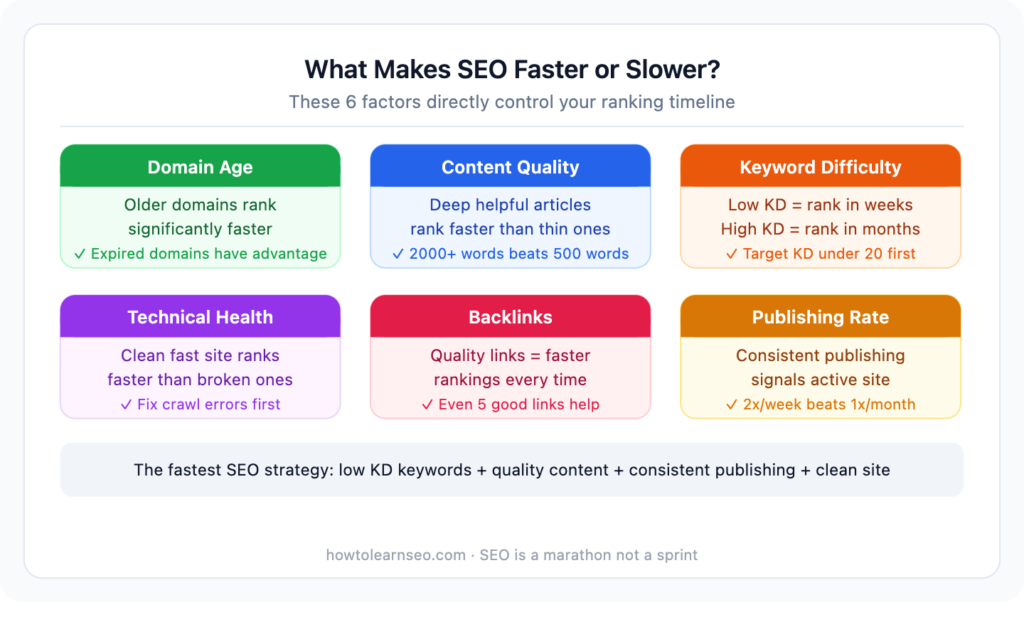
SEO speed is shaped by the starting point, the market and the quality of execution. The following factors matter more than a generic calendar.
Crawling and Indexing Health
A page cannot rank if Google cannot access or index it. Check response codes, robots directives, canonical tags, rendering and sitemap consistency first. Our technical SEO guide covers the core checks.
Content Usefulness and Differentiation
Google recommends original information, substantial coverage and value beyond what other sources already provide. A page that merely repeats the existing results has a weaker reason to be indexed or ranked than one with clear expertise, examples, evidence or analysis.
Search Intent and Competition
A precise long-tail query may be achievable sooner than a broad commercial term, but keyword difficulty scores are third-party estimates rather than Google rules. Inspect the actual results, the type of pages ranking and whether your page offers a better answer for the same intent.
Internal Links and Site Structure
Google uses links to discover pages and understand context. Add natural links from relevant, established pages using descriptive anchor text. Our internal-linking guide explains how to do this without forcing keywords.
External Reputation
Relevant editorial links and independent mentions can support discovery and reputation, while paid or manipulative links can create risk. Focus on resources people genuinely want to reference; see our explanation of what backlinks are.
Domain History
An older or expired domain does not receive automatic trust. Previous content, links, ownership changes and reputation can help, hurt or make no meaningful difference. Audit the domain’s history and current signals rather than assuming age will shorten the timeline.
Implementation and Measurement
Sites improve faster when they can identify a problem, implement a focused change and measure the result. Delayed publishing approvals, unresolved technical defects and large batches of undifferentiated content make it harder to learn what is working.
Signs Your SEO Is Actually Working
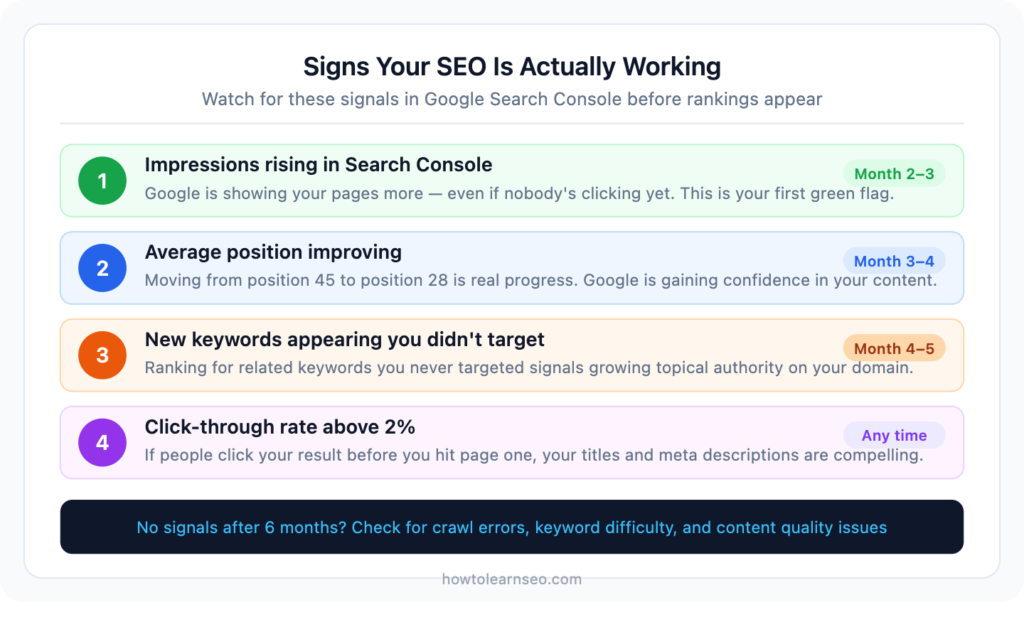
- Important pages become indexed: this confirms that discovery and index eligibility are working, although it does not guarantee rankings.
- Relevant impressions appear: Google has begun showing the page for actual searches. Check the queries to confirm that they match the intended audience.
- Query coverage becomes more relevant: the page starts appearing for a wider set of closely related searches rather than unrelated terms.
- Clicks and engaged visits increase: combine Search Console clicks with GA4 engagement and conversions to judge whether visibility is producing useful visits.
- Performance holds across comparable periods: use several weeks of data and account for seasonality instead of reacting to one-day movements.
There is no universal “good CTR” such as 2%. CTR changes substantially by query, position, device, brand recognition and search-result layout. Compare similar queries and pages over time. Google also advises focusing primarily on impressions and clicks rather than obsessing over a single absolute average-position number.
How to Improve SEO Results Without Chasing Shortcuts
- Fix eligibility first: resolve blocking, canonical, rendering and server problems before rewriting a page that Google cannot access.
- Target a clear intent: use keyword research to find a real audience need, then answer that need completely.
- Improve existing weak pages: add missing evidence, firsthand examples, clearer explanations and factual updates instead of publishing near-duplicates.
- Use contextual internal links: connect each important page to relevant pages that readers and crawlers can already reach.
- Maintain good page experience: improve usability and WordPress performance for visitors rather than chasing a perfect tool score.
- Earn legitimate references: publish useful research, examples, templates or tools and promote them to relevant audiences; avoid buying ranking links.
- Request recrawling selectively: after a meaningful update, submit one URL Inspection request and then allow Google time to process it.
For AI Overviews and AI Mode, Google says there are no special technical requirements beyond normal SEO foundations. A page must first be indexed and eligible to appear in Search with a snippet. Clear structure can help readers and systems understand the answer, but it cannot guarantee an AI citation. Learn more in Google’s AI features guidance and our guide to Google AI Overviews.
Common SEO Timeline Myths — Debunked
“Every site should rank within 30 days.” A page may be discovered or even rank quickly, but no fixed deadline applies across topics and websites. Treat early movement as evidence, not a guarantee.
“A new domain is automatically held in a Google Sandbox.” Google’s current documentation does not define a universal sandbox period. Diagnose crawl, index, relevance, competition and quality signals instead of assuming a hidden timer.
“Publishing every day makes SEO faster.” Frequency alone is not a quality signal. Publish at a pace that allows useful, original and well-maintained pages; rapid low-value production can create overlap and dilute editorial attention.
“An expired domain skips the hard part.” Age does not erase weak content or guarantee inherited authority. Historical links and reputation must be evaluated, and Google may choose to ignore or reassess old signals.
“Request Indexing repeatedly until Google accepts the page.” Repeated requests do not accelerate crawling. Make a meaningful improvement, submit once when appropriate and monitor the result.
“Paid SEO tools produce rankings.” Tools reveal data and opportunities; they do not replace a technically accessible site, useful content, sound decisions and consistent execution.
Key Takeaways
- Use 3–6 months as a planning benchmark for early measurable movement, not a promise.
- Separate discovery, indexing, impressions, rankings, clicks and conversions when measuring progress.
- Google does not guarantee indexing even when a page meets its technical requirements.
- Fix the status shown in Search Console rather than applying the same remedy to every slow page.
- Useful differentiation, intent alignment, internal links and legitimate reputation matter more than domain age or publishing frequency alone.
- Request recrawling once after a meaningful change; repeated submissions do not make Google process the page faster.
- AI visibility still begins with normal Search eligibility: the page must be indexed and eligible for a snippet.
Conclusion: Measure the Stage, Not Just the Month
The honest answer to “How long does SEO take?” is a range followed by a diagnosis. Use the calendar for planning, but use Search Console, GA4 and business outcomes to decide what to do next. If a URL is unknown, improve discovery. If it was crawled but excluded, improve its reason to exist. If it is indexed but invisible, reassess relevance, demand and competition. That approach produces better decisions than waiting for a mythical deadline.
Frequently Asked Questions
How long does SEO take for a new website? There is no fixed period. Discovery and indexing may happen within days or take weeks, while stable traffic for competitive non-brand searches often requires months of technical, content and reputation work. Track indexing and relevant impressions before judging the site only by traffic.
Can SEO start working within three months? Yes. A technically sound page targeting a specific, underserved query can earn impressions or clicks within that period. Three months is not a universal deadline, however, and broad competitive topics may need substantially longer.
Why is my SEO not working after six months? Check whether priority pages are indexed, whether queries have real demand, whether the content matches intent, whether stronger pages already satisfy the search, and whether your page offers distinct evidence or experience. Also inspect internal links, canonical signals, server performance and overlap with your own articles.
Does publishing more articles make SEO work faster? Only when the added pages are useful, differentiated and maintainable. More pages can increase topic coverage and discovery opportunities, but near-duplicates or rushed content can create cannibalization and a larger quality-maintenance burden.
Does domain age determine how quickly SEO works? No. Domain history may affect the starting context, but age alone does not guarantee indexing, trust or rankings. Current content quality, technical health, relevance, links and reputation still need to support each important page.
Can AI Overviews create visibility before a top traditional ranking? AI features can surface a different and broader set of supporting links, but inclusion is not guaranteed. Google requires a supporting page to be indexed and eligible for a normal Search snippet, so technical eligibility and helpful content remain the foundation.