Competitor keyword gap analysis compares the searches competing websites satisfy with the topics your website already covers. It identifies missing lessons, underperforming pages and useful content opportunities. The aim is not to copy a competitor’s keyword list: it is to understand which reader questions your site can answer better. This practical workflow works with a spreadsheet, your own Search Console data and a focused manual search-results review.
Quick Answer
Choose three relevant search competitors, collect comparable queries and landing pages, group keywords by intent, compare each group against your existing pages, and prioritize genuine gaps. Confirm search-results intent before publishing. Record which observations are measured and which are estimates.
Key Takeaways
- Search competitors differ from business competitors.
- A missing keyword is not always a missing article.
- Group synonyms by intent before creating pages.
- Use actual Search Console metrics for your own site.
- Never mistake estimated competitor rankings for guaranteed opportunities.
Choose Comparable Search Competitors
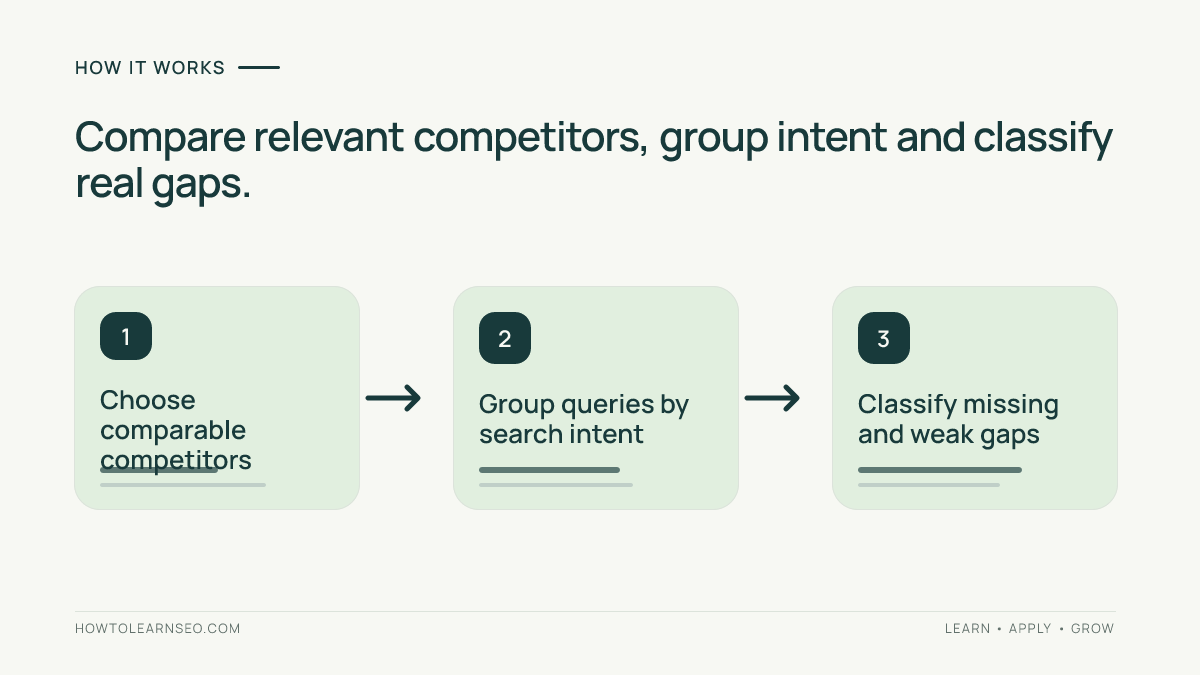
Start with one subject, such as beginner keyword research, rather than comparing entire sites with unrelated audiences. Search its main query and several close variations. Record educational websites that appear repeatedly and serve the same reader. A software marketplace, government resource and personal blog may appear together, but their audiences and formats are not necessarily comparable.
Choose two or three sites with overlapping informational intent. Record each competitor’s exact landing page, country, device and observation date. Do not assume a very large domain is an achievable benchmark for a smaller site. A competitor with a narrowly focused tutorial can be more useful for content planning than a large brand ranking for thousands of unrelated terms.
Collect Evidence and Keep Sources Separate
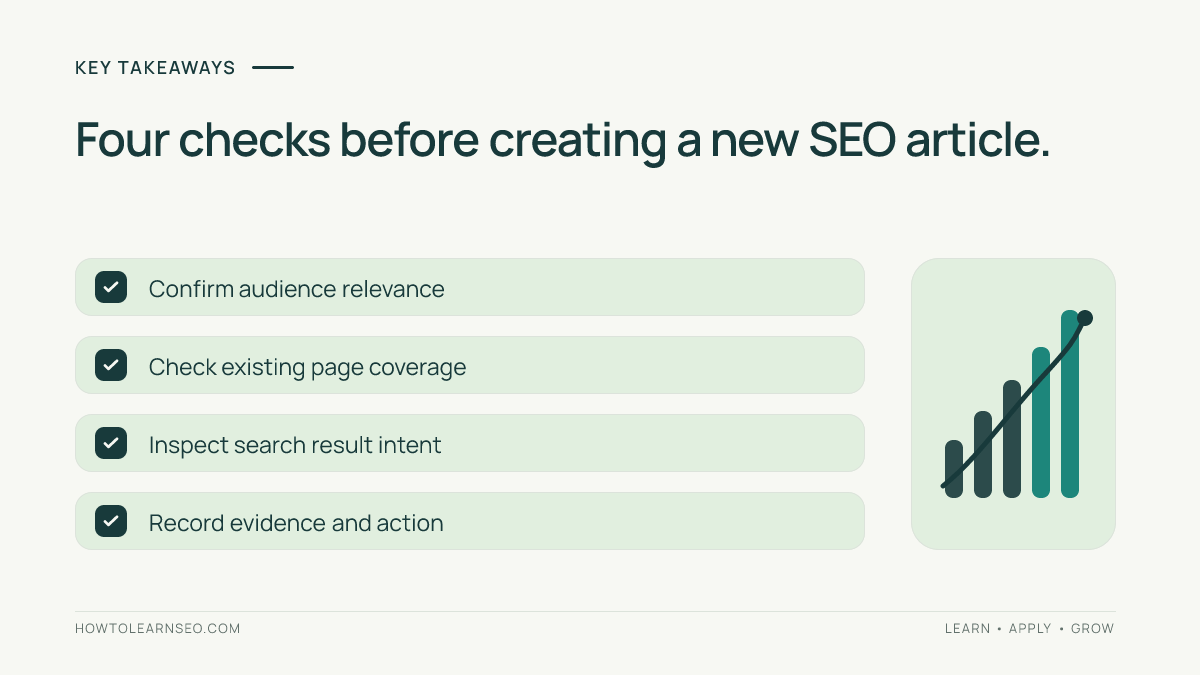
Export your own queries and pages from Google Search Console’s Performance report. Google defines impressions, clicks, click-through rate and average position as distinct measures; its official Performance documentation explains the differences. Filter by the same country and search type you intend to target. Compare meaningful date ranges and remember that some queries are anonymized.
If an authorized keyword database is available, record competitor ranking URLs, estimated traffic, keywords and the provider’s date and geography. Without a paid database, manually inspect a manageable set of search results. A manual sample can show which pages appear for those queries, but cannot establish a competitor’s full keyword portfolio or exact monthly search demand.
Create a worksheet with columns for query, intent group, competitor URL, evidence type, our matching URL, gap label, audience value, competition notes, next action and review date. Leave unknown metrics blank. An empty value is more honest than an invented zero, and makes later research easier.
Classify Gaps by Search Intent
Treat similar queries as one group when they require the same answer. For example, ‘competitor keyword gap analysis’ and ‘keyword gap analysis for SEO’ may be satisfied by the same tutorial. A query about software subscription pricing, however, has a commercial intent and should not be forced into that tutorial.
Assign four labels. Missing means no suitable existing page addresses the need. Weak means an existing page may need deeper explanation or clearer structure. Covered means a useful page already meets the intent. Irrelevant means the query does not serve your readers. Verify these labels against your content inventory, not merely a keyword tool’s automatic comparison.
This distinction prevents unnecessary duplicate articles. A website with an existing keyword research beginner guide should first examine whether the proposed gap is a new reader task or just another wording for its existing lesson.
Illustrative Worksheet: Three Queries
Consider a hypothetical SEO education website with three candidate queries: ‘competitor keyword gap analysis’, ‘what are backlinks’ and ‘local SEO checklist’. Its inventory contains a backlinks definition and a local SEO beginner guide, but no dedicated competitor-gap workflow. These are illustrative inputs, not measured rankings or keyword volumes.
Apply the classification rule: mark the competitor-gap query Missing, backlinks Covered, and the local SEO checklist Needs Review. The checklist may deserve a new page, or the existing local SEO guide may already cover it sufficiently. Do not decide until you inspect that page. This yields one clear tutorial candidate, one rejected duplicate and one research task.
Expected output: a worksheet row with a justified label and next action for each query. To verify, review the current search results and confirm the proposed tutorial matches the dominant informational intent. Edge case: if the results mostly feature tool pricing comparisons, revise or reject the educational tutorial idea. The searcher may want a product comparison rather than a lesson.
Turn Findings Into an Editorial Priority
Rank candidates by reader relevance, distinct intent, evidence quality, effort and fit with the visible search results. High priority means the query serves your audience, has a clear gap and can be answered with useful original instruction. Medium priority needs more evidence or an improved supporting page. Low priority is duplicated, irrelevant or badly matched to the current results.
Do not confuse Google Trends’ relative interest with monthly volume. Advertising competition in Keyword Planner is not the same as organic ranking difficulty. Neither a high estimated volume nor a ‘missing’ label makes a topic easy to rank for. Large competitors may occupy a broad query while a focused supporting tutorial can address a more achievable specific need.
Build connected lessons instead of isolated posts. An introductory concept page can link to a practical workflow, which can link to advanced diagnostics. The site’s internal linking guide and linking best practices provide useful background for connecting related resources naturally.
Write a Brief That Improves on the Results
For the selected topic, specify the reader, starting knowledge, concrete task, required inputs, decision rules, expected output and likely mistakes. Inspect competing pages for missing explanations, but write original examples and structure. A useful gap-analysis tutorial should teach readers how to classify queries and reject false opportunities, not repeat definitions for another thousand words.
Plan the article’s title and description to reflect its actual promise. Google’s snippet guidance explains that search snippets are primarily generated from page content and may use the meta description when appropriate. A descriptive title and summary help communicate relevance, but do not guarantee a particular display or ranking.
Measure the Result Without Overclaiming
After publication, record the date and monitor relevant queries, impressions and clicks in Search Console. Compare equivalent periods and allow for reporting delays. A few days of fluctuations are not proof that the page succeeded or failed. Check whether visitors are finding the intended lesson and whether existing pages now compete for the same intent.
Google’s filtering guidance notes that query filters and anonymized data affect totals. Do not present a filtered export as complete market demand. Repeat the manual search-results check with a consistent country and device, and annotate any changes in competitor page types.
Common errors include comparing different countries, treating every competitor keyword as an editorial assignment, ignoring branded searches, mixing impressions with monthly volume and creating a new URL when an existing page needs improvement. A disciplined worksheet prevents these mistakes and makes future decisions easier to audit.
Frequently Asked Questions
What is competitor keyword gap analysis?
It compares relevant competitor search topics with your own content to identify useful missing or underperforming page opportunities.
Can I do a keyword gap analysis for free?
Yes. Use your own Search Console performance and a focused manual review of search results, while noting the limits of the sample.
How many competitors should I analyze?
Two or three closely relevant search competitors are enough for a first focused analysis; add more when they provide new evidence.
Does every missing keyword need a new article?
No. Check whether an existing page already satisfies the same intent before creating another URL.
Does Google Trends show monthly search volume?
No. Google Trends measures relative interest within the selected geography and time window, not absolute monthly search volume.
How do I verify a keyword gap opportunity?
Check the current search-results intent, confirm your content inventory has a genuine gap and monitor the published page over time.
Conclusion
A useful competitor keyword gap analysis produces a small set of defensible editorial decisions, not a giant spreadsheet of copied keywords. Choose comparable competitors, classify queries by intent, distinguish real measurements from estimates and prioritize lessons that improve the reader’s journey. Revisit the evidence after publication and refine the plan when search behavior changes.