
Local SEO helps a business become more visible when people search for products, services, or places in a specific area. It matters when a customer’s location affects which business can realistically serve them—whether that means visiting a shop, booking a nearby professional, or calling a company that travels to the customer.
This beginner’s guide explains what local SEO is, how local search works, and how to build a practical strategy without relying on tricks or guaranteed-ranking claims. You will learn how Google Business Profile, local landing pages, reviews, citations, links, and structured data work together to help search engines and customers understand a business.
Quick Answer: What Is Local SEO?
Local SEO is the process of improving a business’s visibility in location-based search results. It helps eligible businesses appear when people search for queries such as “dentist near me,” “plumber in Chicago,” or “coffee shop open now.” Local SEO can influence visibility in Google Search, Google Maps, and other services that use local business information.
The work usually combines an accurate Google Business Profile, a useful website, locally relevant content, consistent business details, genuine customer reviews, reputable mentions, and ongoing performance measurement. It is not a way to force a particular position. The goal is to make the business a clear, trustworthy, and relevant option for the customers it can actually serve.
Key Takeaways
- Local SEO is designed for businesses that serve customers at a physical location or within a defined service area.
- Google says local results are mainly based on relevance, distance, and prominence.
- A complete and accurate Google Business Profile is important, but the business website remains a valuable source of context and authority.
- Local pages should help customers make decisions; swapping city names into duplicated text is not a useful local-content strategy.
- Reviews, accurate citations, relevant links, and clear business information reinforce trust, but none can guarantee a ranking.
- Performance should be measured through leads and customer actions as well as rankings and traffic.
Table of Contents
- How local SEO works
- Who should use local SEO
- Local SEO compared with traditional SEO
- The main elements of local SEO
- A step-by-step local SEO process
- How to measure local SEO performance
- Common local SEO mistakes
- A practical local SEO checklist
How Does Local SEO Work?
Search engines try to match a local query with businesses that are suitable for the searcher’s need and location. A query can carry local intent even when it does not contain a city name. Someone searching for “emergency locksmith,” for example, probably needs a provider who can reach the area quickly.
Local visibility can appear in several places. Google may show a map-based group of businesses, individual Business Profiles, standard organic results, or a mixture of these formats. The exact presentation varies by query, device, location, and available business data.
Relevance, distance, and prominence
Google’s official guidance says that local results are mainly based on relevance, distance, and prominence:
- Relevance describes how well a business matches what the searcher wants. Accurate categories, services, website content, and profile details help clarify that match.
- Distance considers how far a business is from the location used for the search. If the searcher does not specify a place, Google estimates location from the information available to it.
- Prominence reflects how well known or established a business appears. Google explains that links, reviews, ratings, and information found across the web can contribute to this understanding.
You can improve relevance and strengthen signs of prominence, but you cannot optimize away physical distance. A business should focus on accurately representing where it operates instead of pretending to have locations it does not have.
Google Business Profile and the website have different roles
A Google Business Profile supplies details that customers may need immediately: business category, location or service area, hours, phone number, photos, services, reviews, and directions. The website can explain the business in greater depth through service pages, location information, proof of expertise, policies, pricing context, and answers to customer questions.
These assets should reinforce each other. The profile can send a customer to the most relevant website page, while the website can confirm that the business genuinely provides the service described in the profile.
Who Should Use Local SEO?
Local SEO is most relevant when a business either receives customers at a real location or travels to customers within a service area. Common examples include restaurants, clinics, retail stores, repair companies, law firms, salons, home-service providers, and multi-location businesses.
Google’s Business Profile guidelines state that an eligible business generally needs to make in-person contact with customers during its stated hours, either at its location or at the customer’s location. Online-only brands, lead-generation companies without a qualifying customer-facing operation, and virtual offices that do not meet the guidelines should not create misleading profiles.
Practical rule: If geography determines who can buy from or be served by the business, local SEO is probably relevant. If the business serves customers entirely online with no meaningful local component, broader SEO fundamentals are usually the better starting point.
Local SEO vs. Traditional SEO
Local SEO and traditional organic SEO share many principles, including useful content, crawlable pages, strong internal structure, trustworthy links, and a good user experience. The main difference is the role of location and business-entity information.
| Area | Local SEO | Traditional SEO |
|---|---|---|
| Primary goal | Reach customers in a defined area | Reach relevant searchers regardless of location |
| Important search surfaces | Google Maps, Business Profiles, and local organic results | Standard organic search results |
| Core information | Location, service area, hours, category, reviews, and contact details | Topic relevance, content quality, site structure, and authority |
| Typical keywords | Service plus city, neighborhood, or “near me” intent | Informational, commercial, navigational, or transactional queries |
| Measurement | Calls, direction requests, bookings, local leads, and visits | Organic traffic, conversions, visibility, and revenue |
A local business normally needs both. Its Business Profile can support map visibility, while its website can earn organic rankings for detailed service questions and strengthen the information Google and customers use to evaluate the business.
What Are the Main Elements of Local SEO?
1. An accurate Google Business Profile
Claim and verify the correct profile, then complete every field that genuinely applies. Use the business’s real-world name rather than adding keywords, locations, or promotional language. Select the most specific primary category that reflects the core business and add only relevant secondary categories.
Keep hours, phone numbers, services, appointment links, photos, and holiday schedules current. Google recommends accurate, complete, and up-to-date information because it helps the system understand the business and helps customers avoid wasted journeys or calls.
2. Local keyword research based on customer language
Local keyword research begins with the services customers need, the words they use, and the places the business truly serves. Useful patterns include service-plus-location queries, urgent needs, problem-based searches, and comparison searches.
Do not build the strategy from search volume alone. A lower-volume phrase that accurately describes a profitable service may be more valuable than a broad term with unclear intent. The site’s keyword research guide explains how to connect keywords with intent rather than chasing isolated numbers.
3. Helpful service and location pages
A local landing page should help a customer decide whether the business is a suitable choice. It can explain the service, location or service area, process, qualifications, pricing factors, availability, frequently asked questions, and a clear next step.
Multi-location businesses may need a dedicated page for each genuine location, but every page should contain location-specific value. Useful differences might include address details, local staff, services available at that branch, parking or access information, landmarks, testimonials, and original photographs. Replacing one city name with another across dozens of otherwise identical pages creates little value.
Apply the same clarity and heading discipline used in strong on-page SEO: one clear purpose per page, descriptive headings, natural terminology, and information that directly satisfies the visitor’s need.
4. Consistent business information and citations
A local citation is an online mention of a business’s name, address, phone number, or other identifying details. Citations may appear in major directories, industry associations, local chambers, mapping platforms, and community websites.
Consistency helps customers and platforms recognize the correct business entity. Standardize the core name, address, and phone details where practical, fix important inaccuracies, and avoid creating listings on low-quality directories simply to increase the count. A small set of accurate, relevant profiles is more useful than a large set of neglected entries.
5. Genuine customer reviews and responsible responses
Reviews give potential customers first-hand context about a business. Google also notes that review count and positive ratings can contribute to local prominence. Ask real customers for honest feedback at natural points in the customer journey, make the process simple, and never offer misleading incentives or manufacture reviews.
Respond professionally to both positive and critical feedback. A useful response acknowledges the customer, addresses relevant details without exposing private information, and offers an appropriate path to resolve a problem. Reviews should support trust, not become a keyword-stuffing exercise.
6. Relevant links and community authority
Links can help search engines discover pages and understand a business’s reputation and relationships. For a local company, meaningful opportunities may come from suppliers, professional organizations, local news coverage, sponsorships, community partnerships, or useful resources that other sites genuinely want to reference.
The principle is the same as in the site’s guide to backlinks: relevance and editorial value matter more than raw quantity. Buying directory packages or exchanging links at scale can create risk without building real local authority.
7. Clear local business structured data
LocalBusiness structured data can provide machine-readable details such as business type, address, opening hours, and contact information. Google recommends using the most specific applicable subtype and ensuring that the markup matches visible page content.
Structured data helps search engines understand information; it does not guarantee a rich result or a higher local position. Follow Google’s LocalBusiness documentation and validate the implementation. If structured data is new to you, begin with the schema markup guide.
How to Build a Local SEO Strategy Step by Step
- Confirm eligibility and ownership. Make sure the business qualifies for a profile, then claim the genuine listing and keep the owner in control of access.
- Audit the core business information. Record the correct name, address or service area, phone number, website, categories, services, and operating hours.
- Map services to real local intent. Identify how customers describe each service and which geographic terms accurately match the operating area.
- Improve the most useful website pages. Build or revise service and location pages so each one answers customer questions and offers a clear conversion path.
- Complete and maintain the Business Profile. Add accurate details, original photos, services, links, and special hours; update them whenever the business changes.
- Create an ethical review process. Ask genuine customers consistently, provide an easy review path, and respond in a helpful, privacy-conscious manner.
- Correct priority citations and earn relevant mentions. Fix inaccurate listings first, then pursue reputable industry and community opportunities.
- Measure outcomes and refine. Track visibility, website behavior, calls, bookings, direction requests, leads, and sales rather than relying on a single ranking snapshot.
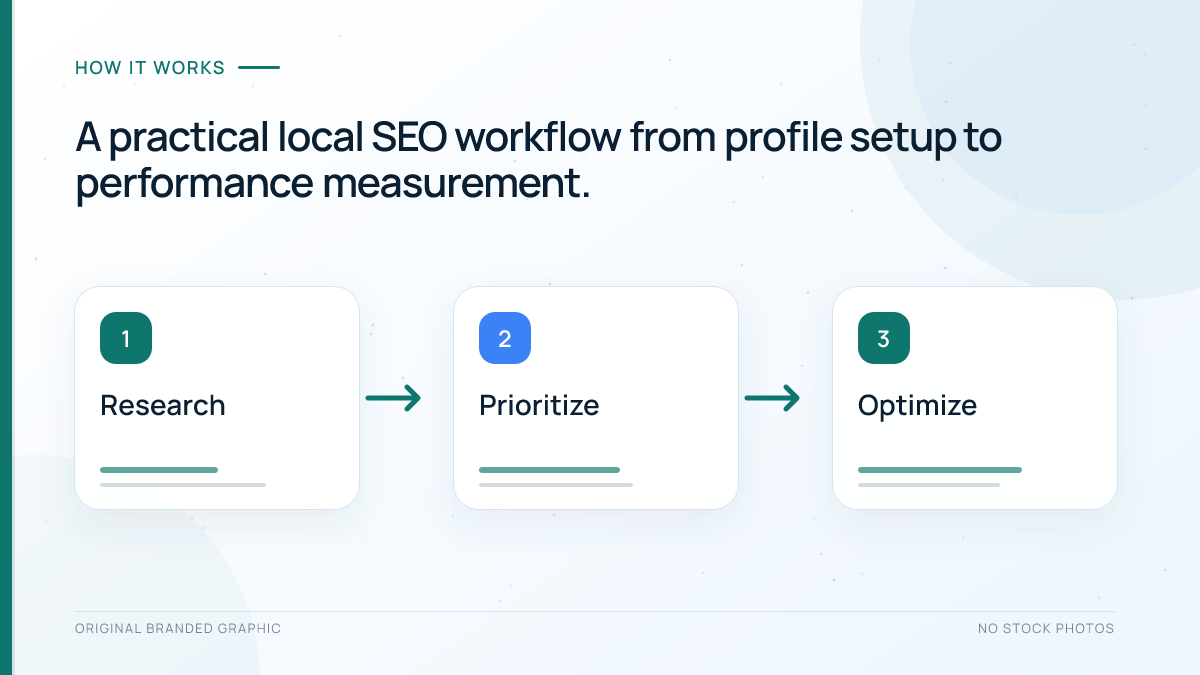
Work through this sequence in order. A polished profile cannot compensate for an ineligible business or incorrect information, and a technically sound website will struggle to convert local visitors if its service details are vague.
How Should You Measure Local SEO Performance?
Local rankings can change by location, device, query wording, and time, so one manual search is not a reliable reporting system. Measure several indicators and connect them to business outcomes.
- Business Profile actions: calls, website visits, direction requests, bookings, messages, and other supported interactions.
- Organic search performance: queries, impressions, clicks, pages, and positions in Google Search Console.
- Website engagement: landing-page sessions, useful interactions, form submissions, calls, and appointments.
- Conversion quality: whether leads come from the correct locations and request services the business actually offers.
- Reputation signals: review quality, response coverage, recurring customer concerns, and profile accuracy.
- Indexing and technical health: whether important local pages are crawlable, indexable, canonical, mobile-friendly, and internally linked.
The Google Search Console guide explains how to inspect query and page data. When reviewing results, compare meaningful periods and annotate major changes such as a new location page, altered hours, a site migration, or a seasonal shift.
Common Local SEO Mistakes
Adding keywords to the business name
The profile name should reflect the real-world business name. Adding services or cities that are not part of the genuine name can violate Google’s guidelines and may lead to corrections or suspension.
Creating profiles for locations that do not qualify
Virtual offices, borrowed addresses, and fabricated locations do not create legitimate proximity. Use only real, eligible locations and truthful service areas.
Publishing duplicated city pages
Pages that differ only by a city name rarely help readers. Create a local page only when the business can offer distinct, accurate, and useful information for that location.
Treating reviews as a one-time campaign
A sudden push followed by months of silence is less useful than an ongoing process tied to real customer interactions. Never gate feedback by asking only happy customers or pressure people to leave positive ratings.
Ignoring incorrect high-visibility listings
An old phone number or address on a major platform can send customers to the wrong place. Correct prominent and industry-relevant sources before spending time on obscure directories.
Tracking rankings without tracking customers
Visibility is valuable only when it supports meaningful results. A business can gain impressions for irrelevant searches while receiving fewer qualified calls. Connect reporting to leads, bookings, visits, and revenue wherever measurement is available.
Local SEO Best-Practice Checklist
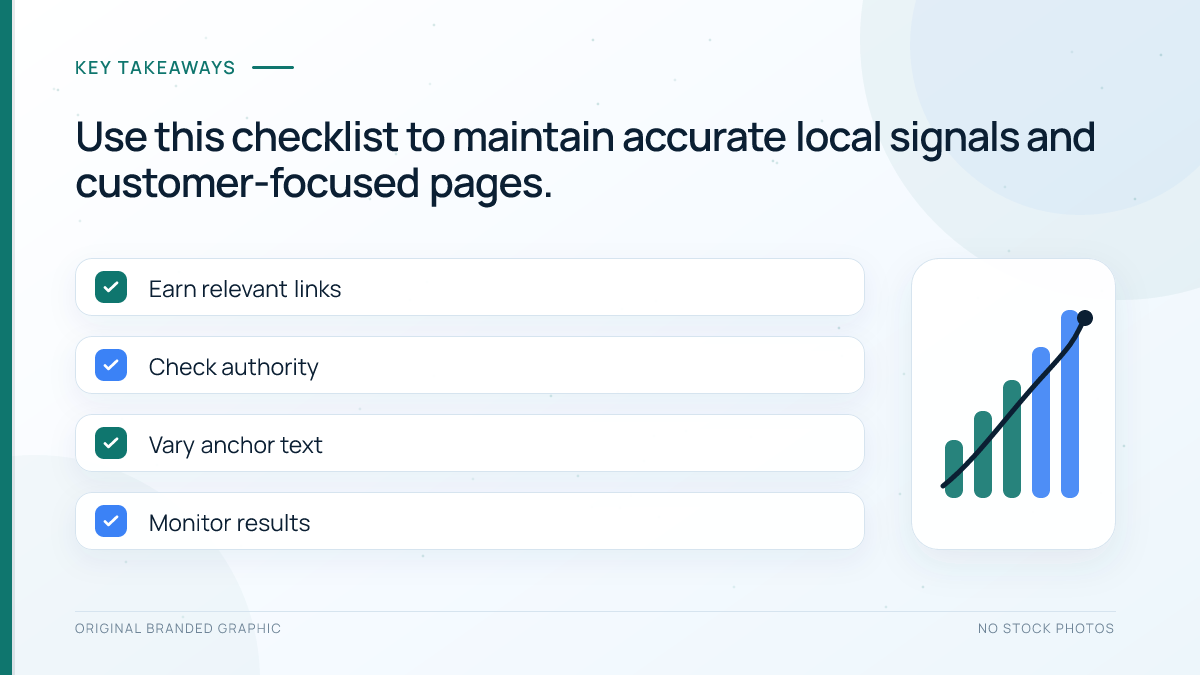
- Use one eligible Business Profile for each genuine location unless Google’s guidelines specifically support another arrangement.
- Keep the real-world business name, address or service area, phone number, categories, hours, and website accurate.
- Choose the most specific primary category that describes the core business.
- Create helpful service and location pages for areas the business genuinely serves.
- Keep important business information consistent across major, relevant platforms.
- Ask real customers for honest reviews and respond professionally.
- Use original photos that accurately represent the location, team, products, or work.
- Earn relevant links and mentions through genuine business and community relationships.
- Add accurate structured data that agrees with visible page content.
- Link related local pages logically so users and crawlers can find them.
- Track calls, bookings, direction requests, qualified leads, and other business outcomes.
- Review profile access and information whenever staff, hours, services, or locations change.
Frequently Asked Questions
Can a service-area business use local SEO without showing a home address?
Yes, an eligible service-area business can hide its address from customers if it travels to serve them and does not receive customers at that address. It should define an accurate service area and follow Google’s representation guidelines. Hiding an address is not permission to create profiles in places where the business has no legitimate operation.
How long does local SEO take to produce results?
There is no universal timeline. Progress depends on competition, proximity, existing reputation, website quality, profile accuracy, and how quickly search engines process changes. Some profile edits may become visible quickly, while meaningful growth can take longer. Measure improvements over consistent periods and focus on qualified customer actions rather than expecting an immediate ranking jump.
Does a local business need a website if it has a Google Business Profile?
A Business Profile can create visibility without a website, but a useful website gives the business more control over its service explanations, location details, trust signals, and conversions. It can also rank in organic results for questions that a profile cannot answer fully. For most established local businesses, the profile and website work better together.
Should every location have its own page?
A genuine customer-facing location usually benefits from a dedicated page when the page provides accurate, location-specific value. Include details such as services, hours, access information, staff, photos, and local contact options. Do not create near-identical pages for towns the business merely hopes to target; pages should represent real operations and help real customers.
Are local citations still useful for SEO?
Accurate citations remain useful because customers and platforms use them to identify and contact a business. Focus on major mapping services, trusted directories, industry platforms, and relevant local organizations. Citation volume alone is not a goal. Correctness, relevance, and maintenance are more valuable than submitting the business to hundreds of low-quality directories.
Does LocalBusiness schema improve local rankings?
LocalBusiness structured data can help search engines interpret details such as business type, address, and hours, but it does not guarantee better rankings or a special search appearance. Treat it as a clarity and eligibility tool. The markup must match visible content, use the correct subtype, and follow Google’s structured-data guidelines.
Conclusion
Local SEO helps eligible businesses connect with customers whose needs are tied to a place. A strong strategy starts with truthful business information, an accurate Google Business Profile, useful local pages, genuine reviews, relevant citations and links, and measurement that reflects real customer outcomes.
The most important lesson is that local SEO is not a collection of shortcuts. Build a clear and consistent representation of the business, explain services better than competing options, and maintain the information customers rely on. Those fundamentals give search engines stronger evidence while making it easier for nearby customers to choose with confidence.