
Quick answer: An AI search content brief is a prewriting plan for one reader task. It defines the reader’s question, evidence, original value, structure, eligibility checks, and success measures. It does not require special AI schema, llms.txt, or separate pages for every query variation.
Key takeaways
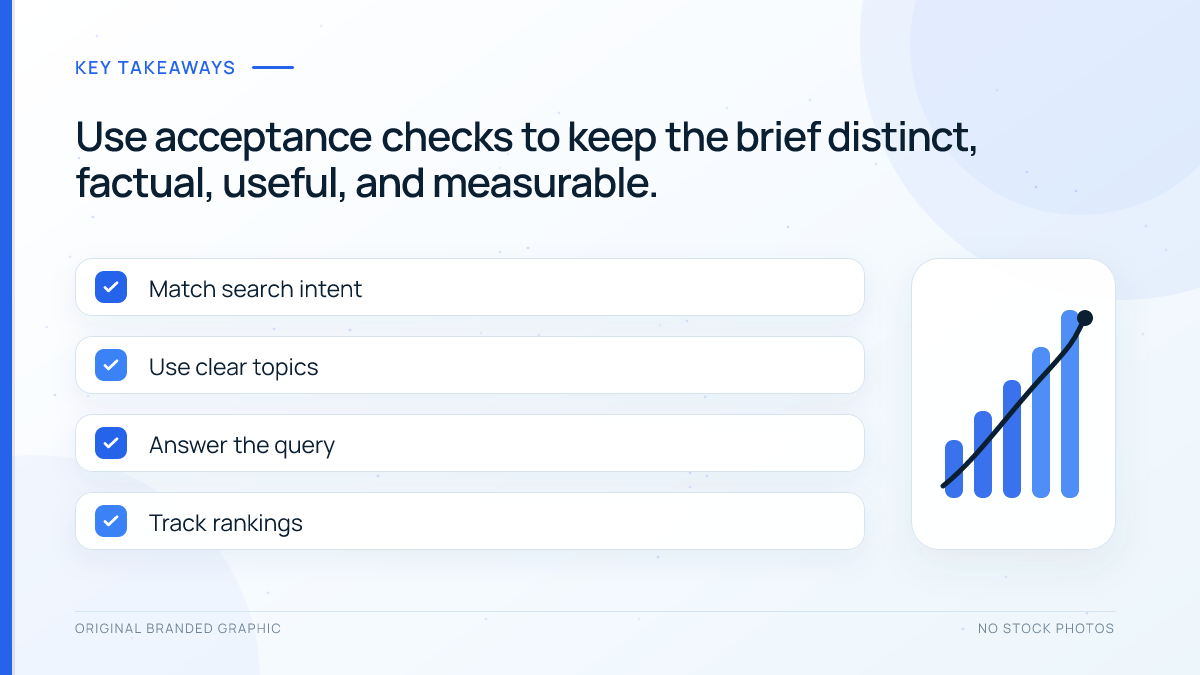
- Start with one reader problem and one useful outcome, not a list of keyword variations.
- Plan evidence, examples, entities, images, internal links, and technical checks before drafting.
- Separate eligibility, content quality, citations, and business outcomes in the measurement plan.
- Treat AI visibility as uncertain: a strong brief can improve the page, but cannot guarantee indexing, citations, or traffic.
What you need before creating the brief
Gather the topic, audience level, intended outcome, current content inventory, and primary documentation. Review existing pages first so the new article does not compete with a page that already satisfies the same intent. A keyword map is useful for assigning one dominant intent to one URL.
You also need a realistic source plan. Google recommends original information or analysis, clear sourcing, and substantial value beyond simply rewriting other pages. Its people-first guidance also says there is no preferred Google word count. Read the current helpful-content self-assessment before using a fixed template.
The seven fields in a useful AI search content brief
| Field | What to record | Acceptance check |
|---|---|---|
| Reader task | One problem and the result the reader needs | A reader can state the outcome in one sentence |
| Scope | Included steps, exclusions, and assumed knowledge | No neighboring article intent is duplicated |
| Evidence | Primary sources and claims each source supports | Important factual claims have a nearby source |
| Original value | A worked example, decision rule, template, or first-party insight | The page adds more than a summary |
| Structure | Direct answer, logical headings, table or checklist, limitations, FAQs | Every section advances the reader’s task |
| Eligibility | Crawl, HTTP, indexability, canonical, snippet, and page-experience checks | The published URL can qualify for search |
| Measurement | Baseline, follow-up dates, and outcome metrics | Metrics do not confuse exposure with visits |
How to create an AI search content brief step by step
1. Write the task statement
Use this format: “Help [audience] complete [specific task] using [constraints].” For example: “Help a WordPress site owner find and repair orphan pages using free tools.” This is stronger than a broad topic such as “internal linking for AI” because it gives the article a finish line.
2. Check intent overlap
Compare the proposed task with every published, draft, scheduled, private, and pending page. Consolidate close variants into one article when the same reader would expect the same answer. Google specifically warns against creating separate pages for many query or fan-out variations primarily to manipulate Search. Its current generative AI optimization guide says the established SEO foundations still apply.
3. Build a claim-to-source map
List only the claims that need verification, then assign a primary source to each. Record the supported point, document date when available, and any limitation. For a repeatable workflow, use the source-audit process for AI search content. Do not cite a source merely because it mentions the topic; it must support the nearby statement.
4. Specify the original contribution
Choose one concrete addition that a generic summary would not provide: an annotated example, a calculation, a decision table, an owner-supplied observation, or a reusable worksheet. Label hypothetical numbers and scenarios as illustrative. Never turn an invented example into a claimed test, result, or client case study.
5. Design the answer path
Place a direct answer near the start, followed by prerequisites, the procedure, a worked example, troubleshooting, limitations, and genuine FAQs. Use descriptive headings and semantic HTML for readers and accessibility. Google says special AI markup and artificial “chunking” are unnecessary; structured data should match visible content and serve a supported Search feature. The existing guide to structuring content for Google AI Overviews can help with readable organization without turning the brief into a citation hack.
6. Add technical publication checks
The brief should require a public URL that returns HTTP 200, does not block Googlebot, and contains indexable content. Those are Google’s minimum technical requirements, but meeting them does not guarantee indexing. Also check the intended canonical, robots directives, mobile rendering, main-content visibility, and whether snippet controls allow the desired preview.
7. Define measurement before publication
Record the baseline and schedule 14-day and 28-day reviews. For Google, use Search Console’s available search and generative-AI performance reporting rather than inferring AI exposure from query wording. For referred visits, GA4’s current default channel rules classify traffic as AI Assistant when the medium is exactly ai-assistant, including when a recognized assistant referrer sets that medium. That measures identifiable visits, not every mention or citation. Use the site’s free AI visibility tracking workflow to keep the signals separate.
Worked example: brief for an orphan-page repair tutorial
This example is illustrative, not a reported experiment. The reader is a WordPress beginner who wants to repair pages with no internal links. The brief assigns one tutorial instead of splitting close query variants.
- Direct answer: explain how to confirm an orphan page, decide whether it deserves support, and add relevant links from published pages.
- Evidence: Google crawling and link guidance, plus current WordPress behavior where relevant.
- Original value: a three-page worksheet showing keep, improve, or retire decisions; retirement remains outside the tutorial unless safely supported.
- Internal links: connect to the broader architecture and internal-linking resources only where they help complete the task.
- Acceptance checks: no duplicate intent, links are contextually useful, factual claims are sourced, the URL is indexable, and the example is clearly labeled.
The draft is ready only when another editor can use the brief without guessing what the article must accomplish.
Troubleshooting a weak brief
- The scope keeps expanding: rewrite the task statement around one deliverable and move secondary questions to internal links or FAQs.
- The outline repeats existing articles: change the task or improve the existing page through the appropriate editorial workflow; do not publish a competing variation.
- No original value is available: request a real example, expert review, screenshot, process record, or first-party data. Do not fabricate experience.
- The plan relies on crawler access alone: distinguish discovery from selection. OpenAI’s crawler documentation says OAI-SearchBot manages ChatGPT search crawling, while GPTBot relates to model training; allowing a crawler does not promise inclusion or a citation.
- The measurement plan says “rank in AI”: replace it with observable signals such as eligible/indexed status, impressions, clicks, identifiable assistant referrals, engaged sessions, and sampled citations with recorded prompts and dates.
Limitations to state in the brief
No content format guarantees a Google AI Overview, AI Mode link, ChatGPT citation, ranking, or referral. AI systems can select different sources for different users and queries. A brief cannot replace eligibility, editorial judgment, genuine expertise, or a useful offering. Treat it as a quality-control document, then revise the published page when evidence shows a real gap.
Frequently Asked Questions
What is an AI search content brief?
An AI search content brief is a prewriting plan that defines one reader task, required evidence, original value, structure, technical checks, and measurement. It guides a useful article without promising AI citations.
Do I need special schema for AI search?
No. Google states that special structured data is not required for its generative AI features. Use supported schema only when it accurately matches visible content and qualifies for a relevant Search feature.
Should I create a page for every fan-out query?
No. Combine close variations when they share the same intent and learning outcome. Create another page only when the reader needs a genuinely different task, depth, or deliverable.
Can an AI tool write the brief?
It can help organize inputs, but a human editor should verify intent, sources, examples, inventory overlap, and claims. Never let the tool invent testing, experience, credentials, or results.
How should I measure the article after publishing?
Track index eligibility, Search Console impressions and clicks, available generative-AI reporting, identifiable AI-assistant referrals, engagement, and business outcomes. Keep mentions, citations, crawler requests, and referred visits as separate signals.
Conclusion
A strong AI search content brief narrows the article to one reader task and makes quality verifiable before drafting begins. Define the intent, map evidence, add a real contribution, plan the answer path, confirm technical eligibility, and choose honest measurements. The result is a clearer article for people and a better-organized source for search systems—without relying on unsupported GEO shortcuts.