
Keyword research becomes much easier when you can separate an attractive search term from a realistic ranking opportunity. Search volume shows how often people search, but it does not tell you how difficult it may be to compete with the pages already ranking. That is where keyword difficulty helps.
This guide explains what keyword difficulty means, how SEO tools estimate it, why scores vary, and how to combine the metric with manual search-results analysis. You will also learn how to choose keywords that fit your website’s current authority, content quality, and resources.
Quick Answer: What Is Keyword Difficulty?
Keyword difficulty is an SEO metric that estimates how challenging it may be for a webpage to rank prominently for a particular search query. Most SEO tools express it as a score, often from 0 to 100. A higher score usually indicates stronger competition, but the calculation and scale differ between tools.
Keyword difficulty is not a Google metric and it is not a guarantee. Treat it as an initial comparison tool, then review the actual search engine results page before deciding whether a keyword is suitable.
Key Takeaways
- Keyword difficulty estimates ranking competition; it does not predict rankings with certainty.
- Different SEO tools can show different scores because they use different databases and formulas.
- Backlinks and domain authority often influence the calculation, but search intent and content quality also matter.
- A good target depends on your website’s strength, topical relevance, and ability to create a better resource.
- Manual SERP analysis should confirm every important keyword decision.
Table of Contents
- How keyword difficulty works
- Why scores vary between SEO tools
- How to interpret keyword difficulty scores
- How to assess ranking difficulty manually
- How to choose realistic keywords
- Common keyword difficulty mistakes
How Does Keyword Difficulty Work?
SEO platforms study the pages currently ranking for a keyword and convert several competitive signals into a simplified score. The purpose is not to describe every ranking factor. It is to help you compare many keyword ideas quickly and identify which ones deserve closer examination.
For example, suppose you discover 100 possible topics through a keyword research process. Reviewing every result page manually would take considerable time. A difficulty score can help you create a shortlist, after which you inspect the most promising search results yourself.
Signals Commonly Used in Keyword Difficulty Calculations
| Signal | What the tool examines | Why it matters |
|---|---|---|
| Backlink strength | The quantity and quality of links pointing to ranking pages | Pages supported by strong links may be harder to displace |
| Domain or website authority | The overall link strength of ranking websites | Established sites may have more trust and ranking history |
| Page authority | The strength of each individual ranking URL | A strong domain can still have a weak page, and vice versa |
| Content relevance | How closely ranking pages satisfy the query | A highly relevant page may outperform a stronger but less useful result |
| SERP composition | Brands, forums, shops, videos, local results, and other result types | The result mix reveals what Google appears to prefer for the query |
Not every platform uses every signal, and most providers do not reveal the complete weighting of their formulas. That is why the number should guide investigation rather than replace professional judgment.
Why Do Keyword Difficulty Scores Vary Between SEO Tools?
Two tools can analyze the same keyword and report noticeably different difficulty scores. This does not necessarily mean one is wrong. Each platform maintains its own backlink index, updates data on a different schedule, and applies a proprietary formula.
Check the provider’s documented method before interpreting its score. For example, Ahrefs explains its keyword-difficulty calculation in terms of linking domains to the top-ranking pages. Do not assume that intent, page usability, or firsthand experience is included in a particular provider’s numerical formula; inspect those factors yourself.
Use one primary tool consistently when comparing keywords within a project. If you switch platforms, do not assume that a score of 30 means exactly the same thing everywhere. Our guide to the best SEO tools for beginners can help you understand how different platforms fit into a beginner workflow.
How Should You Interpret Keyword Difficulty Scores?
There is no universal score cutoff that makes a keyword easy for a new site. Compare scores only within the same provider, country database, and retrieval date. Interpret the metric alongside the actual result pages and your ability to satisfy the reader’s task. The decision table below replaces unsupported generic difficulty bands.
| Observation | What it establishes | Next decision |
|---|---|---|
| The provider reports a lower score than other candidates | A relative estimate within that tool | Check intent and page-level competitors before selecting it |
| No country-specific score or volume is available | Competition and demand are unverified | Record “unknown”; prioritize audience usefulness and collect evidence |
| Leading pages solve a different task | Possible intent mismatch, not proven low competition | Reconsider the query or content format |
| A useful worked example is missing from several relevant results | An observed content gap | Plan an original example without assuming that it ensures ranking |
| Close variants lead to the same reader task | Likely one content opportunity | Group them on one appropriate page rather than creating competing posts |
Illustrative Worked Example: Make a Decision Without Inventing KD
Imagine a small SEO site comparing “what is a canonical tag” with “canonical tag not working.” This is a fictional planning example, not a live SERP test. Suppose a manual review in the intended market finds that the second task needs a clearer diagnostic example. No actual keyword-difficulty or search-volume data is available.
Record the provider, market, and date as “not collected” instead of filling in guessed numbers. Check whether an existing canonical guide can answer the troubleshooting task before planning a new URL. Add the useful diagnostic section to that guide when the intents fit; create a separate page only for a distinct unmet task. Use keyword mapping to document the chosen page and supporting variants.
Keyword Difficulty vs. Keyword Competition
Keyword difficulty estimates organic ranking competition. Google Ads Keyword Planner’s “Competition” field measures advertiser participation for the selected location and network; it is not organic SEO difficulty. Google’s Keyword Planner metric definitions explain that distinction and the settings behind average monthly searches. Paid competition cannot substantiate a “low competition” SEO claim.
A keyword can have high paid competition because it leads to valuable sales while having moderate organic difficulty. Another query may be difficult organically because authoritative educational sites dominate the results, even when advertisers show little interest. Always check which metric a tool is displaying before using it in your SEO plan.
How to Assess Keyword Difficulty Manually
A score can narrow your options, but the current search results show the competition you must actually beat. Follow this process before committing significant time to a target keyword.
1. Search the Exact Query in the Correct Market
Use the country, language, and device most relevant to your audience. Results can differ by location and personalization, so an SEO tool’s neutral SERP view is often more reliable than a casual browser search.
2. Identify the Dominant Search Intent
Look at the types of pages ranking near the top. Are they definitions, tutorials, product pages, category pages, videos, or tools? Your planned page should match the dominant search intent unless you have strong evidence that the results fail to satisfy users.
3. Examine the Strength of Ranking Websites and Pages
Review both domain-level authority and page-level backlinks. Do not abandon a keyword only because large brands appear. A powerful domain may rank with a relatively weak or outdated page, creating an opportunity for a more focused resource.
4. Evaluate Content Quality and Topical Coverage
Read the leading pages. Check whether they answer the query clearly, cover important follow-up questions, use helpful examples, and remain current. Thin explanations, confusing structure, or missing beginner guidance may give you room to compete.
5. Check SERP Features and Result Diversity
AI summaries, featured snippets, videos, local packs, shopping results, and discussion forums affect both ranking opportunity and click potential. A keyword may be rankable but still generate limited traffic if non-organic features occupy most of the visible page.
6. Compare the Opportunity With Your Website
Ask whether your website has relevant supporting articles, truthful expertise, and resources to create something meaningfully useful. Topic clusters and internal links can help readers discover related answers; they do not guarantee rankings. Assess the page’s contribution rather than assuming that more supporting articles automatically improve authority.
How to Choose Realistic Keywords Using Difficulty
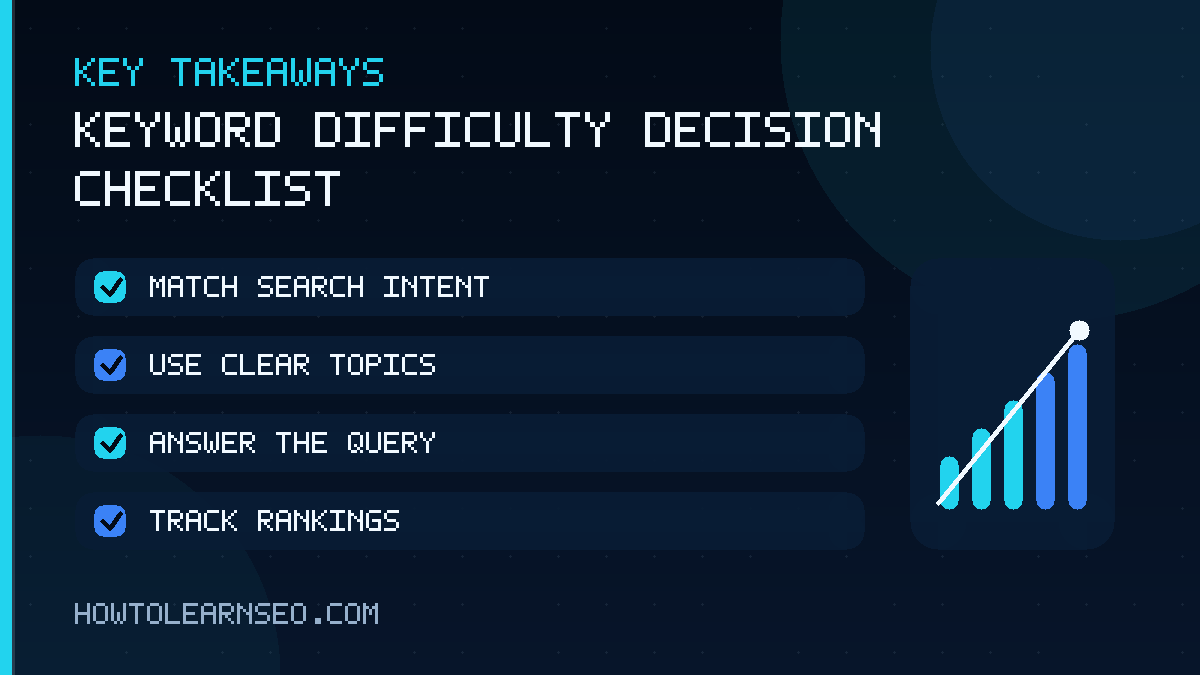
Start by grouping keywords according to intent and topic rather than sorting the entire list by difficulty alone. Within each group, compare search demand, business or educational value, relevance, and the effort required to create the best suitable page.
- New websites: Begin with specific questions and narrowly defined topics where the current results are weak or only partially relevant.
- Growing websites: Mix lower-difficulty opportunities with a smaller number of medium-difficulty topics that strengthen important clusters.
- Established websites: Pursue more competitive terms when the site has genuine authority, supporting coverage, and a clear reason to deserve visibility.
- All websites: Keep some strategic high-difficulty targets in a long-term roadmap instead of ignoring them permanently.
Choose topics that fill genuine gaps and support the site’s purpose. A lower tool score does not guarantee early traffic, faster indexing, or authority growth. Record the evidence, intended page, and review date so later results can inform the plan.
What Keyword Difficulty Cannot Tell You
Keyword difficulty does not tell you whether a query is valuable to your audience, whether your content matches the correct intent, or whether searchers will click an organic result. It also cannot fully measure your first-hand expertise, brand recognition, content usability, or the unique strength of your topical coverage.
The metric may also miss a rapidly changing SERP. New pages, fresh links, algorithmic changes, and shifting user behavior can alter the competitive landscape after a tool calculates its score. Use the score as a snapshot, not a permanent label.
Common Keyword Difficulty Mistakes
- Treating the score as a guarantee: Low difficulty does not guarantee a ranking, and high difficulty does not make ranking impossible.
- Comparing scores from different tools directly: Each tool uses its own scale and calculation.
- Ignoring search intent: A perfectly optimized tutorial will struggle when Google primarily shows product pages.
- Looking only at domain authority: Relevance, page quality, page-level links, and result format also matter.
- Choosing only low-difficulty keywords: This can produce a scattered site with little strategic value.
- Skipping manual SERP analysis: The score cannot show every weakness or opportunity visible in the actual results.
Keyword Difficulty Best Practices
- Use difficulty to compare keywords within the same tool and database.
- Confirm important decisions by reviewing the top-ranking pages manually.
- Evaluate the page-level competition, not only the strength of each domain.
- Match the content format and purpose to the dominant search intent.
- Consider topical relevance and existing internal-link support.
- Recheck priority keywords periodically because search results change.
- Balance achievable opportunities with strategically important long-term targets.
Frequently Asked Questions About Keyword Difficulty
Is keyword difficulty a Google ranking metric?
No. Keyword difficulty is a third-party SEO metric created by tool providers to estimate organic competition. Google does not publish a keyword difficulty score or use a tool’s score as a ranking factor. The metric summarizes selected competitive signals, so it should support your research rather than be treated as an official Google measurement.
What is a good keyword difficulty score?
A good score is one that fits your website’s current strength and the quality of the competing results. A new site may prioritize lower scores, while an established specialist site may compete successfully at higher levels. Because scales differ between tools, compare opportunities inside the same platform and confirm them through manual SERP analysis.
Can a new website rank for a high-difficulty keyword?
It is possible, but it is usually a long-term challenge. A new website would need exceptional relevance, useful content, credible expertise, supporting topic coverage, and often strong links. Building authority through more specific and achievable topics first can create a stronger foundation for pursuing the competitive keyword later.
Why does the same keyword have different difficulty scores in different tools?
Each SEO platform uses its own backlink database, authority metrics, update schedule, and calculation. One may emphasize referring domains, while another gives more weight to the authority of ranking websites. Use one tool consistently for comparisons and avoid translating a score directly from one platform to another.
Should I target only low-difficulty keywords?
No. Targeting only easy terms can limit your topical coverage and lead to articles with little value for your audience. Use lower-difficulty opportunities for achievable growth, but also build supporting content around important medium- and high-difficulty topics. The right mix depends on your authority, goals, and resources.
Does keyword difficulty change over time?
Yes. Difficulty can change as new pages enter the results, existing pages gain or lose backlinks, search intent shifts, and tools refresh their databases. Recheck important keywords before creating content and revisit strategic targets periodically, especially when an older analysis no longer resembles the current SERP.
Conclusion
Keyword difficulty helps you compare ranking opportunities, but the score is only the beginning of the decision. Use it to filter and prioritize ideas, then examine search intent, ranking-page strength, content quality, SERP features, and your own topical authority.
The most useful keyword is not always the one with the lowest score. It is the one that serves your audience, fits your website’s current capabilities, and contributes to a coherent long-term SEO learning path.