This Semrush review examines keyword research, competitor analysis, backlinks, technical auditing, pricing, and alternatives. Semrush can accelerate SEO research, but its estimates must be interpreted carefully and verified before turning them into website changes.
Quick Answer
Semrush is a research suite for discovering keywords, examining search competitors, auditing sites, reviewing backlinks, and monitoring rankings. It is valuable when those investigations lead to concrete publishing or technical decisions. Its estimates are not a competitor’s actual analytics, and no score guarantees rankings. Test a small set of real SEO tasks, compare the results with first-party evidence, and verify the current plan limits before subscribing. A subscription is worthwhile only when it saves meaningful time or improves decisions that your team can implement.
Key Takeaways
Semrush offers an integrated workflow rather than a substitute for editorial judgment. Keyword volumes and modeled traffic are estimates. Site Audit findings require verification. Position Tracking must be configured for relevant locations and devices. Compare Semrush with Ahrefs and dedicated crawlers using identical tasks, not screenshots or marketing claims. Evaluate current pricing, project allowances, exports, and access for collaborators. The most useful output is a prioritized action plan with owners and measurable verification, not a large collection of dashboard charts.
What Semrush Actually Does
Semrush combines tools for organic search research, competitor analysis, technical crawling, position monitoring, and backlink investigation. Depending on the product and subscription, additional marketing and AI-search functions may be available. These features answer different questions. Keyword research suggests what people might search; competitor research identifies pages that appear for those queries; auditing surfaces crawlable technical issues; position tracking monitors chosen searches under configured conditions. None of these tools edits your website automatically or guarantees search performance. A useful review therefore judges whether the findings improve decisions. A small site may need only Search Console and a focused crawler, while an agency may value having several research tasks in one environment.
Who Benefits Most
Content teams planning multiple topic clusters, agencies researching several markets, and in-house SEO specialists investigating competitors have plausible use cases. Their requirements are not identical. A content strategist needs relevant topics and intent evidence; a technical specialist needs reproducible crawl findings; an account manager needs defensible reports. A solo business owner with a handful of pages may have more urgent implementation work than research work. Write down who will use the tool, how often, and which deliverables must result. If nobody owns the recommendations, an expensive platform can become a reporting habit rather than an improvement system. For each recommendation, record the source, date, market setting, decision owner, and what would disprove the hypothesis. This lightweight evidence log helps colleagues reproduce the finding and prevents modeled numbers from being mistaken for measured business outcomes. Review unresolved actions before collecting another batch of data.
Define a Fair Evaluation
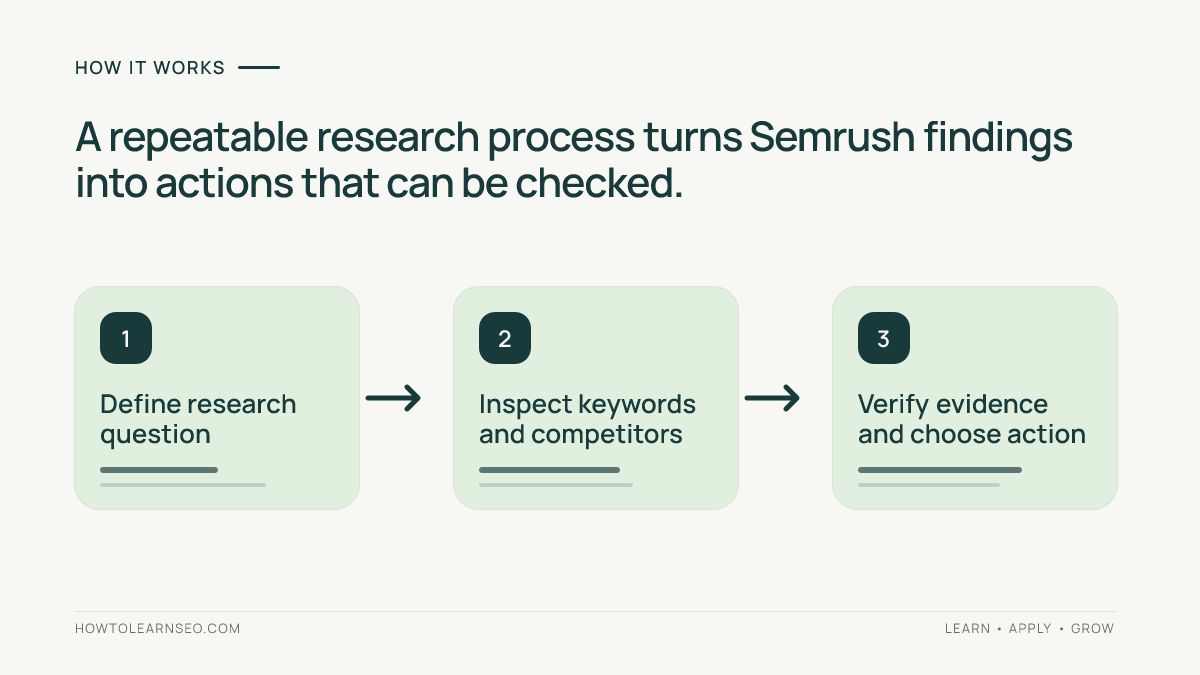
Before opening Semrush, choose one website, one target country, and five tasks. For example: discover ten relevant queries, identify three organic competitors, examine five referring pages, reproduce one technical issue, and prepare one actionable content brief. Record the time spent, useful discoveries, missing data, export limitations, and decisions made. Use the same tasks when evaluating alternatives. Do not mistake this suggested evaluation procedure for hands-on testing conducted for this review. A fair trial is reproducible: another analyst should be able to follow the same filters and understand why a candidate keyword or technical issue was selected.
Keyword Magic Tool: Start With Intent
Enter a seed phrase related to a customer problem and choose the relevant regional database. Semrush’s Keyword Magic Tool documentation describes match types, keyword groups, questions, intent labels, and filtering. Begin broadly, then narrow the list to phrases that match your products, services, and expertise. Review the actual results page before choosing a content format. A commercial query may favor service pages, while an informational question may favor a tutorial. Group synonyms with the same intent instead of creating a separate URL for every variation. The existing keyword research guide explains how to turn these discoveries into a sensible page plan. For each recommendation, record the source, date, market setting, decision owner, and what would disprove the hypothesis. This lightweight evidence log helps colleagues reproduce the finding and prevents modeled numbers from being mistaken for measured business outcomes. Review unresolved actions before collecting another batch of data.
Understand Volume and Difficulty
Search volume is an estimate based on a provider’s data and methods, not a guaranteed number of future visitors. Keyword difficulty is a proprietary assessment, not Google’s ranking formula. Both can guide prioritization, but neither replaces checking the live search results. Compare the intent, quality, and relevance of the pages already ranking. Consider whether your site can offer genuinely useful evidence or a clearer answer. A lower-volume phrase with strong commercial relevance may be more valuable than a popular question with little connection to your business. For an existing page, compare the opportunity with first-party Search Console impressions. When reliable numbers are unavailable, record uncertainty rather than inventing a forecast.
Keyword Groups and Topic Clusters
Related queries can form a topic cluster, but clustering requires human review. Identify the primary reader job and decide whether several terms deserve one comprehensive page or separate pages with genuinely different purposes. For instance, a bookkeeping service query and a general definition of bookkeeping may require different destinations. A near-synonym probably does not. Create a mapping table with target query, intent, existing URL, planned action, and verification method. Mark ambiguous cases for manual SERP inspection. This prevents a keyword export from turning into dozens of thin articles. The goal is a coherent learning or service journey, supported by useful internal links, not maximum URL count. For each recommendation, record the source, date, market setting, decision owner, and what would disprove the hypothesis. This lightweight evidence log helps colleagues reproduce the finding and prevents modeled numbers from being mistaken for measured business outcomes. Review unresolved actions before collecting another batch of data.
Organic Competitor Research
Search competitors are the sites competing for relevant results, not necessarily the businesses competing for customers. A specialist firm might encounter directories, government resources, publishers, and direct service providers. Use competitor research to find recurring ranking domains and pages, then verify their relevance in your market. Compare what each page actually helps readers accomplish: explanations, pricing factors, evidence, demonstrations, or next steps. Avoid copying headings or treating modeled competitor traffic as a verified analytics total. Instead, identify where your existing content fails to answer an important question. A concrete improvement to one relevant page is often better than publishing a redundant competitor-inspired article.
Keyword Gap: Filter Before Publishing
A keyword gap highlights searches associated with competitors that your site may not cover. It is a discovery list, not an automatic editorial calendar. Remove irrelevant branded queries, mismatched locations, and terms outside your expertise. Check whether an existing page already answers the intent; a tool’s missing-keyword report does not prove that a new URL is necessary. Choose between refreshing a page, adding a section, improving internal links, or creating distinct content. Document the decision in a practical content brief. This protects against keyword cannibalization and keeps the editorial backlog focused on reader needs rather than database size. For each recommendation, record the source, date, market setting, decision owner, and what would disprove the hypothesis. This lightweight evidence log helps colleagues reproduce the finding and prevents modeled numbers from being mistaken for measured business outcomes. Review unresolved actions before collecting another batch of data.
A Reproducible Bookkeeping Example
Imagine a fictional bookkeeping firm serving small businesses. It has service pages for payroll, tax preparation, and monthly bookkeeping. The team enters bookkeeping-related seeds, selects its country, and filters for commercial intent. One candidate concerns monthly bookkeeping for small companies. The visible results favor service pages that describe deliverables, onboarding, and pricing factors. Because the firm already has a suitable service URL, the action is to improve that page rather than publish a duplicate. The input is a seed-query list and current URL; the rule is intent alignment; the output is a prioritized content brief. Verification comes from checking the updated live page and later comparing relevant Search Console queries. If local map results dominate, local visibility requires separate attention.
How to Judge That Example
The immediate result of the example is a better decision, not a guaranteed ranking increase. Record the existing page’s baseline impressions, clicks, and conversions where configured. Save the competitor URLs and the date of inspection. After updating the service page, verify that its headings, navigation, and relevant internal links work as intended. Annotate the change date and review performance over a suitable period. If impressions decline, investigate indexing, seasonality, query mix, and other site changes before attributing the result to one edit. If performance improves, avoid claiming causation without evidence. This separation between research outputs and business outcomes makes Semrush reporting more credible.
Site Audit: Scope Comes First
Site Audit crawls pages under a configured scope and reports potential technical problems. Define the correct hostname, subdomains, URL patterns, crawl limits, and access conditions before interpreting results. Consider robots rules, redirects, canonical URLs, and important templates such as products, categories, articles, and pagination. For a large site, use representative sections or a carefully planned crawl. Compare findings with the sitemap and Search Console. The complete SEO audit guide explains the wider process. A third-party crawler reports what it encountered under its configuration; it does not reveal every decision Google’s indexing systems make. Keep crawl settings consistent across repeated audits. For each recommendation, record the source, date, market setting, decision owner, and what would disprove the hypothesis. This lightweight evidence log helps colleagues reproduce the finding and prevents modeled numbers from being mistaken for measured business outcomes. Review unresolved actions before collecting another batch of data.
Prioritize Audit Findings
A dashboard may show hundreds of warnings, but they do not all warrant immediate engineering work. Start with important pages that are unexpectedly blocked, broken, non-indexable, incorrectly canonicalized, or difficult to reach through internal navigation. Group similar symptoms by root cause. A template-level problem can affect many URLs, while a warning on an intentionally excluded login page may need no change. For each confirmed issue, record the affected URL, observed behavior, expected behavior, reproduction steps, and verification method. Ask developers to fix the cause rather than individual examples when appropriate. Rerun the relevant crawl and check the live response after deployment. A useful audit produces resolved issues, not merely exported alerts.
Position Tracking and Geography
Position Tracking monitors chosen keywords according to configured search engines, devices, and locations. The official Position Tracking guide describes these settings and their plan-dependent availability. Choose queries tied to important customer journeys and separate branded from nonbranded terms. A tracked position is a measurement under defined conditions, not a universal rank seen by every searcher. Local results can vary substantially by area and device. Record a baseline, annotate major changes, and examine longer-term patterns. Compare tracked visibility with first-party clicks and impressions where possible. A small ranking movement without relevant traffic or business impact should not dominate the monthly report. For each recommendation, record the source, date, market setting, decision owner, and what would disprove the hypothesis. This lightweight evidence log helps colleagues reproduce the finding and prevents modeled numbers from being mistaken for measured business outcomes. Review unresolved actions before collecting another batch of data.
Backlink Analytics: Verify Sources
Backlink reports can help identify referring domains, linking pages, anchors, and patterns worth investigating. They are research leads rather than direct measures of Google’s evaluation. Inspect actual referring pages, check that links exist, and consider whether their context benefits readers. A relevant editorial citation may matter more to your outreach strategy than many unrelated directory links. Proprietary authority metrics are not Google ranking scores. A sudden change in a link graph may reflect crawling or index updates as well as real site changes. Keep verified observations separate from hypotheses, especially when advising clients about lost links or apparent competitor gains.
Backlink Gap and Outreach
A backlink gap may reveal sites that cite competitors but not your website. Qualify those prospects editorially before outreach. Ask whether the publication serves a relevant audience and whether you have something genuinely useful to contribute, such as original research, a helpful guide, or a legitimate community resource. Avoid purchased links, irrelevant directories, and bulk requests based solely on proprietary scores. The community partnership backlink guide offers a grounded approach for local organizations. Record the prospect, audience relevance, proposed resource, and actual outcome. Finding a referring domain in a database does not mean it will link to you or improve rankings. For each recommendation, record the source, date, market setting, decision owner, and what would disprove the hypothesis. This lightweight evidence log helps colleagues reproduce the finding and prevents modeled numbers from being mistaken for measured business outcomes. Review unresolved actions before collecting another batch of data.
Content Recommendations Need Editing
Content-oriented features can help organize topics and suggest questions or terms, depending on the subscribed product. Treat these as editorial prompts rather than mandatory keyword quotas. A recommendation to add a phrase may be irrelevant if it changes the page’s intent or creates repetition. Check factual claims against authoritative sources and explain the reader’s task with original examples. A distinct senior editing pass should remove unsupported assertions, improve transitions, and confirm that every section adds new value. A content score is not Google’s grade, and maximizing it does not guarantee visibility. Good content earns its place by answering the question accurately and helping readers act.
Reporting for Stakeholders
A useful SEO report begins with the decision made and the evidence supporting it. State the target market, date, research question, observed finding, recommended action, owner, and verification method. Distinguish first-party facts from third-party estimates and strategic judgments. For example, a competitor page visibly explains onboarding better; Semrush estimates demand for the topic; the team recommends improving an existing service page; Search Console will monitor later performance. Include source URLs and relevant settings so another analyst can reproduce the reasoning. Avoid exact revenue forecasts derived only from search volume. A manager should leave knowing what will change and why, not merely which dashboard has the most charts. For each recommendation, record the source, date, market setting, decision owner, and what would disprove the hypothesis. This lightweight evidence log helps colleagues reproduce the finding and prevents modeled numbers from being mistaken for measured business outcomes. Review unresolved actions before collecting another batch of data.
Semrush Versus Google Search Console
Google Search Console supplies first-party search performance and indexing information for a verified property. Semrush provides third-party research into broader markets and competitors. These are complementary roles. Search Console can show impressions and clicks for your site, but it does not disclose a competitor’s private analytics. Semrush can model competitor visibility, but those estimates are not their actual organic sessions or conversions. Use the official Search Console overview to understand the first-party source. A sound workflow uses Semrush to develop hypotheses and Search Console to assess what happens on your own pages. Keeping these data types separate prevents misleading client reports.
Semrush Versus Ahrefs
Both Semrush and Ahrefs offer major SEO research workflows, including keyword discovery, competitor investigation, and backlink analysis. Their datasets, interfaces, plan allowances, and bundles can differ. A fair comparison uses the same website, country, queries, and tasks. Record the relevance of results, time needed, export access, and current total cost. Read the existing Ahrefs review for the companion evaluation. Do not declare a universal winner from an isolated database-size claim or one impressive report. The best platform is the one that consistently helps your team make and implement better decisions within its budget. For each recommendation, record the source, date, market setting, decision owner, and what would disprove the hypothesis. This lightweight evidence log helps colleagues reproduce the finding and prevents modeled numbers from being mistaken for measured business outcomes. Review unresolved actions before collecting another batch of data.
Semrush Versus Screaming Frog
Screaming Frog SEO Spider is a dedicated desktop crawler for detailed URL-level technical investigation. Semrush Site Audit is part of a broader research environment. Both can surface crawl problems, but their configuration, exports, and workflows differ. A technical specialist may prefer granular crawling controls, while a cross-functional team may value integrated dashboards and reporting. The Screaming Frog review explains that crawler in more detail. Some organizations use both for separate tasks. Test the exact diagnostics your developers require, especially for redirects, canonicals, and template-driven websites, before choosing.
Pricing and Plan Entitlements
Semrush subscription tiers, product bundles, and usage limits can change. Verify current amounts and inclusions on the official pricing page instead of trusting a static article’s price table. Check tracked keywords, projects, exports, users, historical data, and whether the desired feature requires an additional toolkit or add-on. Consider training time and the number of people who need access. Estimate the monthly workload that the subscription will actually support. A higher tier is not automatically better if its extra capacity is unused. If your team only needs an occasional technical audit, compare that need with a dedicated tool or existing resources.
A Five-Task Trial Scorecard
Evaluate the tool against five outputs: ten relevant queries, three genuine organic competitors, five manually checked referring pages, one reproducible technical finding, and one actionable content brief. Score each task for usefulness, time, clarity, and limitations. Use identical targets for competing products. If a needed feature is unavailable on the tested plan, mark it untested rather than assuming it performs poorly. Ask a colleague to follow one recommendation without extra explanation. If they cannot identify the next action and how to verify it, the report needs improvement. This framework is a proposed evaluation, not a claim of hands-on experiments performed for this review. For each recommendation, record the source, date, market setting, decision owner, and what would disprove the hypothesis. This lightweight evidence log helps colleagues reproduce the finding and prevents modeled numbers from being mistaken for measured business outcomes. Review unresolved actions before collecting another batch of data.
Common Interpretation Mistakes
Avoid treating authority scores or keyword difficulty as Google ranking factors. Do not present estimated competitor traffic as an audited total. Do not publish every term from a keyword-gap export without checking existing page coverage. Do not forward crawl warnings to developers without reproducing them. Do not infer business growth from a one-position ranking change. These mistakes all confuse research signals with validated outcomes. Attach a decision, evidence source, and verification method to every important finding. A smaller, carefully reviewed set of recommendations is more useful than a huge report with no clear owner.
A Monthly Semrush Workflow
Start each month with first-party performance and outstanding action items. Use Semrush to investigate a few relevant competitor changes and content gaps. Choose opportunities that match the site’s expertise and have distinct destination pages. Run a scoped technical crawl and group issues by root cause. Manually review important backlink changes. Assign actions to content or engineering owners and record expected verification. At month’s end, review what was actually implemented before generating more research. A growing backlog may indicate an execution bottleneck rather than insufficient keyword ideas. Keep modeled metrics separate from measured business outcomes. For each recommendation, record the source, date, market setting, decision owner, and what would disprove the hypothesis. This lightweight evidence log helps colleagues reproduce the finding and prevents modeled numbers from being mistaken for measured business outcomes. Review unresolved actions before collecting another batch of data.
When Not to Buy Semrush
A small site with little implementation capacity may gain more from improving existing pages, fixing navigation, and setting up Search Console correctly. A team needing only deep crawling may prefer a dedicated crawler. An organization already paying for another suite should identify a specific unmet need before adding overlapping subscriptions. If nobody can interpret or act on the reports, another platform will not solve the process problem. Choose the smallest toolset that supports recurring, defensible decisions. Reevaluate when the website, team, or competitive environment changes.
Final Buying Checklist
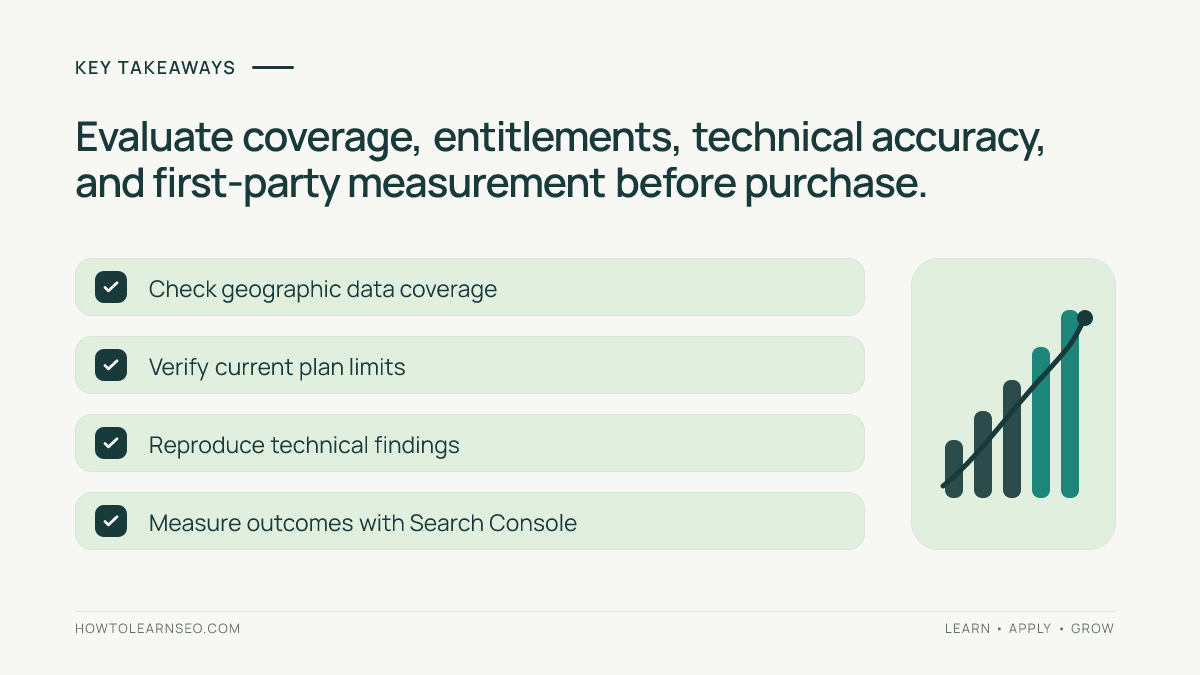
Confirm coverage for your country and industry, run your five real tasks, verify current entitlements, and check export and collaboration requirements. Inspect source pages behind link findings and reproduce important crawl issues. Establish a first-party baseline before making changes. Define what success means: research hours saved, better prioritization, or technical problems resolved. Decide in advance what would justify renewing, downgrading, or canceling. The right purchase should improve repeatable work, not simply expand the number of dashboards your team can open. For each recommendation, record the source, date, market setting, decision owner, and what would disprove the hypothesis. This lightweight evidence log helps colleagues reproduce the finding and prevents modeled numbers from being mistaken for measured business outcomes. Review unresolved actions before collecting another batch of data.
Frequently Asked Questions
Is Semrush worth it for a small website?
It depends on recurring research needs and implementation capacity. Start with Search Console and a defined evaluation task before paying for a subscription.
Can Semrush show a competitor’s exact organic traffic?
No. Competitor traffic numbers are modeled estimates, not access to another website’s private analytics or Search Console account.
Does a high Semrush Authority Score guarantee rankings?
No. Authority Score is a proprietary research metric, not a Google ranking score or a guarantee of organic visibility.
Can Semrush replace Google Search Console?
No. Search Console provides first-party information for verified properties; Semrush offers complementary third-party market and competitor research.
Is Semrush always better than Ahrefs?
No. Compare the products using identical real tasks, current plan entitlements, geographic coverage, reporting needs, and total costs.
Should every Site Audit warning be fixed?
No. Reproduce the issue, determine whether the behavior is intentional, and prioritize problems affecting important pages before changing the website.
Conclusion
Semrush can be valuable when its research consistently improves the decisions your team makes and implements. Test actual workflows, verify plan limits, separate estimates from first-party facts, and prioritize useful outcomes over impressive dashboards. Choose the subscription only when its benefits justify the ongoing cost.