An SEO content brief is the practical bridge between keyword research and a trustworthy article. It tells a writer who the page serves, what decision or task it must help with, which claims require evidence and how the finished page fits the website. A strong brief prevents repetitive outlines and invented expertise without prescribing every sentence in advance. This guide gives a reproducible briefing method and review checklist.
Quick Answer
Create an SEO content brief by defining one primary search intent, the reader’s starting knowledge, the concrete expected outcome, the page’s unique scope, reliable sources and relevant existing internal links. List essential questions and a recommended content format, then agree on success and fact-checking requirements. This is a human-centered editorial planning workflow; our separate AI search content brief guide addresses a narrower generative-search use case.
Key Takeaways
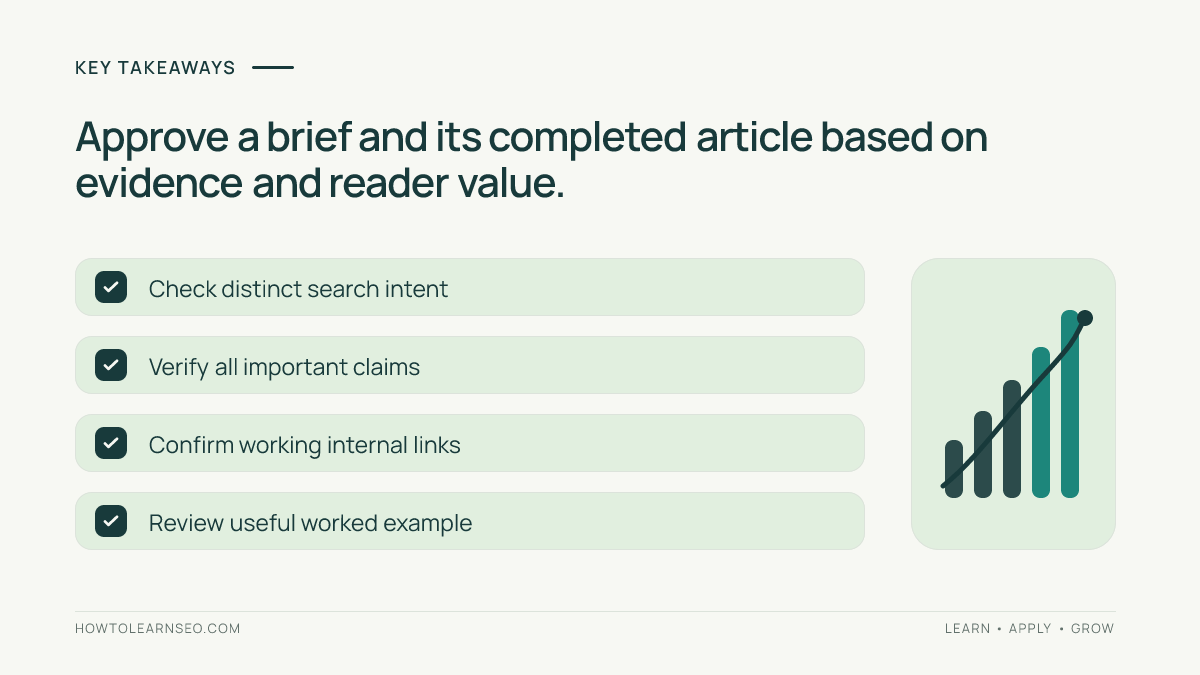
- Begin with the reader’s task, not a long list of keyword variations.
- Record what the site already covers to prevent duplicate intent.
- Specify useful evidence, examples and verification requirements.
- Allow article structure to reflect the question being answered.
- Review the finished page against the brief rather than counting headings.
Define the reader and one dominant task
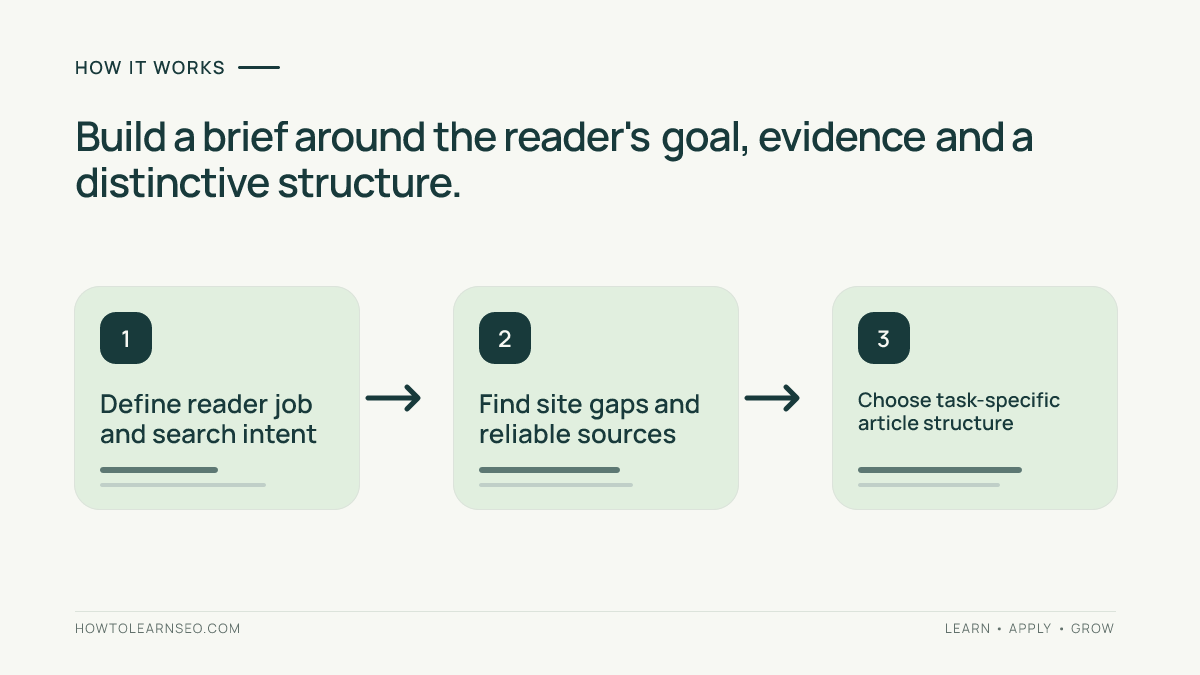
Start with a one-sentence job statement: “A first-time shop owner needs to decide which product categories deserve separate pages.” This is more useful than “write about ecommerce SEO.” Note what the reader likely knows, which terms need explanation and which action should be possible after reading. A definition guide, troubleshooting article and comparison should have different structures because their readers need different outcomes.
Choose a working primary keyword from research, but separate verified search-volume numbers from qualitative assumptions. Use related queries and customer questions as clues about the task, not obligations to include every phrase. Our keyword research workflow explains how to find relevant subjects. If demand data is unavailable, write down that limitation rather than inserting a made-up estimate into the brief.
Set boundaries using the site’s existing content
List the most relevant published pages and identify what the proposed article will contribute. A website with a complete guide to local SEO may still need a branch-location checklist; it probably does not need another near-identical “complete local SEO guide.” State which questions are out of scope and should be answered by existing pages. This protects the new article from expanding into a confusing encyclopedia entry.
Use a simple intent map: primary question, supporting questions, neighboring articles and links that help the reader continue. Our keyword mapping guide explains assigning distinct intentions to URLs. For a large website, review drafts and pending content as well as published posts. A clever change of title cannot eliminate cannibalization if two articles still promise exactly the same outcome.
Identify the evidence the article must actually provide
For technical subjects, specify official documentation, test inputs and expected outputs. For comparisons, name the decision criteria and how each option will be evaluated. For process guides, identify prerequisites, steps, verification and important edge cases. An article should not claim that a particular tool was tested unless an actual test occurred. The brief can request an illustrative example, but it must be labeled as such and should never contain invented traffic results.
Google’s people-first content guidance asks whether content offers original analysis, reliable sources and a satisfying answer. Translate that into specific instructions such as “show a worked URL classification table” rather than “add E-E-A-T.” Document which claims need a subject-matter reviewer, especially for legal, health or changing product instructions. Credibility comes from verifiable substance, not an authoritative voice alone.
Choose a format that matches the answer
A buyer deciding between two tools benefits from a comparison table and tradeoffs. A developer repairing an indexing problem needs a diagnostic sequence, example responses and rollback considerations. A beginner learning canonical tags may need a definition and visual explanation. Do not give every topic the same collection of broad headings simply because a publishing prompt contains a standard template. Preserve consistent navigation while letting the main teaching structure vary.
Suggest the page’s key sections in plain language and explain what evidence belongs under each. Allow the writer to reorganize the sections if research reveals a clearer order. Use tables only when side-by-side information genuinely helps, and do not require a fixed number of numbered steps. The goal is an answer that feels designed for its subject instead of a generic machine-generated SEO article.
Worked example: a comparison brief for product categories
Input: Imagine a fictional retailer asking whether “running shoes” should be one category or split into “trail running shoes” and “road running shoes.” The website currently has one mixed category and a separate general ecommerce SEO guide. Search-volume estimates are unavailable. This is an illustrative planning case, not an actual keyword study.
Brief instructions: Target the decision-making task “when to create a product subcategory.” Ask the writer to compare distinct customer use cases, inventory depth, discoverable navigation and maintenance costs. Require a table with two proposed structures, a realistic internal-link path, an edge case where a small assortment does not justify splitting, and citations to Google’s ecommerce navigation documentation. Exclude generic advice already covered by the sitewide guide.
Expected output: A reader can evaluate whether the assortment supports a new subcategory. Verify: Check that the draft answers the decision, that the example states its assumptions and that links lead to existing relevant pages. Edge case: If all eight items have identical intent, the brief should allow a single useful collection rather than forcing two thin pages to target more keywords.
Prepare links, visuals and metadata without overfitting
Identify three to six genuinely useful internal destinations and describe why each link serves the reader. For an article about category structure, the website architecture guide may explain hierarchy and the on-page SEO guide may provide complementary page-level guidance. Avoid links inserted only to hit a numeric target; every anchor should make sense within the paragraph.
A visual brief might call for a three-stage decision flow or a checklist rather than a generic decorative illustration. Define the information the diagram must communicate, its alt text and where it belongs in the article. Set a provisional title and meta description only after clarifying the page’s main point; Google can generate different title links and snippets, so no wording guarantees a click-through rate.
Review the completed article against the original job
Ask a separate editor to evaluate whether the promised reader outcome is achieved, not merely whether the writer obeyed the outline. Check factual claims against sources, test any instructions that claim an observed result, verify links and remove repetition. Return a specific revision request if an example lacks an input or a conclusion makes unsupported promises. The review should add clarity and judgment without flattening the writer’s structure into generic prose.
Once published, inspect the queries and pages in Search Console after enough data has accumulated. Relevant impressions and engagement may show that the intent was matched, while repeated irrelevant queries can suggest that the page sends mixed signals. Record what was learned for the next brief without rewriting the editorial policy around a single week’s results. A useful system improves through evidence and expert review.
Frequently Asked Questions
What is an SEO content brief?
An SEO content brief is a working plan defining a page’s reader, search intent, scope, evidence needs, internal links and expected outcome before drafting begins.
Does an SEO content brief need a keyword density target?
No. A useful brief focuses on intent, topic coverage and factual accuracy rather than prescribing an arbitrary repetition percentage.
Who should approve the brief?
Ideally the content strategist and a subject-matter reviewer approve its purpose, sources and important claims before a writer starts.
How many keywords should one article target?
Choose one clear primary intent and relevant supporting terms. Multiple phrases are acceptable when they help answer the same task rather than creating conflicting purposes.
Should the writer copy competitor headings?
No. Competitor pages may reveal common questions, but the brief must use original structure, verified information and a distinct useful perspective.
How do you judge whether the brief succeeded?
Check whether the finished page answers the defined reader task, passes an evidence review and later attracts relevant queries and useful engagement.
Conclusion
An SEO content brief should help writers produce a distinct answer that readers can act on. Define the task, clarify the page’s boundaries, identify trustworthy sources and choose a fitting structure. Treat keywords as evidence about demand and language, not a script to repeat. The resulting article should demonstrate useful understanding rather than merely satisfy a template.