
A website can contain excellent pages and still make them difficult to discover. If important content sits behind confusing menus, inconsistent categories, weak internal links, or countless duplicate URLs, visitors may struggle to find it and search engines may struggle to understand how it fits together.
Website architecture for SEO solves that problem by arranging pages into a clear hierarchy and connecting them through useful, crawlable paths. It is the structural layer beneath navigation, URLs, categories, breadcrumbs, topic hubs, and internal links.
This guide explains how SEO site architecture works, why it matters, how to design it for different types of websites, and how to audit an existing structure without reorganizing everything unnecessarily.
Quick Answer: What Is Website Architecture for SEO?
Website architecture for SEO is the way a site’s pages are organized, grouped, named, and linked so that people and search engines can understand their relationships and reach important content efficiently. A strong architecture usually has a logical hierarchy, descriptive navigation, crawlable internal links, useful category or hub pages, consistent URLs, breadcrumbs, and few orphan pages.
Site architecture is part of technical SEO, but it is not purely technical. It also reflects how visitors think about the subject. The best structure connects a clear information model with the journeys people actually take.
Key Takeaways
- Good architecture helps visitors find information and helps search engines discover and contextualize pages.
- A hierarchy should reflect real topics and user tasks, not an arbitrary desire to place every page at the same depth.
- Navigation, contextual internal links, breadcrumbs, categories, URLs, and sitemaps serve different purposes and should support one another.
- Important pages should receive clear, crawlable links from relevant pages rather than depending only on an XML sitemap.
- Shallow architecture is useful when it reduces unnecessary steps, but there is no universal “three-click rule” that guarantees rankings.
- Changing established URLs can create more risk than benefit, so architecture improvements do not always require a URL migration.
- Architecture should be monitored as the site grows because publishing, filters, tags, and redesigns can gradually create orphan or duplicate pages.
Website Architecture for SEO: Table of Contents
- Why website architecture matters
- Core components of SEO site architecture
- Common architecture models
- How to plan a search-friendly structure
- Practical architecture examples
- How to audit an existing architecture
- Common website architecture mistakes
- Website architecture checklist
Why Website Architecture Matters for SEO
Architecture does not replace useful content, search intent, or authority. It makes those assets easier to access and interpret. Its value becomes clearer when viewed through discovery, understanding, usability, and maintenance.
It helps search engines discover pages
Search engines commonly find new URLs by following links from pages they already know. A page that receives no crawlable internal link may remain difficult to discover even if it appears in a sitemap. By contrast, a page linked from a relevant category, hub, navigation element, or article has a visible path into the site.
This is part of the broader crawling process explained in how search engines work. An internal link does not guarantee that a URL will be crawled or indexed, but it gives search engines a practical route to the page and context about what they may find there.
It clarifies relationships between pages
A search engine does not see a website as a folder diagram alone. It uses links, anchor text, navigation, content, URLs, structured data, and other signals to understand relationships. When a beginner guide links to focused supporting articles, and those articles link back to the main guide, the connection is easier for people and systems to interpret.
Clear relationships also reduce ambiguity. If the same page appears under several unrelated categories, carries inconsistent labels, and receives vague anchor text, its role becomes harder to understand. Consistent architecture communicates which pages are broad, which are specific, and which are related.
It improves navigation and task completion
Visitors rarely arrive with a complete map of the site. They may land on an article from search, open a product from social media, or follow a link from an email. Useful architecture gives them an obvious next step: move to a parent category, compare alternatives, learn a prerequisite, or continue to a related task.
This matters beyond SEO metrics. A visitor who can locate information quickly is more likely to continue reading, evaluate an offer, complete a form, or return later. Architecture supports those journeys without forcing every page to carry a crowded menu.
It helps distribute internal link signals intentionally
Links connect pages and pass signals through a website. Pages linked prominently from strong, relevant locations are easier to discover and are usually understood as more central than pages buried in isolated archives.
This does not mean every page should link to every other page. Excessive sitewide links can make navigation noisy and reduce the contextual value of individual links. The goal is to create meaningful paths that reflect importance and relevance. The internal linking guide covers link placement and anchor text in greater depth.
It makes a growing website easier to manage
Without a model, each new page becomes a one-off decision. Categories overlap, tags multiply, similar pages compete, and navigation expands until it becomes difficult to use. A defined architecture gives editors and developers a repeatable answer to three questions:
- Where does this page belong?
- Which page should link to it?
- What should visitors explore next?
That consistency becomes more valuable as the number of pages increases.
Core Components of SEO Site Architecture
Site architecture is not one setting or plugin. It is the combined effect of several systems. Understanding their different roles prevents a common mistake: expecting a sitemap, menu, or URL alone to solve the whole structure.
Hierarchy
The hierarchy is the conceptual arrangement of pages from broad to specific. A simple service website might use:
- Homepage
- Primary service categories
- Individual service pages
- Supporting guides, locations, or case studies
An educational site may use subject hubs, subtopics, and focused lessons. An online store may use departments, categories, subcategories, products, brands, and guides. The exact number of levels depends on the content and user needs; a rigid template is less useful than a hierarchy that makes sense.
Primary and secondary navigation
Primary navigation exposes the most important sections visitors may need from many pages. Secondary navigation may include category menus, filters, account links, local menus, or footer resources.
Navigation should not attempt to list the entire website. Its job is to establish the major paths. Use clear labels based on familiar concepts. Creative wording may suit brand copy, but a menu label should help a visitor predict what happens after selecting it.
Contextual internal links
Contextual links appear within the main content and connect the current page to a relevant resource. They are valuable because the surrounding sentence explains why the destination matters.
Use standard HTML anchor elements with valid href values so search engines can reliably crawl them. Buttons created only with script events, empty links, and non-link elements styled to look clickable can fail to provide the same dependable path.
Category, hub, and pillar pages
A hub page introduces a broad subject and directs visitors to its important subtopics. It should provide genuine orientation rather than exist as a thin list of links. A useful hub may define the subject, explain how the subtopics fit together, recommend a learning sequence, and link to the relevant resources.
Topic hubs often complement topic clusters, but the terms are not interchangeable. A topic cluster is a content strategy; architecture is the sitewide system that determines where the hub lives, how its pages connect, and how users reach it.
URL structure
URLs give each page a stable address. Descriptive, readable URLs can help people understand a destination and make site maintenance easier. Use lowercase conventions, hyphens between words, and as few unnecessary parameters as practical.
The visible folder path can reflect categories, but it does not need to mirror every level of the organizational chart. A short WordPress post URL can belong to a strong topic cluster through navigation and links even when the category is not embedded in the address. Read the dedicated URL structure SEO guide before changing established permalinks.
Breadcrumbs
Breadcrumbs show a page’s position within a hierarchy and let visitors move to broader levels. A trail such as Home → SEO Guides → Technical SEO → Site Architecture communicates context without expanding the main menu.
Visible breadcrumbs help navigation, while valid BreadcrumbList structured data can give search engines explicit information about the trail. The labels and destinations should match a real, useful hierarchy rather than a fabricated path created only for markup.
Taxonomies
Categories, tags, product attributes, and other taxonomies group related content. Categories usually represent stable, meaningful sections. Tags are often narrower connections that cut across categories.
A taxonomy can create useful landing pages, but it can also generate thin archives and duplication. Before creating a category or tag, ask whether it has a distinct purpose, enough content to help visitors, and a plan for maintenance. Ten nearly identical tags do not create ten meaningful topics.
XML sitemaps
An XML sitemap tells search engines which canonical URLs the site considers important and can provide information about updates. It is useful for discovery and monitoring, especially on large, new, or media-heavy sites.
A sitemap is not a replacement for internal architecture. If an important page appears only in the sitemap and has no internal link, visitors cannot navigate to it and search engines receive little relational context. Use the sitemap as a supporting discovery mechanism, not the primary route through the site.
Canonical and duplicate-URL controls
Filters, sorting, tracking parameters, print views, and alternate paths can produce several URLs for similar content. Architecture planning should define which versions are intended for indexing and how other versions are handled.
Depending on the situation, the solution may involve consistent internal links, redirects, canonicals, parameter controls in the application, or preventing unnecessary URLs from being generated. Canonical tags are a signal, not a substitute for a coherent URL system.
Common Website Architecture Models
Most websites combine several models rather than following one perfectly. Choose the model that reflects how people explore the subject and how the organization maintains content.
| Model | How it works | Best suited to | Main risk |
|---|---|---|---|
| Hierarchical | Broad sections lead to increasingly specific pages. | Services, publishers, institutions, and most business sites. | Too many unnecessary levels can bury useful pages. |
| Hub-and-spoke | A central guide links to focused supporting resources that connect back. | Educational content and topical-authority programs. | Thin hubs or forced links can make the model artificial. |
| Faceted | Users filter a collection by properties such as size, color, location, or price. | Ecommerce, listings, travel, and large databases. | Combinations can create enormous numbers of duplicate or low-value URLs. |
| Sequential | Pages are designed to be followed in a particular order. | Courses, onboarding, tutorials, and application steps. | A strict sequence may make individual pages hard to reach directly. |
| Database-led | Templates generate pages from structured records and relationships. | Marketplaces, directories, documentation, and large platforms. | Weak rules can generate thin, orphaned, or inconsistent pages at scale. |
Why “flat” architecture is often misunderstood
A flat architecture aims to keep important content reasonably accessible without unnecessary layers. It does not mean every page must be linked from the homepage, every URL must sit at the root, or every visitor must reach every page in exactly three clicks.
Click depth is a useful diagnostic: if a commercially important page requires a long, obscure path, the structure may need improvement. But depth should be interpreted with page importance and user behavior. A niche policy page may reasonably sit deeper than a primary service page.
Why strict SEO silos can become restrictive
A silo separates topic sections and may discourage links between them. Clear topical groups can be useful, but real subjects often overlap. A guide about mobile architecture may be relevant to technical SEO, ecommerce, and page experience.
Do not withhold a useful link merely to protect an artificial silo. Build clear primary groupings, then add contextual cross-links where they genuinely improve understanding.
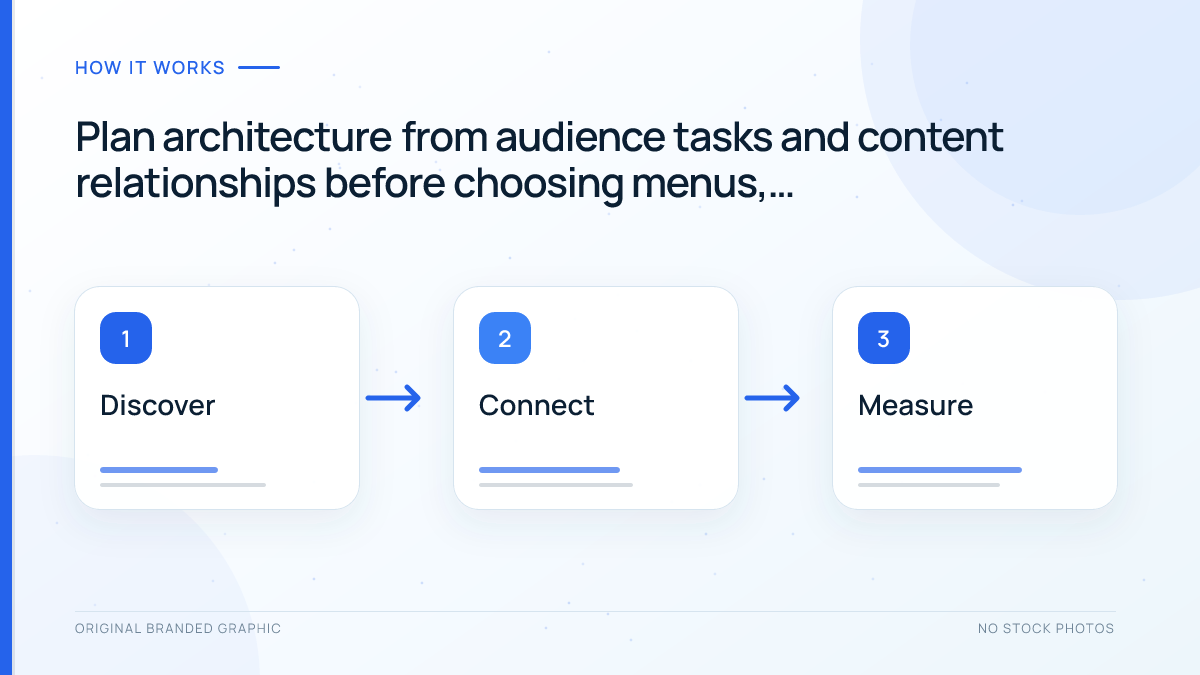
How to Plan a Search-Friendly Website Structure
Step 1: Define the site’s purpose and primary audiences
Start with what the website must help people accomplish. A software company may need visitors to understand products, compare solutions, read documentation, and request a demonstration. A learning site may need beginners to start with foundations and progress into specialized topics.
List the main audience groups and their most important tasks. Architecture should make those journeys clear while preserving access to supporting information.
Step 2: Inventory existing and planned content
Create a list of live pages, planned pages, templates, categories, tags, filters, and system-generated URLs. Include status, purpose, organic performance, internal links, canonical target, and owner when possible.
This inventory exposes duplication and gaps before a diagram makes them look organized. Two pages with different titles may still serve the same intent; one page may cover several subjects that deserve separate resources.
Step 3: Group pages by user intent and subject
Group content according to the questions or tasks it solves. Avoid creating a category for every keyword variation. Pages belong together when a visitor would reasonably expect to move between them and a shared hub can explain their relationship.
Keep commercial and educational intent visible. A product category, comparison guide, and troubleshooting article can support the same broad topic without being interchangeable.
Step 4: Choose the main sections
Turn the strongest groups into stable sections. Each main section should have a clear purpose and a name that people understand without explanation. If two labels sound synonymous, either define their boundaries or merge them.
Do not force a section to exist because it appears in a competitor’s menu. The right structure depends on your content, audience, and business model.
Step 5: Identify cornerstone and hub pages
Choose the pages that introduce each major subject or task. These pages should orient the reader and connect to important supporting resources. They often deserve links from navigation, related sections, and relevant content.
A cornerstone page does not need to be the longest page. Its value comes from clearly representing the subject and helping visitors choose the next useful destination.
Step 6: Design navigation and contextual paths
Sketch the global menu, local section navigation, breadcrumbs, related-content modules, and in-content links. Ask how a person can move:
- From the homepage to a major section.
- From a major section to a specific resource.
- From a detail page back to its parent or hub.
- Between closely related resources.
- From an educational page to an appropriate commercial step.
Use descriptive anchor text. “Technical SEO audit checklist” gives more context than “learn more,” as long as it fits naturally.
Step 7: Establish URL and taxonomy rules
Define conventions before the site grows: lowercase or mixed case, hyphens, trailing slashes, category depth, tag criteria, and parameter behavior. Consistency prevents duplicate versions and reduces editorial guesswork.
For an established site, do not change every URL simply to match a new diagram. Preserve stable URLs when possible and improve navigation, breadcrumbs, and internal links around them. If a migration is necessary, map every valuable old URL to its closest relevant destination and monitor the transition.
Step 8: Decide how filtered and paginated pages behave
Faceted navigation needs rules for which combinations may be crawled and indexed. A useful category such as “women’s waterproof hiking jackets” may deserve a stable landing page; endless combinations of sort order, session ID, size, and price may not.
Pagination and infinite scroll should also provide persistent, crawlable routes to content. Do not depend entirely on interactions that search crawlers may not perform reliably.
Step 9: Validate the structure before scaling it
Test the proposed architecture with real tasks. Ask someone unfamiliar with the project to locate a specific product, beginner guide, support answer, and contact route. Review mobile behavior as well as desktop menus.
Then crawl a small implementation. Confirm that links are parseable, canonical destinations are consistent, redirects work, and important pages are not orphaned.
Practical Website Architecture Examples
A small service-business website
A local home-services company might use:
- Home
- Services
- Heating repair
- Air-conditioning installation
- Maintenance plans
- Service areas
- City pages with genuinely local information
- Guides
- About
- Contact
Each service page can link to relevant locations, FAQs, and guides. Location pages should not be near-identical doorway pages with only a city name changed. The hierarchy creates clarity, but each indexable page still needs a distinct purpose.
An educational SEO website
An SEO learning site might organize foundational subjects into hubs such as SEO Basics, Technical SEO, On-Page SEO, Off-Page SEO, AI Search, and Tools. Each hub can introduce its field and link to focused lessons.
A technical hub might connect crawling, indexing, robots directives, canonicalization, redirects, structured data, page experience, mobile SEO, and architecture. Contextual links can cross between sections when topics overlap. The hierarchy establishes a default home; it does not prohibit useful relationships.
An ecommerce website
An online clothing store may use:
- Home
- Women
- Tops
- Dresses
- Activewear
- Men
- Shirts
- Trousers
- Activewear
- Kids
- Collections or use-case guides
- Individual products
Filters help visitors narrow collections, while indexation rules prevent every combination from becoming a competing URL. Product pages link back to usable categories and may connect to complementary products or guidance. The broader ecommerce SEO guide explains product, category, and faceted-navigation considerations.
A software documentation site
Documentation may combine a product hierarchy with a sequential learning path:
- Getting started
- Concepts
- Task-based guides
- API reference
- Troubleshooting
- Release notes
Each page should be reachable from an index, section navigation, or contextual link. Versioning requires special care so outdated and current documentation do not compete or send users to incompatible instructions.
How to Audit Existing Website Architecture
An architecture audit should identify practical barriers, not reward a site for matching a fashionable diagram. Combine crawl data, analytics, Search Console, and manual navigation.
1. Crawl the website
Use a crawler to collect indexable URLs, status codes, canonicals, internal link counts, depth, directives, titles, and redirect chains. Compare crawlable pages with the XML sitemap and content inventory.
No single metric proves a problem. A page with few internal links may be intentionally narrow; an important page with no links is more concerning.
2. Find orphan and near-orphan pages
A true orphan page has no internal link from another crawlable page. A near-orphan page may receive one weak link from an old archive that users rarely reach. Compare crawler data with sitemaps, analytics landing pages, Search Console pages, and the CMS database to uncover URLs a normal crawl missed.
3. Review click depth and prominence
Identify important pages that require many steps from major entry points. Then inspect the actual route. Sometimes the fix is a new hub or contextual link, not a larger global menu.
Prioritize pages by business value, search demand, user need, and topical role. Equal depth for every URL is neither realistic nor necessary.
4. Inspect internal link quality
Look for broken links, chains through redirects, generic anchors, links to non-canonical versions, excessive repetitive modules, and clusters that never connect to a useful parent page.
Review rendered HTML when navigation depends on JavaScript. A link should normally appear as an anchor element with an accessible destination.
5. Evaluate categories and tags
Find empty archives, single-post tags, overlapping categories, inconsistent naming, and taxonomies that create duplicate paths. Decide which archives deserve improvement, consolidation, noindex treatment, or removal from navigation based on their purpose and current behavior.
Do not make mass indexation changes without checking traffic, backlinks, and dependencies. A taxonomy page that looks thin in the CMS may still receive search visits or valuable links.
6. Check URL consistency and duplication
Test variations involving uppercase letters, trailing slashes, HTTP and HTTPS, www and non-www, parameters, sorting, and tracking codes. Confirm that internal links consistently point to preferred URLs and that redirects or canonical signals behave as intended.
7. Test breadcrumbs and structured data
Verify that visible breadcrumb trails match the logical hierarchy and every intermediate destination works. If breadcrumb structured data is present, validate it and ensure it describes the visible path. The schema markup guide explains how structured data communicates page information.
8. Review the sitemap as a consistency check
The XML sitemap should contain canonical, indexable URLs the site wants search engines to discover. Exclude redirects, error pages, duplicate parameter versions, and deliberately non-indexable pages. A mismatch between sitemaps, canonicals, navigation, and directives often reveals an underlying process problem.
9. Observe user journeys
Analytics can show common landing pages, next pages, exits, internal-search usage, and conversion paths. Session recordings or usability tests can reveal menu labels and categories that make sense internally but confuse visitors.
10. Prioritize changes and monitor them
Rank findings by impact, evidence, effort, and risk. Fix broken discovery paths and conflicting indexation signals before polishing minor URL wording. After deployment, crawl the site again and monitor indexing, organic landing pages, user behavior, and conversion paths.
For a broader diagnostic process, use the complete SEO audit guide alongside this architecture review.
Common Website Architecture Mistakes
Putting every page in the main menu
A menu is an orientation tool, not a complete sitemap. Too many options make important choices harder to see. Link the major sections globally and use hubs, local navigation, breadcrumbs, and contextual links for deeper resources.
Creating categories around isolated keywords
A category should represent a durable subject or task. Creating many thin archives for small keyword variations fragments the site and produces pages with little independent value.
Relying on an XML sitemap instead of internal links
Sitemaps support discovery, but they do not provide a human journey or the same contextual relationships as internal links. Important pages need usable links from relevant pages.
Following the three-click rule mechanically
Reducing unnecessary depth is sensible, but forcing every URL within three clicks can overload navigation and flatten meaningful groups. Evaluate whether important tasks are easy, not whether every obscure page meets an arbitrary count.
Changing URLs during every reorganization
Menus and categories can often change without changing established URLs. Unnecessary migrations create redirects, lost links, reporting discontinuity, and implementation risk. Change addresses only when the long-term benefit justifies that cost.
Using uncrawlable interface elements as links
A clickable card or button may work for a person while lacking a standard anchor and valid destination in rendered HTML. Check critical navigation with JavaScript enabled and through search-engine rendering tools.
Generating unlimited filter combinations
Faceted systems can multiply a modest catalog into millions of URLs. Establish crawl and indexation rules based on user value and demand before launching every combination.
Leaving old sections disconnected after a redesign
Redesign teams often rebuild the primary journey while forgetting older guides, campaigns, or support pages. Compare the new crawl with the complete URL inventory before launch so valuable pages do not become orphans.
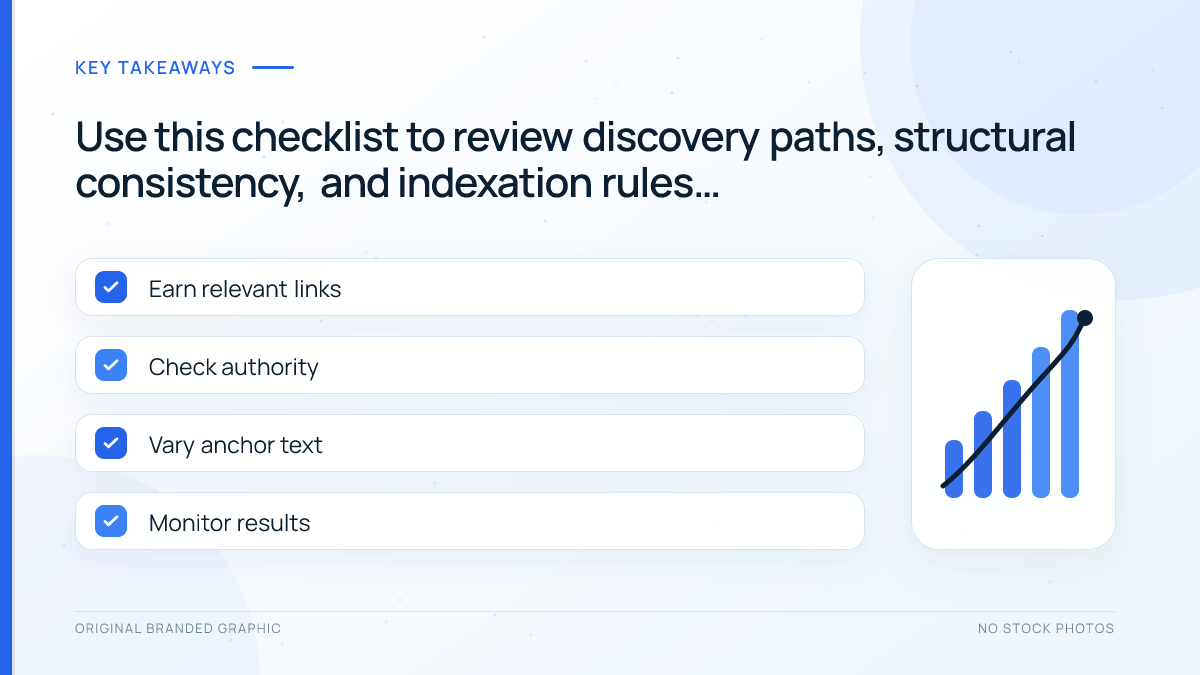
Website Architecture for SEO Checklist
- The main sections reflect real visitor tasks and distinct topics.
- Every important indexable page has at least one relevant, crawlable internal link.
- Primary navigation uses clear labels and remains usable on mobile.
- Hub and category pages provide orientation, not only a list of links.
- Contextual links use concise, descriptive anchor text.
- Breadcrumbs match a genuine hierarchy and lead to working pages.
- URLs are readable, consistent, and free of unnecessary parameters where practical.
- Internal links point directly to preferred canonical URLs.
- Taxonomies have distinct purposes and enough content to remain useful.
- Filtered, sorted, and paginated URLs follow documented crawl and indexation rules.
- The XML sitemap contains canonical, indexable URLs that the site wants discovered.
- Important content is not available only through site search, forms, or user interaction.
- Orphan pages are identified by combining crawl, sitemap, analytics, Search Console, and CMS data.
- Architecture changes preserve valuable URLs unless a migration has a clear benefit.
- Post-launch monitoring checks crawling, indexing, organic traffic, and user journeys.
Frequently Asked Questions
How many levels should a website architecture have?
There is no ideal number for every website. Use as many levels as visitors need to understand and explore the content without creating unnecessary detours. Important pages should have clear paths from major entry points, while specialized pages may reasonably sit deeper. Judge depth by usability, importance, and discoverability rather than a fixed numerical rule.
Does every page need to be within three clicks of the homepage?
No. The three-click rule is a usability heuristic, not a Google requirement or ranking guarantee. It can help identify pages that are unnecessarily buried, but forcing every URL into three clicks may create crowded menus and weak groupings. Prioritize easy access to important pages and provide logical routes to specialized content.
Are subfolders better than subdomains for SEO architecture?
Neither option receives an automatic ranking advantage in every situation. Subfolders are often simpler when content belongs to one website and one management system. Subdomains may make sense for distinct products, platforms, languages, or technical ownership. Choose the structure that fits operational and user needs, then connect and maintain it consistently.
Can I improve site architecture without changing URLs?
Yes. Many improvements come from better navigation, hub pages, breadcrumbs, contextual links, taxonomy cleanup, and consistent canonical linking. Keeping established URLs avoids migration risk. Change URLs only when the current structure creates a meaningful long-term problem and you can implement redirects, update internal links, and monitor the transition carefully.
What is the difference between website architecture and internal linking?
Website architecture is the broader system that organizes pages, hierarchies, navigation, taxonomies, URLs, breadcrumbs, and discovery paths. Internal linking is one important mechanism within that system. You can improve individual links without fixing an incoherent architecture, or design a logical hierarchy that still performs poorly because its pages are not connected with crawlable links.
How do I know whether a page is orphaned?
A crawler may label a page orphaned when it appears in a sitemap, analytics, Search Console, or CMS export but is absent from the internal-link crawl. Confirm the finding because login requirements, blocked resources, or incomplete crawl settings can create false positives. Then add a relevant link, consolidate the page, or intentionally retire it based on its value.
Conclusion
Website architecture for SEO gives content a clear place and creates dependable paths between related pages. A useful structure combines logical hierarchy, understandable navigation, crawlable links, focused hubs, consistent URLs, meaningful taxonomies, breadcrumbs, and a clean sitemap.
The objective is not to make every website look identical or reduce every page to the same depth. It is to help people find what they need and help search engines discover and interpret the site without conflicting signals. Start with audience tasks and content relationships, preserve stable URLs when practical, and audit the structure as publishing and functionality expand.