This Ahrefs review explains how to evaluate its keyword research, competitor analysis, backlink tools, site auditing, and reporting without confusing estimates with verified results. The right choice depends on whether the platform improves decisions your team actually makes.
Quick Answer
Ahrefs is a third-party SEO research platform for investigating keywords, competing websites, backlinks, organic-search opportunities, and technical issues. It is most useful when these investigations lead to decisions: which page to improve, which topic to cover, which link to reclaim, or which technical defect to fix. It does not disclose a competitor’s actual analytics, guarantee rankings, or replace Google Search Console. This Ahrefs review evaluates the product through repeatable workflows rather than unverified promises. Teams that routinely compare competing sites and research link profiles have a clearer reason to consider a subscription than owners who only need basic indexing information. Before paying, test one representative project and inspect the current plan’s usage limits.
Key Takeaways
Use Ahrefs to generate and prioritize research hypotheses, not to treat estimated metrics as confirmed outcomes. Its keyword, competitor, link, tracking, and auditing functions solve related but different problems. A useful purchase evaluation checks target-country coverage, reporting allowances, collaboration needs, and the quality of the actions the tool suggests. Proprietary link and keyword metrics are not Google ranking factors. Verify critical findings using live pages, Search Console, and other first-party evidence. A focused scorecard provides a better basis for choosing a plan than a feature count. Pricing and access can change, so consult the vendor directly before buying.
What Ahrefs is designed to do
Ahrefs brings several research workflows into one interface. Site Explorer investigates domains, pages, and backlinks in the company’s databases. Keywords Explorer supports query discovery and assessment. Site Audit crawls a configured website and groups technical findings. Rank Tracker monitors a selected set of keywords under defined location and device conditions. These modules complement one another: a keyword opportunity can lead to a competing page, which can reveal relevant citations and content gaps. Yet their measurements are not interchangeable. An estimated competitor traffic figure cannot establish conversions; a crawler warning cannot prove that Google refused to index a URL. Start with a specific decision and choose the relevant module rather than browsing dashboards without an objective. The official Ahrefs website provides the current product overview.
Who is likely to benefit
An agency researching multiple client markets may use Ahrefs regularly to compare domains, discover competing content, and examine links. An in-house SEO team might use it to build an editorial backlog or monitor a crowded market. A publisher could investigate topics and reference-worthy assets. Conversely, a small local business with a few pages may get more immediate value from first-party search reporting and fixing known site problems. Buying an advanced suite before defining the team’s workflow can create expensive reporting activity without better decisions. Ask how many investigations are performed each month, who will interpret the findings, and who will implement changes. If those answers are unclear, create a simple SEO operating process before purchasing software.
Set a measurable evaluation brief
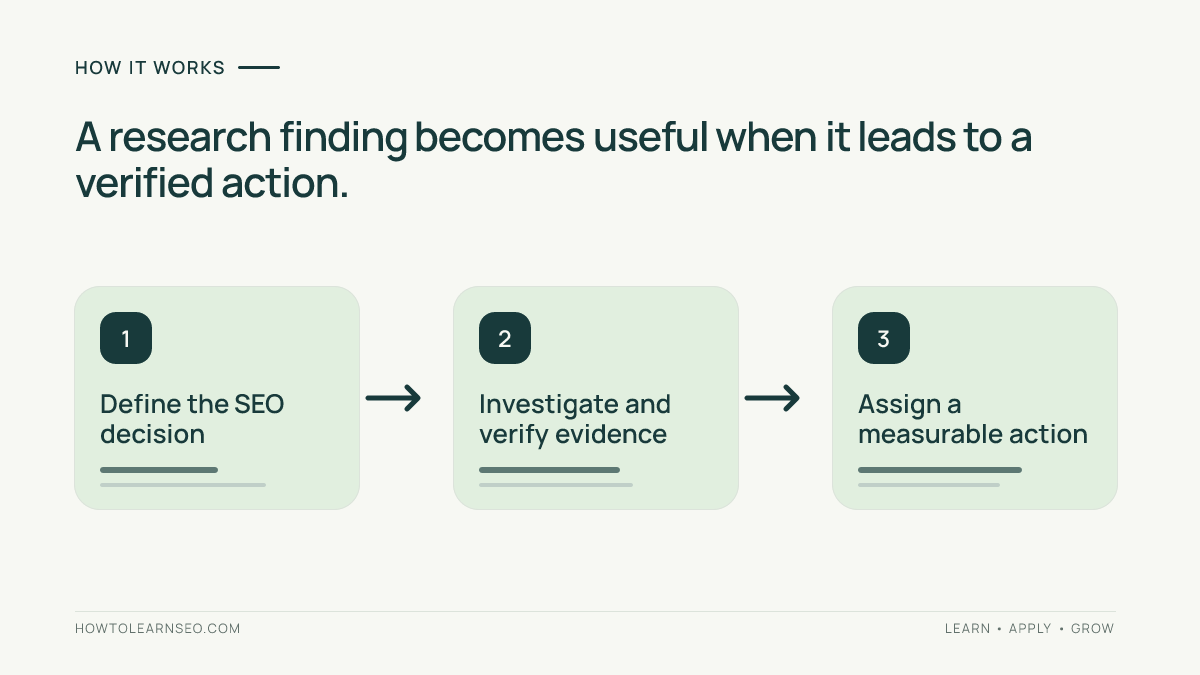
Choose one site, one market, and a small number of questions. For example, a fictional bookkeeping firm wants ten realistic service-keyword opportunities, three actual search competitors, several credible potential citations, and a technical audit of its important templates. Specify the country, language, device context, and available first-party evidence. Define the output before opening the tool: a table with target query, intent, competing URL, existing destination page, proposed action, evidence, and uncertainty. This prevents an attractive dashboard from becoming the deliverable. Reserve time to validate a sample manually. A useful evaluation ends with a prioritized action list that a writer or developer can execute. It does not end with a large export of unsorted keywords.
Keyword research: start with customer problems
Enter a few seed phrases based on actual services or audience questions, then select the market where the site competes. Explore related terms, but sort them by intent before volume. A phrase asking what bookkeeping means belongs to a different page type from one seeking a monthly bookkeeping provider. Inspect the live results to understand whether the dominant format is a service page, tutorial, comparison, directory, or video. Check whether your site already has a suitable destination. Group close variants under one intent rather than creating a page for every spelling. The keyword research guide explains the underlying planning process. Record candidates that match the site’s expertise and business model, then prioritize opportunities where the page can offer a clear, credible answer.
What search-volume estimates can and cannot tell you
Third-party search volumes are estimates, not a promise of visitors. The figure can differ by market, query spelling, season, and provider methodology. A low-volume phrase may still attract valuable customers, while a broad term with large estimated demand may produce little relevant business. Compare variants expressing the same intent and avoid adding their volumes together as though every search were distinct. For an existing site, use Search Console impressions and clicks as first-party context where available. For a new topic, label the forecast as uncertain. An opportunity table can use a confidence rating rather than pretending a precise traffic prediction exists. Remember that ranking, search-result features, click behavior, and conversion intent all affect actual outcomes beyond raw query demand.
Keyword difficulty is a screening signal
A difficulty score is a proprietary model intended to help compare opportunities. It is not Google’s ranking formula and cannot establish whether your specific page will succeed. Review the actual results: are the pages relevant to the query, do they address the same audience, and are they supported by credible evidence? Consider whether the SERP is dominated by brands, directories, or local results. A specialized website may compete effectively on a narrow problem even when broad terms appear difficult. Conversely, a supposedly easy keyword may be unsuitable if your content cannot satisfy the intent. Use the score to decide what deserves closer inspection, not as a publication rule. The final choice should combine audience need, existing site coverage, feasibility, and business value.
Discover real search competitors
Business competitors and organic-search competitors are not always the same. A regional service provider may compete in search with directories, publishers, national brands, and government resources. Identify domains that repeatedly appear for your priority queries, then classify them by type. A directory listing is not necessarily a useful template for a specialist service page. Open the relevant competing URLs and note the problem they solve, the supporting evidence they provide, and the information missing from your site. Compare pages rather than relying only on domain-level charts. A large site can have many unrelated ranking pages; the useful comparison is often one competing URL against your own intended destination. Record the date and country for each observation because search results change.
Use content gaps without creating duplicates
A content-gap report can surface queries where competing sites appear and your site may not. Treat that as a discovery queue, not an automatic publishing calendar. Exclude irrelevant terms, competitors’ brand names without legitimate comparison intent, and topics outside your expertise. Check every candidate against published, draft, and planned pages. If an existing article partly satisfies the intent, improving it may be better than creating another URL. For each valid opportunity, specify the reader’s job, page type, evidence needed, and internal-link destination. The SEO content brief template can turn this into an actionable assignment. Prioritize a small set with clear ownership. Hundreds of unsorted gaps often produce repetitive content and unnecessary cannibalization.
Backlink analysis: investigate the source
Ahrefs can show discovered referring domains, backlinks, anchor text, and linked pages. The useful question is why a particular page attracted a citation. Was it original research, a public resource, a useful tool, or a relevant partnership? Inspect the actual referring page and the context of the link before assigning value. A link from an unrelated directory may be less useful than a relevant editorial citation. Domain Rating and similar metrics help organize investigation but are not Google ranking scores. A change in a backlink chart may reflect the tool’s discovery process as well as real linking activity. Avoid assuming that every reported link exists in its original form today. Verify important links and document whether they are editorial, relevant, accessible, and still pointing to the intended destination.
Link opportunity research without spam
Investigate relevant organizations that cite genuinely useful resources in your industry. Look for association pages, educational references, community programs, and publishers that might value original evidence. A prospective linking site should have a reason to send readers to your content. Avoid mass outreach based solely on a domain metric, paid link schemes, or copying a competitor’s questionable tactics. For local businesses, partnerships and authentic community contributions may create more defensible opportunities. The local backlink partnership guide explains a complementary approach. Track candidate source, relevance, contact rationale, actual outreach, and outcome. A database listing is only a lead; it is not proof that a site will link or that any eventual link will improve rankings.
Recover genuinely broken citations
A lost-link report is a starting point for verification. Open the referring page, check whether the citation remains, and inspect the destination’s response. Links can appear lost because of crawler access, redirects, temporary errors, or changed pages. If an important resource moved, consider a relevant redirect or a courteous request to update the citation. Do not redirect unrelated old pages to the homepage simply to preserve a metric. Prioritize citations that help real readers or point to important resources. The broken backlink reclamation guide covers the repair process. Record the original URL, observed failure, intended destination, corrective action, and later verification. Treat the verified repair as the outcome, not merely a change in the third-party link count.
Site Audit: scope the crawl before running it
A technical crawler reports what it could access under its settings at a particular time. Define the correct host, subdomains, crawl limits, and representative templates before starting. Consider robots restrictions, login barriers, staging environments, canonical variants, and whether large filtered sections should be included. On ecommerce sites, a carefully chosen sample may be more useful than spending allowances on millions of near-identical URLs. Compare results with the XML sitemap and first-party indexing information. The SEO audit guide
Turn technical warnings into engineering tickets
Do not hand developers an undifferentiated export of warnings. Prioritize affected pages that should attract organic visitors but have broken responses, unintended noindex rules, incorrect canonicals, or inaccessible navigation. Group repeated findings by shared template or root cause. Reproduce a sample in the browser and inspect headers when necessary. Some apparent warnings are intentional: login pages should not necessarily be indexable, and redirects can be correct. Write a ticket with the affected template, actual behavior, expected behavior, reproduction steps, business impact, and acceptance test. After implementation, rerun the relevant crawl and inspect the affected pages. The important result is a verified fix, not simply fewer alerts on a dashboard. Assign ownership and avoid claiming that a resolved warning automatically produces a ranking gain.
Rank tracking: choose a useful baseline
Select keywords representing real customer journeys, not just phrases that produce attractive charts. Configure country, device, and relevant location settings, then separate branded and nonbranded groups. Record the baseline before significant content or technical changes. Tracked positions reflect configured measurement conditions; individual users may see different results because of geography and search features. A small position movement should be interpreted alongside clicks, impressions, conversions, and changes in demand. Use first-party Search Console data for your verified site wherever possible. Define the monthly report around priority pages and business outcomes rather than a count of green arrows. Check current keyword allowances and update frequencies in the selected plan because these entitlements can vary.
Practical example: a bookkeeping service page
Imagine a bookkeeping firm with three service pages and a target market in one country. The team enters five seed phrases, filters for commercial intent, and identifies a cluster around monthly bookkeeping for small businesses. It opens the live results and confirms that service pages are prominent. Two competitors explain onboarding, deliverables, software integrations, and pricing factors more clearly than the firm’s existing page. The firm therefore chooses to improve that page rather than publish a duplicate. Its brief lists the missing sections, required evidence, intended internal links, and conversion action. Expected output: a revised service page addressing the actual query. Verification: check the published page and monitor relevant Search Console queries over time. Edge case: if map results dominate, also assess local visibility rather than assuming page copy alone solves the problem.
How to measure the example fairly
The immediate success is a complete, evidence-based content brief and an implemented page improvement. Organic growth is a later possibility, not a guaranteed consequence. Record baseline clicks, impressions, relevant conversions, and the affected URL before making changes. Annotate the update date, then review performance over an appropriate period while considering seasonality and other releases. If traffic falls, inspect indexing and changes in query mix before concluding the research was wrong. If traffic rises, do not attribute every gain to one edit without evidence. This separation makes tool evaluations credible. Ahrefs can help identify a plausible opportunity; the website team must still create the content, publish it correctly, and measure whether it serves visitors.
Data freshness and geographic coverage
Third-party databases have sampling and discovery limitations. A small local site may receive real inquiries despite showing little modeled organic traffic. New pages or links may take time to appear in a vendor’s index. Coverage can differ across languages, countries, and niche queries. A missing link in the report is not proof that no link exists, and a modeled competitor traffic drop is not proof of an actual analytics decline. Verify important findings using live pages and first-party information. Record the date, market, and scope of the observation. When data is sparse, say so explicitly. This matters when preparing client reports: estimates should be labeled estimates, and observed facts should be separated from hypotheses and recommendations.
Pricing: inspect the actual entitlements
Subscription prices, plan names, included reports, seats, and usage rules can change. Consult the official pricing page before committing rather than trusting an old review’s figures. Check projects, crawl allowances, tracked keywords, exports, historical data, collaboration, and any additional usage charges that matter to your workflow. Estimate monthly tasks and how much time the tool could realistically save. A more expensive tier is not automatically more economical if its extra limits remain unused. Consider training and implementation time as part of the total cost. If the research is a one-off project, a recurring subscription may not be justified. Document the specific entitlements you confirmed and the date you checked them.
Compare with Google Search Console
Google Search Console is a first-party tool for a verified website’s search performance and indexing information. Ahrefs is a third-party research platform that can help investigate competitors, keywords, and backlinks beyond your own property. They answer different questions. Search Console reports actual impressions and clicks for your verified property, subject to its reporting methods; Ahrefs models competitor visibility without access to competitors’ private analytics. The official Search Console overview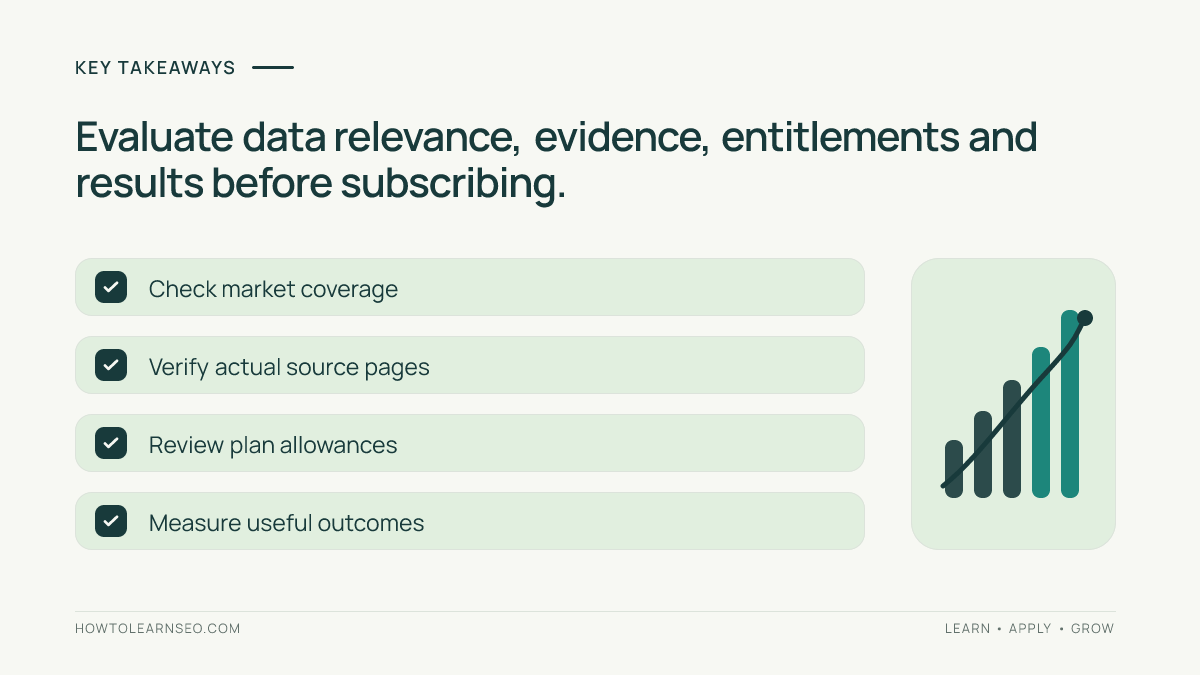
Compare with Screaming Frog
Screaming Frog SEO Spider is a desktop crawler designed for detailed inspection of URLs, metadata, responses, directives, and internal links. Ahrefs Site Audit also crawls sites but is integrated into a wider keyword, backlink, and competitor research suite. Choose according to the job. A specialist technical auditor may prioritize crawling flexibility and export controls; a strategist may value integrated competitive research. The existing Screaming Frog review
Compare with other SEO suites
Semrush and other SEO suites also combine keyword, competitive, technical, and reporting functions. Similar feature names do not guarantee identical data, workflows, or allowances. Run the same evaluation brief across alternatives: one target country, one domain, a consistent keyword set, and the same completion criteria. Compare whether each tool helps produce a defensible list of actions with manageable effort. Consider support, integrations, user access, exports, and the frequency with which your team uses each module. A feature that looks impressive but is rarely used may have little economic value. Avoid declaring a universal winner from a single screenshot or proprietary score. The better product is the one that reliably supports your recurring decisions within your budget.
Common errors and how to avoid them
A common mistake is treating Domain Rating or keyword difficulty as direct Google ranking factors. Another is publishing one page for every exported keyword without checking intent or existing coverage. Teams also mistake modeled traffic for actual competitor analytics, treat every lost link as an emergency, and forward crawl warnings without confirming the issue. Fix these habits by attaching a decision and a verification method to every report. A keyword list should identify the destination page and reader problem. A backlink review should distinguish credible citations from irrelevant sites. A technical ticket should describe reproducible behavior. Metrics are useful when they support action; they are distracting when they become goals in themselves. Avoid promising rankings, traffic, or revenue that the data cannot establish.
A five-task evaluation scorecard
Use a practical scorecard before purchasing. Task one: identify ten relevant queries for an existing service. Task two: find three genuine organic-search competitors. Task three: inspect five credible referring pages. Task four: crawl representative URLs and reproduce one important technical issue. Task five: produce a concise action plan that another person can implement. Record completion time, missing information, unclear interface steps, and plan limits encountered. Apply the same tasks to alternatives for a fair comparison. If a trial does not include a feature, mark it unavailable rather than judging its quality. These are proposed evaluation steps, not claims of hands-on tests performed for this article. The final scorecard should reveal whether the software changes decisions enough to justify its cost.
Reporting findings without false precision
A good stakeholder report leads with decisions made. State the business problem, source of evidence, proposed action, owner, and verification method. Distinguish direct observations from third-party estimates and strategic judgment. For example, a competitor page visibly answers a service question more completely; Ahrefs estimates interest in related queries; the recommendation is to improve an existing page; Search Console will monitor later performance. Keep original URLs and observation dates so another analyst can reproduce the reasoning. Avoid exact revenue forecasts derived from search volume alone. A useful report acknowledges uncertainty while still giving the team a concrete next step. This is more valuable than exporting dozens of charts that no one has time to interpret.
Decision checklist before subscribing
Confirm useful coverage in your market, inspect a real competitor, verify several referring pages, and complete one scoped crawl. Check the plan’s current allowances, collaboration model, and export access. Produce an actionable brief and ensure someone is responsible for implementing it. Establish a first-party baseline where available. Decide what success means: fewer research hours, clearer content priorities, or more reliably diagnosed technical issues. If the tool repeatedly improves important decisions, paying for it may be sensible. If free tools and existing processes answer the same questions adequately, wait. Keep a brief evidence log with the date, source, market setting, and uncertainty level for every important recommendation. That habit improves SEO work regardless of the platform selected.
Frequently Asked Questions
Is Ahrefs worth buying for a small business?
It depends on how frequently the business needs competitor, keyword, and backlink research. Test a specific workflow and compare the subscription with free first-party tools.
Can Ahrefs reveal a competitor’s exact Google traffic?
No. Competitor traffic figures are third-party estimates, not access to another website’s private Google Analytics or Search Console reports.
Does a high Domain Rating guarantee good rankings?
No. Domain Rating is a proprietary link metric, not a Google ranking score or a guarantee that a page will rank.
Can Ahrefs replace Google Search Console?
No. Search Console provides first-party data for verified properties, while Ahrefs adds third-party keyword, backlink, and competitor research.
Does an Ahrefs crawl prove that Google indexed a URL?
No. A crawler reports what it can access under its settings. Google’s indexing status requires appropriate first-party verification.
Should I choose Ahrefs or Screaming Frog?
Choose based on your main task. Integrated competitive research favors an SEO suite, while detailed desktop crawling may favor a specialist crawler.
Conclusion
Ahrefs can support disciplined SEO research, but its estimates need interpretation and its findings require action. Test the workflows that matter, verify important observations, and compare current plan limits before paying. Choose the platform that improves decisions, not the one with the most impressive charts.