To learn how to earn local backlinks, start with useful relationships rather than directory submissions or mass email pitches. A local backlink is a link from another website relevant to your community, industry or service area. The strongest opportunities arise when a real organization has a good editorial reason to send its readers to your business or a resource you maintain.
Quick Answer
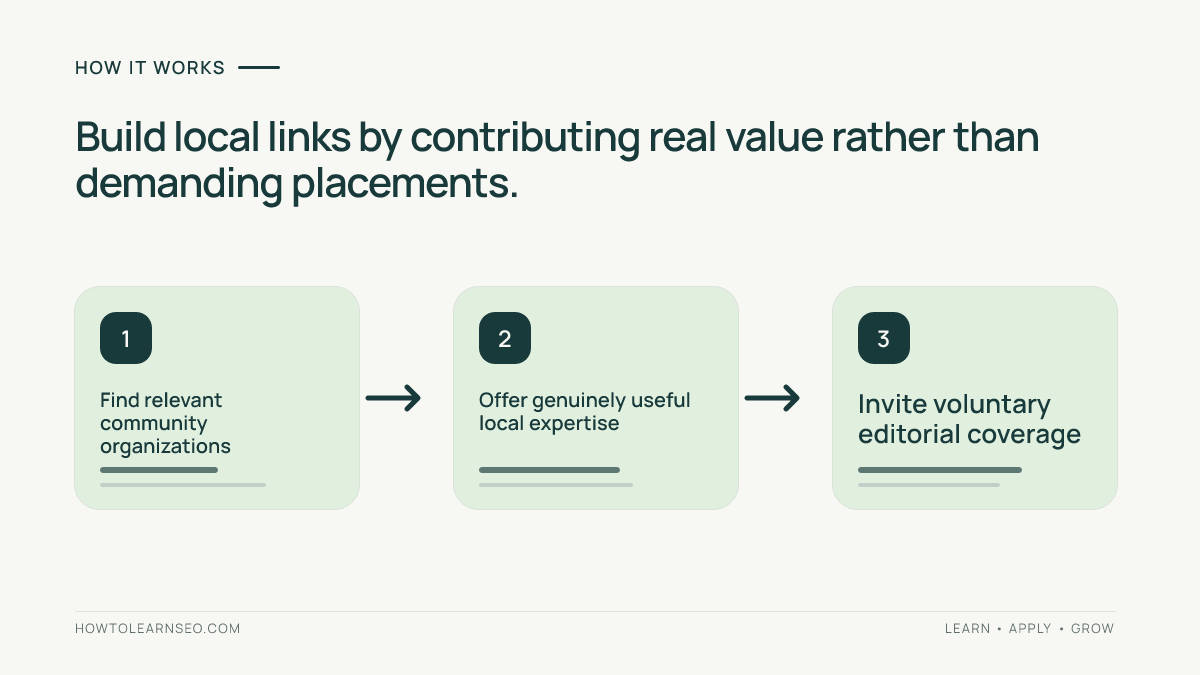
Find local organizations whose audiences overlap with your customers, identify a practical way to contribute, create a genuinely useful destination on your website, and invite voluntary coverage without demanding a link. Verify published mentions and measure referral value. This approach complements local SEO fundamentals and avoids buying artificial ranking signals.
Key Takeaways
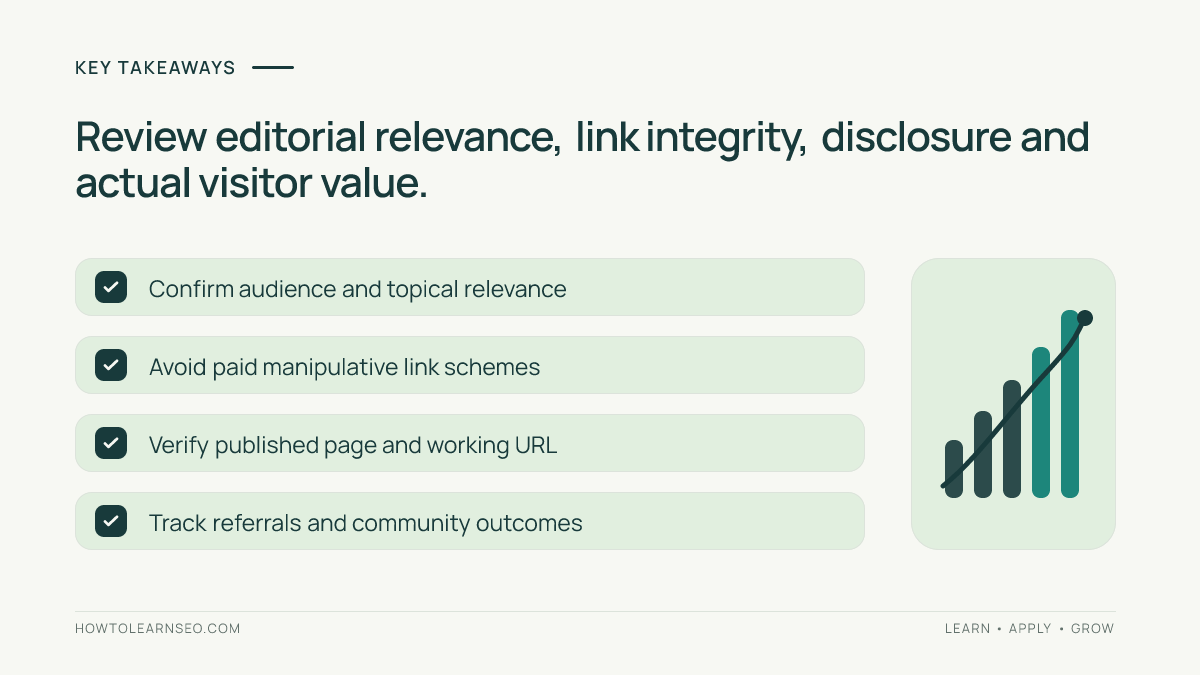
- Choose real community relevance over generic domain metrics.
- Offer an activity, resource or expertise worth mentioning.
- Contact a small number of appropriate partners personally.
- Respect editorial independence and disclose sponsored relationships.
- Track useful visits and enquiries, not just backlink totals.
Start with a legitimate local reason to collaborate
Imagine a neighborhood bicycle shop. A nearby cycling club might welcome a free maintenance workshop; a community college could use a safety checklist; a local event organizer may need route preparation advice. These are different from sending fifty organizations the same request to “exchange SEO links.” A useful partnership should make sense even if nobody adds a hyperlink.
List your service areas, actual specialties, staff expertise and activities you can reasonably support. Then identify community groups that already serve those audiences. Google’s people-first content guidance favors information created to help visitors, not pages assembled solely to attract search traffic. Apply the same principle to outreach: the contribution should solve a real problem.
Build a short, qualified prospect list
Search for relevant chambers of commerce, nonprofit projects, community associations, professional groups, libraries, clubs and event organizers. Confirm that each organization is active and that its site actually publishes partner information or helpful resources. Do not scrape private contact details or target unrelated schools and charities merely because their domains look authoritative.
Create a spreadsheet with organization, audience, contact channel, relevant page, proposed contribution, possible benefit, outreach date and response. Start with perhaps five highly relevant prospects as a manageable planning example, not a promised conversion benchmark. A nearby cycling group with an active member resource page is a better prospect for a bicycle shop than an unrelated national directory.
Use our backlink primer to understand why links are references between pages. Relevance and editorial context matter more than treating every mention as a score. Avoid third-party services promising hundreds of local backlinks overnight; those offers rarely explain who benefits from the links or why the references belong on the pages.
Choose an offer the partner can genuinely use
Useful collaboration formats include a public workshop, a safety demonstration, a locally researched checklist, a volunteer project or expert input for a community guide. The offer must be feasible for your team and appropriate to the organization’s needs. A small clinic might contribute medically reviewed accessibility advice, while a home-repair company could provide a seasonal maintenance checklist.
Publish a supporting resource only when it adds substance: clear steps, accurate local details, current contact information and a useful next action. Avoid thin “partner pages” that merely repeat an organization’s name to manufacture reciprocal links. The on-page SEO guide explains how to structure useful pages for readers. Link the resource from your own relevant navigation so it remains accessible after the event ends.
Write outreach that respects editorial choice
Use the organization’s public contact channel and explain in a few sentences why your contribution fits its audience. Mention the relevant activity, the specific resource you can provide, and the practical benefit. Do not imply that a link is payment for a donation, participation or favorable coverage. An editor may choose to mention the project without linking, and that is their decision.
A concise example: “Our repair team is offering a free bicycle-safety workshop for local commuters. We have a printable pre-ride checklist your members can use. Would that be useful for your events calendar or member resources?” This asks whether the contribution helps. It does not demand anchor text, a dofollow attribute or a guaranteed backlink.
Google’s spam policies warn against link schemes, including buying or exchanging links primarily to manipulate rankings. A sponsorship can still be a legitimate business activity; if a link is part of a paid arrangement, Google’s outbound-link qualification guidance explains sponsored and nofollow attributes. Do not disguise a paid placement as an independent recommendation.
Worked example: a bicycle shop and a cycling club
Input: A fictional shop called Riverside Cycles serves commuters near a local trail. A cycling club has an events page but no beginner maintenance resource. The shop has an experienced mechanic and can offer a one-hour workshop. This is an illustrative scenario, not a reported outreach campaign or measured SEO result.
Action: The shop publishes a useful checklist explaining tire pressure, brake checks, lights and when to seek professional repair. It offers the club a workshop and shares the checklist for participants. The club independently decides whether to list the workshop and link to the resource. The shop records the outreach and publication date without specifying paid anchor text.
Expected output: Members have an actionable resource and a way to learn about the event. If a link appears, it points to a relevant page rather than an unrelated sales promotion. Verification: Open the club’s published page, test the destination, confirm the information is accurate and review tagged referral visits where possible. Edge case: If the club only sends a newsletter without a public web page, the relationship can still be valuable; do not fabricate a web link to claim SEO success.
Check published coverage and maintain the relationship
After an event or resource launch, review the organization’s public page manually. Verify that the destination works, that the linked page answers the promised question and that the description is truthful. If the URL is broken, ask for a correction politely. Do not pressure editors to replace natural wording with keyword-rich anchor text.
Monitor referrals and enquiries where analytics permits, but remember that privacy settings, email clients and attribution rules can hide some visits. Our Search Console guide covers website search performance, which is different from tracking clicks from partner websites. Search Console’s link reports may be delayed or incomplete; absence from one report does not necessarily mean a published link does not exist.
Know when to decline a backlink opportunity
Reject offers requiring unrelated reciprocal link pages, fabricated testimonials, keyword-stuffed anchors or a network of sites created solely to pass ranking signals. Also decline opportunities where a community organization expects a financial contribution that your business cannot justify independently of SEO. A legitimate sponsorship should have a business or community rationale even if the link uses sponsored attributes.
For a separate recovery task, broken backlink reclamation explains how to repair references to lost pages. That process differs from earning a new community mention. Keep both workflows distinct so your outreach remains specific and credible rather than a generic campaign chasing links from every possible source.
Frequently Asked Questions
Do local backlinks guarantee higher map rankings?
No. Relevant editorial links can help people discover a business and support its online presence, but local visibility also depends on relevance, distance, prominence and other factors.
Should I pay a local organization for a backlink?
Do not buy links to manipulate rankings. Sponsorships can be legitimate marketing, but paid links should use appropriate rel attributes such as sponsored or nofollow.
Can a business earn links without sponsoring events?
Yes. Useful local resources, genuine partnerships, expert contributions and participation in relevant community projects may lead to voluntary editorial mentions.
How many local backlinks should I build each month?
There is no universal quota. Prioritize genuine relevance, trustworthy partners and measurable community value instead of a fixed link count.
What if a partner mentions my business without linking?
A polite request for a helpful source link is reasonable when it improves the reader experience. Respect the publisher’s editorial choice if they decline.
How can I tell whether a partnership worked?
Track actual referral visits, enquiries, published coverage and relationship outcomes. Organic ranking changes alone cannot prove that one backlink caused an improvement.
Conclusion
The sustainable way to earn local backlinks is to contribute something your community would value even without search engines. Identify relevant partners, offer useful expertise, publish a trustworthy destination and let editors choose whether to cite it. Measure genuine referral and relationship outcomes while avoiding manipulative link arrangements. The result is a stronger local presence built around real work rather than manufactured authority.