A local citation audit checks whether websites and directories describe a business accurately. It focuses on real-world name, address or service area, phone number, website and operating details. Inconsistent citations can confuse prospective customers even when the business’s own website is correct, making this a practical local SEO maintenance task rather than a guaranteed ranking tactic.
Quick Answer
Audit local citations by collecting important business listings, comparing each entry with a verified business information sheet, correcting errors on trusted platforms, and recording the results. Prioritize locations and directories customers actually use. Google’s local visibility considers relevance, distance and prominence, but citation cleanup alone cannot guarantee rankings. Our local SEO beginner’s guide establishes the wider strategy.
Key Takeaways
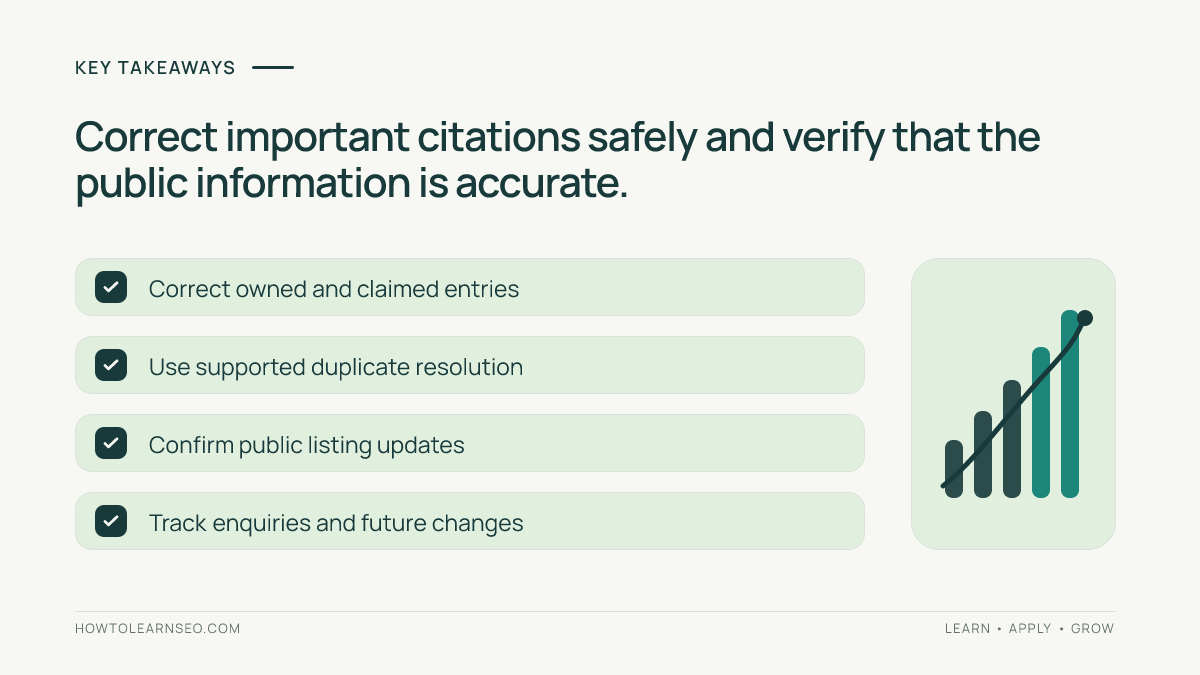
- Use one verified source of truth for business information.
- Check customer-facing directories, local organizations and industry sites first.
- Distinguish real locations from virtual offices and service-area businesses.
- Correct duplicates through official platform processes; never create fake entries.
- Measure information accuracy and customer outcomes, not directory counts alone.
Create the source-of-truth business record
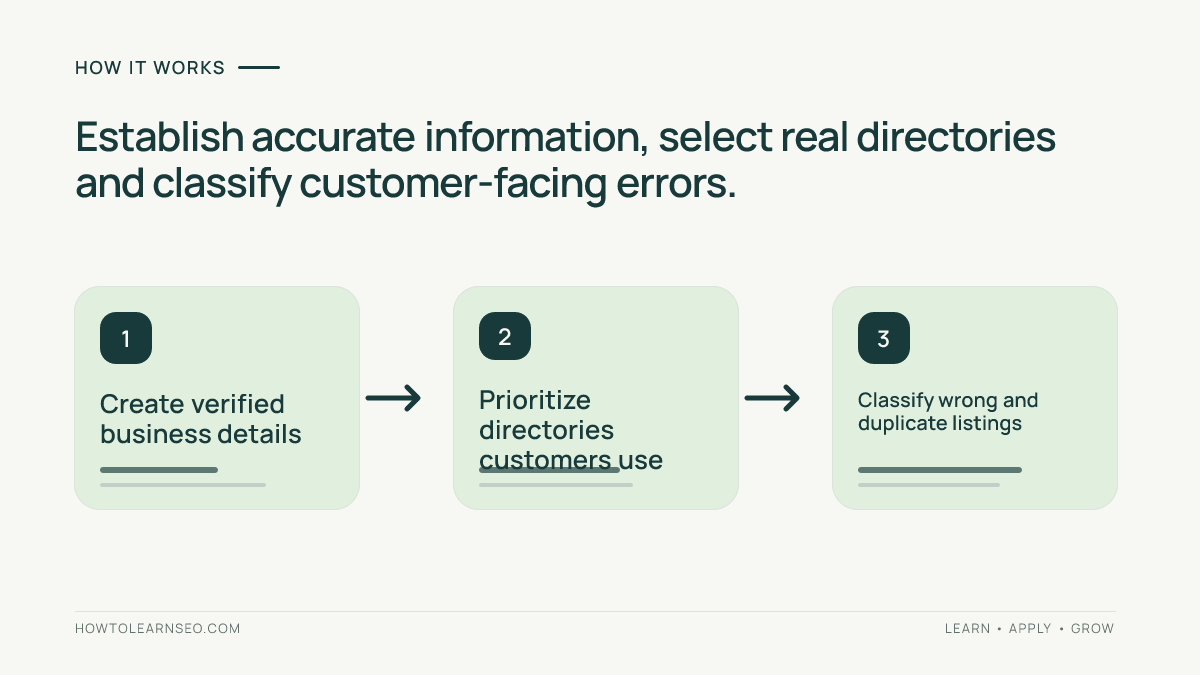
Write down the genuine trading name, main category, legitimate address or service area, published phone number, main website, opening hours and business description. Ask the owner to confirm that these details describe how the company operates today. Record former names, numbers and closed premises separately, so old data can be recognized without accidentally being reused. For a multi-location company, build one distinct sheet per qualifying location.
Do not invent a storefront address for an at-home service company. Google’s representation guidelines explain eligibility, service areas and address display. The information sheet is not a license to force identical text everywhere: directories may offer different fields, abbreviations or formatting requirements. Accuracy matters more than matching punctuation in a street name.
Choose which citation sources deserve attention
Start with the actual channels that send customers to the business: Google Business Profile, widely used map services, relevant trade associations, professional organizations, chambers of commerce and trustworthy regional directories. Include industry-specific marketplaces when they legitimately list the company. A local plumber, for example, may benefit more from a credible trade association listing than from dozens of unrelated generic profile sites.
Record each source’s URL, business name, contact details, ownership access, last checked date and any correction process. Do not assume that a directory is important simply because an SEO tool calls it authoritative. Inspect whether it has an actual audience, whether the listing is maintained, and whether the page is accessible without misleading offers. Our Google Business Profile checklist covers the primary customer-facing profile separately.
Classify errors before making changes
Common problems include a disconnected phone number, outdated address, old trading name, dead website link, incorrect map pin, closed location shown as open, and duplicate profiles for the same premises. Rank issues by potential customer harm. A broken phone number that prevents bookings is generally more urgent than a slightly different abbreviation in a road name.
Make a simple triage table with source, issue, severity, intended correction, owner and status. Mark unknown ownership or contested claims as a separate state. Avoid mass-edits based only on a scraped directory database: stale data may come from third parties, and a genuine business may already have initiated a correction. Keep screenshots or documented page details before making changes, especially when a directory offers no audit history.
Correct listings without multiplying duplicates
For a listing the business owns, update the relevant fields through that platform’s supported dashboard. If an entry is unclaimed, follow the site’s verification process rather than creating a second listing with the desired details. For duplicates, confirm that the profiles actually refer to the same eligible business and use the provider’s merge, report or removal route. Do not assume that two departments sharing an address should always be merged.
Where a correction needs editorial approval, provide evidence such as official public information rather than sensitive records unnecessarily. Verify the live result after moderation; an accepted submission is not proof that the public listing changed. Document unresolved issues and follow up through supported channels. Google notes that local ranking involves relevance, distance and prominence; it does not offer a guaranteed placement for correcting citations.
Connect the directory entry to a helpful destination
Choose a website link that serves someone coming from that listing. For a local restaurant, this might be a clearly maintained location or booking-information page, rather than an expired homepage promotion. For a multi-location organization, use the matching legitimate branch page when one exists. The landing page should agree with the public contact details and provide an accessible next step.
Our on-page SEO guide explains how headings and useful facts support a visitor’s intent. On the company website, keep local service and contact pages internally discoverable; the internal linking guide gives practical linking principles. A directory cannot make up for a website that omits the essential location and service information customers need.
Illustrative example: a clinic changing its phone number
Input: Imagine a fictional physiotherapy clinic at one legitimate office. Its verified website and main profile use 555-0142, but a local association listing and an old map directory still display 555-0199. A third generic directory contains two near-identical entries. These are fictional data designed to demonstrate the audit, not real clinic findings.
Rule and action: Confirm the current number with the business owner and test the website contact page. Claim or edit the association entry through its approved route, request correction on the map directory, and review whether the two generic entries truly represent the same clinic. Document each submission and the response. Do not create new citations merely to drown out the old ones.
Expected output: The two important public entries display the tested phone number, while the duplicate issue is resolved or accurately recorded as pending. Verify: Reopen the public URLs and test the displayed contacts after changes publish. Edge case: If one number belongs to a separate qualifying department, do not overwrite it until the ownership and routing difference is understood.
Measure progress and maintain listings
The primary success measure is an accurate, working set of citations: how many high-priority entries were corrected and how many customer-blocking errors remain. Track referral enquiries where available and ask staff to note recurring complaints about directions or telephone numbers. Avoid judging success by a single broad local ranking screenshot. Search results vary by the searcher’s location, intent and device.
For search reporting, compare relevant pages and queries using Search Console, recognizing that it reports website search visibility, not every directory interaction. Periodically review listings after a relocation, rebrand, new opening hours or telephone migration. Keep a named owner for the spreadsheet so audits become an operational process rather than an occasional directory-submission campaign.
Frequently Asked Questions
What is a local citation in SEO?
A local citation is a mention of a business’s name, location or contact details on another website, such as a directory, association page or local organization listing.
Do local citations guarantee higher rankings?
No. Correct listings improve customer information and consistency, but Google does not promise a ranking improvement from submitting directory entries.
Should every business list its street address?
No. Businesses must respect their actual customer-facing setup. Eligible service-area businesses may need to hide their address under platform rules.
How many local citations should a business create?
There is no universal target. Prioritize accurate, relevant, trusted listings that customers may use instead of submitting to hundreds of low-quality directories.
What should I do with an old phone number?
Update listings that the business legitimately controls, document the corrected number and request changes through the directory’s supported ownership or correction process.
How do I measure a local citation cleanup?
Track corrected live listings, referral enquiries, customer-reported contact issues and comparable organic or profile interactions, without assuming one change caused every movement.
Conclusion
A strong local citation audit is a customer-information repair project. Start with verified facts, prioritize listings that matter, resolve duplicates carefully and test changes on the public pages. Make fewer, higher-quality corrections rather than chasing a large citation count. Accurate information helps customers find the real business, and that is a worthwhile outcome even without a promised search-position gain.