
An SEO prioritization matrix helps you choose which improvements to tackle first by comparing expected business impact, evidence, effort, and implementation risk. Start with a list of specific page-level problems, score each using the same rubric, then review dependencies and measure the results after release. The goal is a defensible work queue, not a claim that any score predicts Google rankings.
Quick Answer
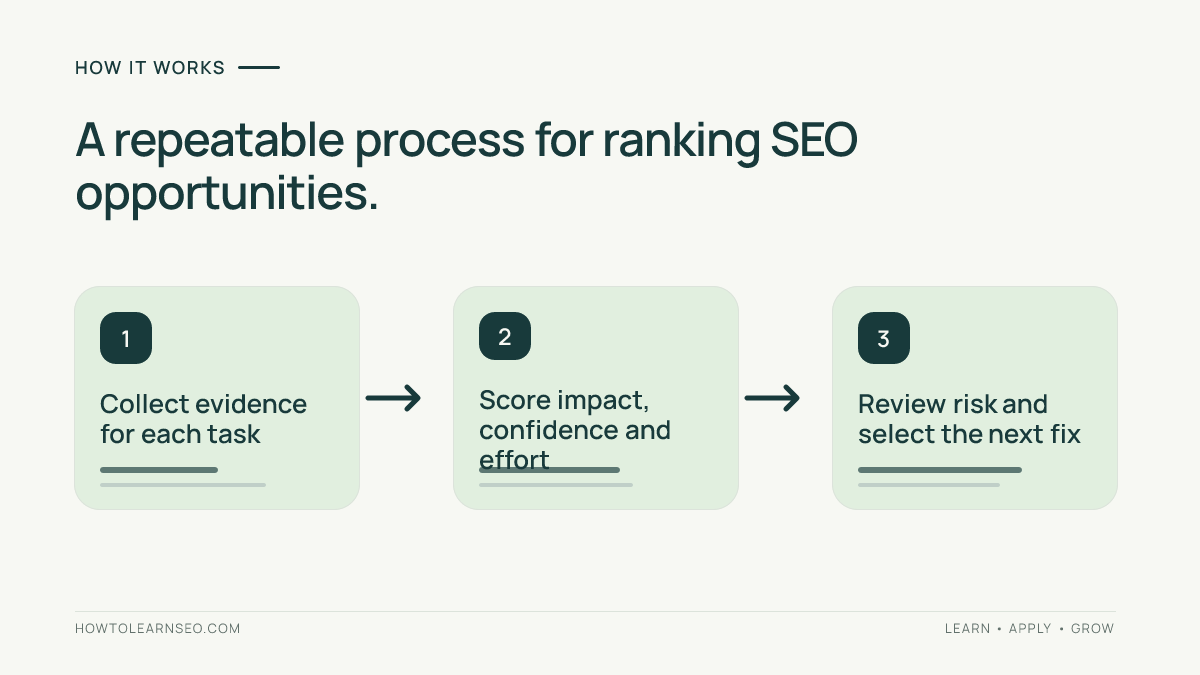
To prioritize SEO tasks, gather opportunities from Search Console, analytics, and a technical review; define the affected pages and desired outcome; assign impact, confidence, effort, and risk scores; rank the candidates; then select a small batch that your team can actually complete. Document the assumptions behind every score. Reassess after measuring results, rather than treating the first ranking as permanent.
Key Takeaways
- Score concrete changes, not vague problems such as “improve SEO.”
- Use observed page and query data before estimating impact.
- Separate confidence from potential upside so guesses do not dominate.
- Consider engineering dependencies, reversibility, and user harm.
- Verify implementation and outcomes with a defined comparison window.
What an SEO Prioritization Matrix Should Decide
A useful matrix answers three operational questions: what should change, why does it matter, and what evidence will show whether it helped? An opportunity such as “update five service pages with missing pricing details” is actionable. “Improve content quality” is not. Record the owner, URL group, proposed action, affected audience, and a measurable result for each row.
Prioritization is especially valuable when different teams compete for the same development time. A broken canonical template may affect hundreds of pages, while rewriting one headline affects a single page. Yet the canonical issue could require a risky deployment, and the headline may solve an urgent user-intent mismatch. A transparent scoring system makes those trade-offs visible without pretending to remove judgment.
Collect Evidence Before Scoring
Build a clean opportunity inventory
Create a spreadsheet with columns for task ID, affected URL, current issue, proposed change, source of evidence, expected user benefit, owner, dependency, and verification method. Deduplicate overlapping suggestions: fixing a template title and rewriting every generated title manually may represent one underlying issue. Split a broad initiative only when the component tasks have independent owners or outcomes.
Use the Google Search Console Performance report to inspect queries, impressions, clicks, and page trends. Google explains the report in its Performance report documentation. Remember that average position is an aggregate and that changes in query mix can alter reported metrics. A drop in clicks does not automatically prove a technical problem.
For established pages, compare the same type of days and account for seasonality. An article about diagnosing content decay can help distinguish aging content from shifts in demand. If you are evaluating a new website, first establish the baseline using a measurement plan so subsequent changes have a reference point.
Separate evidence from assumptions
Label every observation as confirmed, plausible, or untested. A crawl showing that a valuable page returns a server error is direct technical evidence. A hypothesis that a new paragraph will attract more traffic is weaker. Keep both in the queue, but do not assign them equal confidence. Also check whether the proposed change is allowed by product, legal, accessibility, and editorial requirements.
Create a Practical Impact, Confidence, Effort and Risk Rubric
Use a simple one-to-five scale for each factor. Impact estimates the size of the user or business problem addressed; confidence reflects the quality of evidence; effort includes content, design, engineering, review, and testing time; risk reflects possible harm or rollback complexity. Write down what each score means for your organization before reviewing individual tasks.
| Factor | Score 1 | Score 5 |
|---|---|---|
| Impact | Small isolated benefit | Large important user journey |
| Confidence | Mostly hypothesis | Direct reproducible evidence |
| Effort | Small contained change | Complex cross-team release |
| Risk | Easy reversible edit | Potentially disruptive change |
For a first-pass sorting score, calculate impact multiplied by confidence, divided by effort. For example, impact 4, confidence 5, and effort 2 produces 10. This is an illustrative planning heuristic, not an SEO industry standard or a statistically validated forecast. Keep risk as a separate review flag instead of hiding it inside an opaque formula. A high-scoring task with severe deployment risk still needs approval.
Do not assign fake precision. A task scored 8 is not necessarily twice as valuable as one scored 4. Scores are ordinal discussion aids. If your organization has reliable conversion or revenue data, use it to inform impact; otherwise document the qualitative reasoning. An SEO CTR analysis may reveal pages worth investigating, but improving a snippet does not guarantee a higher click-through rate.
Worked Example: Prioritize Four Website Improvements
Imagine a small professional-services website with four opportunities. The figures below are hypothetical training inputs, not measurements from a real property. Its team can complete roughly one medium-sized SEO change each week. The site owner wants to protect inquiry journeys while reducing obvious technical friction.
| Task | Impact | Confidence | Effort | Initial score |
|---|---|---|---|---|
| Fix broken contact-page link | 5 | 5 | 1 | 25 |
| Rewrite thin service introduction | 3 | 3 | 2 | 4.5 |
| Repair inconsistent canonical template | 5 | 4 | 4 | 5 |
| Publish an unrelated blog post | 2 | 2 | 3 | 1.3 |
The broken contact link ranks first because it obstructs a key user journey, is easy to reproduce, and has a contained fix. The canonical template ranks behind it despite potentially broader impact because it needs engineering and regression testing. The service-page rewrite may be worthwhile after the team checks actual query intent. The unrelated blog post has weak justification and should not displace verified fixes.
Next, inspect dependencies. If the canonical defect prevents search engines from selecting intended URLs, repairing it may become urgent even with a lower numerical score. Google describes canonical signals and their limitations in its canonicalization documentation. Confirm the template behavior on representative URLs and obtain a rollback plan before deployment.
The output is a small delivery queue: repair the contact link now; scope and test the canonical fix; validate service-page search intent; defer the speculative blog post. Record why the order changed from the raw score. That explanation matters more than producing a perfect-looking spreadsheet.
Turn the Ranked List into a Weekly SEO Work Plan
Choose no more work than the team can finish and verify. For each accepted item, write an implementation ticket with the exact affected URLs, expected behavior, acceptance tests, responsible owner, and due date. Assign a separate status for blocked tasks. Avoid letting an item appear complete merely because somebody published a document or merged code.
For content work, link each task to its relevant page and target intent. A keyword map can expose competing pages or missing coverage before you commission new copy. For link-related work, review whether the existing navigation and contextual links already help users reach important pages. Do not create links solely to inflate a score.
Include a small reserve for urgent incidents, such as accidental noindex directives or sitewide server failures. These should override the ordinary queue when evidence shows material harm. Conversely, resist declaring every stakeholder request urgent. Ask what happens if the task waits two weeks, and whether a safe workaround exists.
A weekly review can be short: close completed tasks, reassess newly discovered evidence, identify blocked owners, and choose the next two or three changes. Keep an archive of rejected ideas with the reason, so the same low-value proposals do not repeatedly return as fresh opportunities.
Verify the Change and Measure the Outcome
Verification has two layers. First, confirm the intended implementation: the link reaches the correct page, the canonical output matches the specification, or the edited copy appears in rendered HTML. Second, monitor the business and search metrics that motivated the task. A technically correct release can still have little measurable search effect, and that is useful learning.
For technical issues, test a representative sample of affected URLs before and after release. Check HTTP responses, indexability, internal navigation, and relevant page templates. For content changes, preserve the prior version and note the publication date. Google provides guidance on building crawlable links in its link best-practices documentation; use it when checking whether important destinations are accessible through actual links.
Choose a monitoring window appropriate to the task. A broken link can be retested immediately, while search performance may require several weeks of observation. Compare like-for-like periods and annotate seasonality, campaigns, tracking changes, and major site releases. Search Console data can be delayed, and search results are affected by factors outside your change.
Define success before starting: for the contact link, the destination loads and inquiries can be completed; for the canonical template, sampled pages output the intended canonical URL without conflicting signals; for a content rewrite, users can answer the question and engagement or qualified search visits can be reviewed. If results are inconclusive, record that rather than claiming a win.
Common Mistakes and Important Limitations
The biggest mistake is scoring the excitement of an idea instead of its evidence. Other traps include using raw traffic potential as the only measure, ignoring development cost, treating an SEO tool warning as proof of harm, and selecting many tasks that cannot be finished. A priority matrix should help teams ship valuable work, not generate a permanent backlog.
Another mistake is treating correlation as causation. A page can improve after a rewrite because demand changed, a competitor lost visibility, or another site update occurred. Use control pages or comparable groups when feasible, and report uncertainty. Small websites may not have enough observations to distinguish a modest effect from ordinary variation.
This method also has limits. Scores depend on judgment and can favor teams that write persuasive tickets. Counter that by reviewing the rubric together, requiring evidence links, and periodically checking whether high-scoring projects actually produced useful outcomes. Accessibility, legal compliance, and severe technical failures may warrant action regardless of the numerical ranking.
Finally, do not optimize for a fixed number of tasks completed. A single well-tested repair may be more valuable than ten cosmetic edits. Prioritization succeeds when the website becomes easier to use, easier to maintain, and better aligned with real search needs.
Frequently Asked Questions
How often should an SEO priority matrix be updated?
Review the active queue weekly and revisit scoring when new performance evidence, business goals, or technical incidents change the likely value of a task.
Should high-traffic pages always receive priority?
No. Consider business importance, user harm, confidence, and effort. A low-traffic contact or checkout page may deserve urgent attention if it blocks a critical journey.
Can I use the same scores for every website?
Use the same framework, but define impact and effort for each organization. A small local business and a large ecommerce site have different constraints.
What if an SEO task has no reliable traffic forecast?
Mark the forecast as unverified, score confidence conservatively, and use a limited test or direct technical evidence before committing substantial resources.
How should urgent indexing errors be handled?
Escalate confirmed sitewide or business-critical indexing failures outside the routine queue, then document the incident, corrective action, and verification results.
Does a higher prioritization score guarantee better rankings?
No. The score organizes decisions under uncertainty. Rankings depend on many factors, and a successful implementation may not produce measurable organic growth.
Conclusion
A useful SEO prioritization matrix turns scattered ideas into a practical sequence of evidence-backed changes. Define each task precisely, score impact and confidence against effort, review risk and dependencies, and verify the outcome. Keep the rubric simple enough for your team to use consistently, and update priorities when reality challenges the original assumptions.