To find competitor backlink gaps for ethical outreach, compare relevant competing pages, review the real editorial context of their links and approach only publishers whose readers would benefit from your resource. This tutorial provides a repeatable prospecting and verification workflow without promising links or rankings.
Quick Answer
To find competitor backlink gaps, compare relevant websites that link to competing pages but not yours, check whether each linking page is genuine and topically relevant, then develop a useful reason for its editor to consider your resource. A gap is a research lead, not proof that you deserve a link. This guide explains how to create a manageable, evidence-based prospect list without buying links or sending mass-produced requests.
Key Takeaways
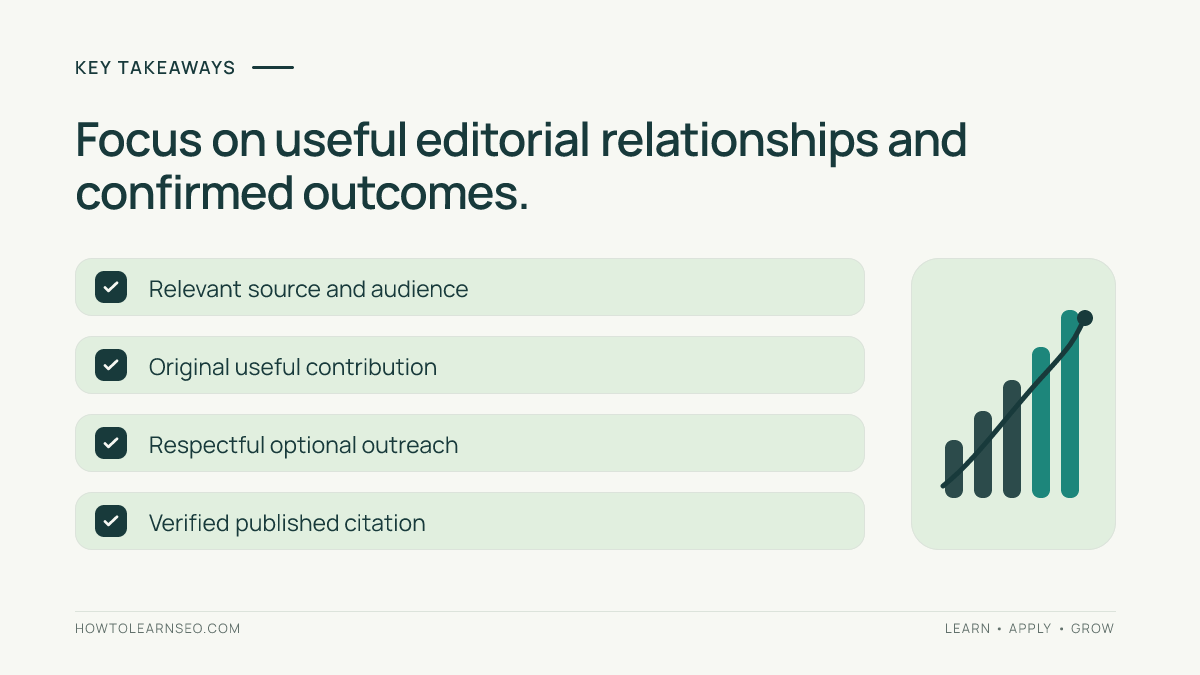
Choose competitors serving the same audience and search intent. Compare specific pages before relying on whole-domain reports. Deduplicate prospects by referring domain and inspect the actual linking pages. Separate editorial citations from directories, advertisements and irrelevant placements. Offer an original resource or correction that genuinely helps readers. Keep outreach personal, optional and respectful. Track editorial responses and qualified links without treating proprietary scores as Google metrics. Verify outcomes on live pages and avoid manipulative exchanges.
Before you begin: define a narrow topic
Choose one topic or service page that deserves relevant citations. Gather its URL, intended audience and strongest evidence. Select two or three competitors that answer the same reader question. A national news publisher is not a useful comparison for a small local plumbing service merely because both rank for one phrase. Write down the search intent and geography so the prospect list remains focused. You will need a spreadsheet, a way to inspect backlink reports, and time to review the actual source pages. A free or existing tool may be enough for a small pilot; vendor databases differ in coverage, so do not assume any single report is exhaustive.
Step 1: Select genuinely comparable pages
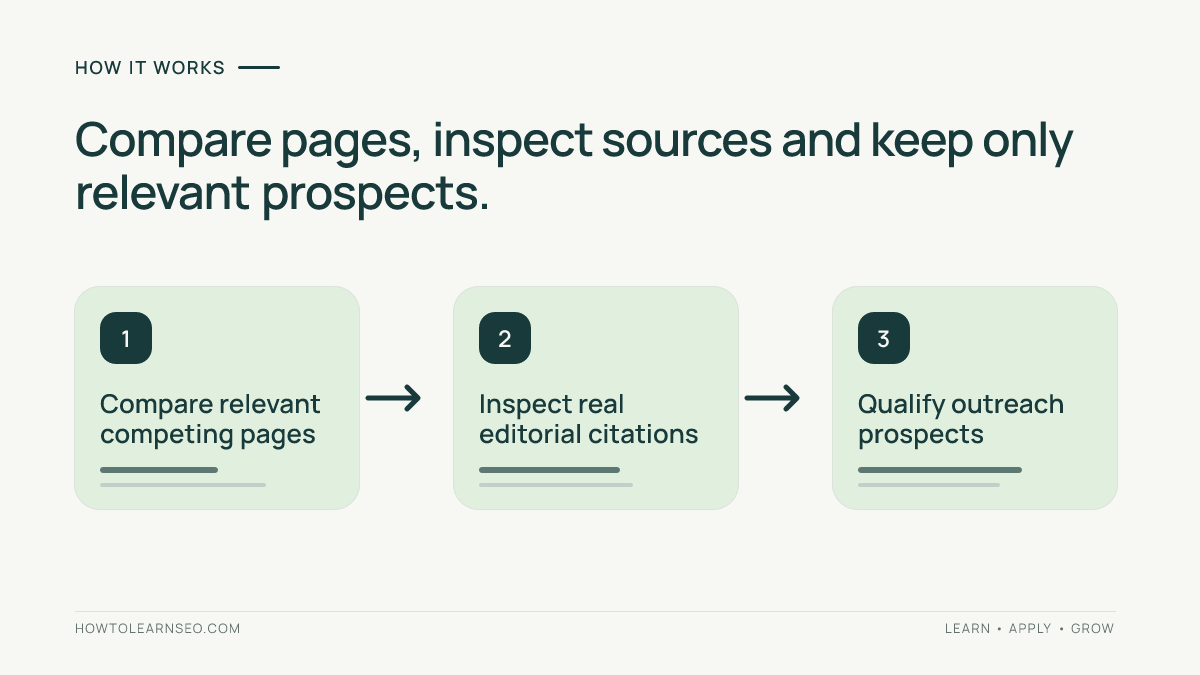
Start with search results and choose competitors offering similar information or services. Compare an article with another article, a local service page with another local service page, or a research resource with another research resource. Record the exact URLs rather than only the domains. Domain-level gaps can be useful for discovery, but they also include links earned for unrelated products, employees or corporate news. If the comparison page is substantially stronger than yours, note what readers gain from it before thinking about outreach. The first task is to understand the citation context, not to copy every backlink.
Step 2: Collect candidate linking sources
Use an accessible backlink report to export pages linking to your selected competitors. Record source URL, destination URL, anchor or surrounding citation, referring domain and discovery date where available. Compare the candidate sources with backlinks already known for your own resource. A spreadsheet with one row per source page is sufficient for a pilot. Keep the original export and the settings used, because backlink indexes can change. If a tool cannot expose a full comparison, manually inspect a small number of relevant competitor citations. Our Majestic review discusses why link databases and metrics need cautious interpretation.
Step 3: Remove irrelevant and misleading gaps
Filter out links that have no realistic relationship to your topic. Examples include a competitor’s investor page, unrelated job listings, private customer portals and automated scraper sites. Inspect the actual linking page rather than trusting a score or anchor-text summary. Check whether the citation is editorial, sponsored, user-generated or simply part of site navigation. A link from a directory may be legitimate but serve a different purpose from a journalist’s citation. Keep prospects whose readers would genuinely benefit from your material. This manual step often reduces a large export to a smaller list worth contacting. A shorter qualified list is more valuable than hundreds of unreviewed domains.
Step 4: Identify the editorial reason for each link
Open the source page and read the paragraph surrounding the competitor citation. Ask what information the editor needed: a statistic, a clear explanation, an example, an expert quote or a reference to a local service. Note whether your resource supplies a distinct answer or more current, verifiable information. Do not assume that a link to a competitor should automatically be replaced with yours. If your content adds no value, improve it before contacting anyone. Our linkable asset audit explains how to assess whether a resource is genuinely citation-worthy.
Step 5: Build a priority worksheet
Create columns for prospect URL, linking context, relevance, editorial contact, possible contribution, evidence, outreach status and outcome. Prioritize pages that are closely related to your topic, actively maintained and accessible to readers. Avoid assigning invented numerical authority or traffic values. Use simple labels such as high, medium and low relevance, with written reasons. For a high-priority prospect, record exactly which sentence or section your resource could help support. Add a last-checked date so stale pages can be removed. This structure makes the decision reproducible and helps prevent repeated outreach to the same editor.
Worked example: a repair-cost guide
Imagine a fictional plumbing company that publishes an original guide explaining what affects emergency repair costs in its city. Two comparable competitors are cited by local homeowner blogs. Input: 40 exported linking-page URLs, the company’s guide and the competitor destinations. Rule: retain only editorial pages discussing local repair planning where the guide offers relevant, verifiable information. Action: remove 22 unrelated or duplicate URLs, inspect 18 candidates and select five with a specific contextual fit. Expected result: five qualified opportunities for optional outreach, not five guaranteed backlinks. Verification: review the live pages and record any editor response or independently published citation. Edge case: one blog links to a competitor’s proprietary survey; your cost guide cannot replace that original evidence, so exclude the prospect. All numbers are illustrative, not observed campaign results.
Step 6: Prepare a useful contribution
Before contacting an editor, check that your page is accurate, accessible and worth recommending. Explain its methodology where relevant, identify limitations and provide clear examples. A resource built solely to attract backlinks can disappoint readers if it lacks substantive value. If the prospect cites a dated fact, offer an updated source only when you can verify the correction. If it cites a competitor’s unique research, do not pretend your general guide is equivalent. Link-worthy resources are useful even if nobody links to them. For legitimate approaches to earning attention, see our community partnership guide.
Step 7: Write a respectful outreach note
Send a short message to the relevant editor only when you have a specific reason. Mention the page you read, explain the useful addition and provide the source URL. Make it clear that a citation is entirely their choice. Do not ask for exact-match commercial anchor text, offer payment for ranking links or imply an obligation to replace an existing citation. One well-researched note is preferable to automated messages sent to every contact on a domain. Our digital PR pitch tutorial offers guidance on concise, non-spammy messages. Respect editorial independence and applicable communication rules.
Step 8: Evaluate links and avoid schemes
Google’s spam policies address link practices intended to manipulate rankings, including certain paid placements and excessive exchanges. Do not purchase editorial links or disguise sponsorship. If a relationship involves compensation or advertising, ensure appropriate link qualification and disclosure. The goal is a genuine recommendation that helps readers, not a fabricated signal. A relevant citation may also send useful referral visitors, but do not promise rankings or traffic from any individual link. A prospect’s proprietary authority score is not a Google ranking metric. Judge the source’s credibility, topic fit and editorial context instead.
Step 9: Verify published outcomes
After outreach, check whether the editor actually published a citation and whether the destination is correct. Record the live source URL, publication date when visible, anchor context and any referral or engagement evidence available. Do not count a positive email response as an earned backlink. If the editor declines or does not respond, close the prospect respectfully rather than escalating pressure. A discovered link can disappear or change later, so occasional verification is useful. Google’s Search Console links report documentation explains first-party link reporting, though it is not an exhaustive inventory. Track confirmed outcomes separately from vendor estimates.
Step 10: Review what the campaign taught you
Review how many prospects were relevant, how many were contacted, how many responded and how many independent citations were verified. Do not judge success only by the total number of links. Ask whether the resource became more useful, whether editors raised questions and whether the process revealed gaps in your original content. A small campaign may show that the resource needs better data before more outreach. Record the editorial reasons behind successful and unsuccessful approaches. Keep this learning separate from ranking claims; organic performance is influenced by many factors. For foundational context, our link building guide explains the broader strategy.
Common mistakes and limitations
Avoid comparing unrelated competitors, treating every backlink as an opportunity, or contacting editors without reading their articles. Do not send generic replacement requests, claim a competitor link is broken when it works, or rely on a single proprietary metric. Link indexes miss some sources and may retain stale records. A gap report cannot reveal whether an editor is open to submissions. Even an excellent pitch may receive no reply. Outreach should respect privacy, publisher guidelines and the recipient’s choice. The method is useful because it identifies potentially relevant relationships, not because it guarantees placements.
A practical monthly maintenance routine
Once a month, review a manageable set of new competitor citations and compare them with your existing prospect sheet. Remove duplicates, check whether old prospects still publish relevant content and update the status of any confirmed editorial links. Revisit your own resource when facts or services change. Avoid repeatedly emailing the same people simply because a tool still lists them as gaps. Keep a clear record of opt-outs and negative responses. Share the resulting lessons with your content team so future resources better answer the questions that editors actually cite. A consistent small process is easier to maintain than sporadic mass outreach.
Frequently Asked Questions
What is a competitor backlink gap?
It is a potential linking source observed citing a competitor but not your selected page or website, subject to the backlink tool’s coverage.
Can backlink gap analysis guarantee new links?
No. A gap identifies a research opportunity; publishers decide independently whether a resource deserves a citation.
Should I compare domains or individual pages?
Start with comparable pages for clearer editorial context. Domain-level comparisons can help discovery but include many unrelated links.
Are authority scores reliable for choosing prospects?
They are proprietary estimates, not Google metrics. Inspect topical relevance, editorial context and source credibility directly.
Is it acceptable to pay for backlink placements?
Avoid paying for links intended to manipulate rankings. Advertising and sponsored placements require appropriate disclosure and link qualification.
How should I measure outreach results?
Track qualified prospects, genuine responses and independently verified published citations, while documenting data and attribution limitations.
Conclusion
Competitor backlink gap analysis works best as a focused editorial research process. Compare comparable pages, qualify sources manually, contribute useful evidence and verify independently published outcomes. Keep outreach optional and respectful, and use each campaign to improve the resources you offer readers.