This Majestic SEO review explains its backlink research workflows, Trust Flow and Citation Flow metrics, index limitations and buying considerations. The key question is whether Majestic helps your team make verifiable link research decisions rather than simply collect more backlink counts.
Quick Answer
Majestic is a specialist backlink intelligence platform focused on link discovery, link profiles and proprietary metrics such as Trust Flow and Citation Flow. It can help SEO teams investigate where links come from, compare referring domains and identify patterns worth checking. Its scores are not Google ranking factors, and its index cannot include every link on the web. It is most useful when backlink research is a recurring task rather than an occasional curiosity.
Key Takeaways
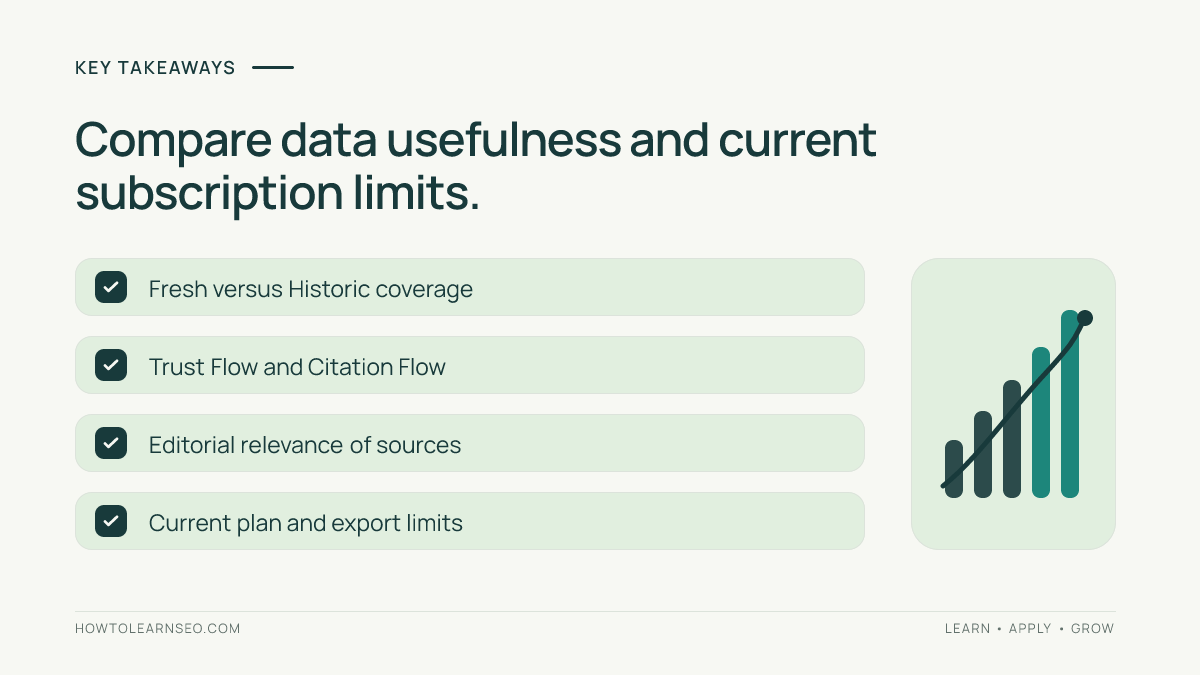
Majestic is best evaluated as a backlink research tool, not a complete replacement for analytics or technical crawling. Understand the difference between Fresh Index and Historic Index before comparing reports. Use Trust Flow and Citation Flow as modeled context, never as guaranteed quality or ranking measures. Examine actual linking pages and topical relevance. Record export limits and current subscription terms. Test whether the data leads to a defensible outreach, cleanup or competitive research decision before purchasing.
What Majestic does
Majestic collects and organizes observations about links between websites. Analysts use its backlink index to examine referring domains, linked pages, anchor text and other relationship patterns. This is a different starting point from a general SEO suite that combines keyword research, technical crawling, ranking reports and content recommendations. Majestic’s specialization can be useful when a team needs to investigate how websites reference one another. Yet a link index is necessarily incomplete and changes as the crawler discovers, revisits and loses access to pages. A missing link in Majestic is not proof that the link does not exist. A detected link is not proof that Google counts it in the same way. The correct output from link research is a reasoned assessment of relevant sources, potential opportunities and suspicious patterns, supported by inspection of actual pages. Treat dashboards as maps for investigation, not substitutes for evidence.
Who should consider Majestic
Link-building consultants, digital PR teams and agencies conducting competitor backlink analysis are natural candidates. An in-house SEO team may use Majestic to understand which publications reference important content and where competitors receive editorial citations. A publisher might examine whether research assets attract links from relevant specialist websites. A small business that rarely conducts link research may be better served by basic first-party reports and occasional manual inspection. Teams needing extensive keyword research, content optimization or technical audits should understand that a specialist link tool may not replace those functions. Start with the recurring decisions you need to make. Are you choosing outreach targets, analyzing the links to a migrated page or understanding a competitor’s cited resources? Assign someone to inspect results and act on them. Without a repeatable decision process, more backlink rows will not create more valuable editorial relationships.
Fresh Index and Historic Index
Majestic is known for Fresh and Historic link indexes. Their purposes differ: a fresher view is intended to reflect more recently observed link relationships, while historical coverage can help investigate a longer record of discovered links. The exact windows, availability and interface behavior can change, so confirm current definitions in the vendor’s documentation. Never compare counts from different indexes as though they represent the same population. A link present in a historical dataset may no longer be live. Conversely, a recently published citation may not yet appear in a crawler’s observations. Record the selected index and export date with every analysis. If you are auditing a current outreach campaign, prioritize live verification of important linking pages. If you are studying a site’s link history, use historical observations as leads to investigate, not conclusive proof that each relationship still exists.
Trust Flow explained
Trust Flow is a proprietary Majestic metric intended to represent aspects of link quality within its own link graph model. It is not a score provided by Google. The metric may help compare broadly similar sites, but it cannot establish whether a particular link is editorially relevant, likely to send readers or valuable for rankings. Always inspect the actual linking page, its subject and the context surrounding the link. A small specialist publication can provide a highly relevant citation even when a broad metric appears modest. Conversely, a large site may link from an irrelevant page that offers little value to users. Avoid setting outreach targets solely around a minimum Trust Flow threshold. Explain to clients that modeled scores are decision aids rather than direct measures of search-engine trust. For current definitions, consult Majestic’s official resources rather than relying on third-party interpretations of the formula.
Citation Flow explained
Citation Flow is another proprietary Majestic metric associated with link influence or quantity-related patterns in its model. It is often viewed alongside Trust Flow, but the relationship between two modeled numbers should not be turned into a universal spam test. A high Citation Flow relative to Trust Flow may prompt investigation, not automatic rejection. Some websites legitimately attract large numbers of repeated or sitewide links. Others may have unusual historical link patterns that no longer reflect current content. Check referring domains, actual source pages, link placement and topical fit before making a judgment. Proprietary metrics can change as indexes and models evolve, so record the observation date. Never describe Citation Flow as a Google ranking factor or claim that adjusting a ratio will guarantee better search visibility. Its role is to help prioritize what to inspect next.
Topical Trust Flow and relevance
Topical Trust Flow groups aspects of Majestic’s link graph into topic-oriented signals. This can help researchers investigate whether a website’s link neighborhood appears aligned with a subject area. It is still a model, not a definitive classification of every page or audience. A publication may legitimately cover multiple subjects, and a single page may be more relevant to your business than its domain-level category suggests. Suppose a cycling repair business finds a link opportunity from a regional sports organization. The organization may publish content across many sports, but a specific article about bicycle maintenance could be highly relevant. Inspect the page, editorial context and audience before deciding. Use topical metrics to narrow a long list, then apply human judgment. The strongest opportunity is a useful citation that makes sense even if the proprietary topic score were hidden.
Site Explorer workflow
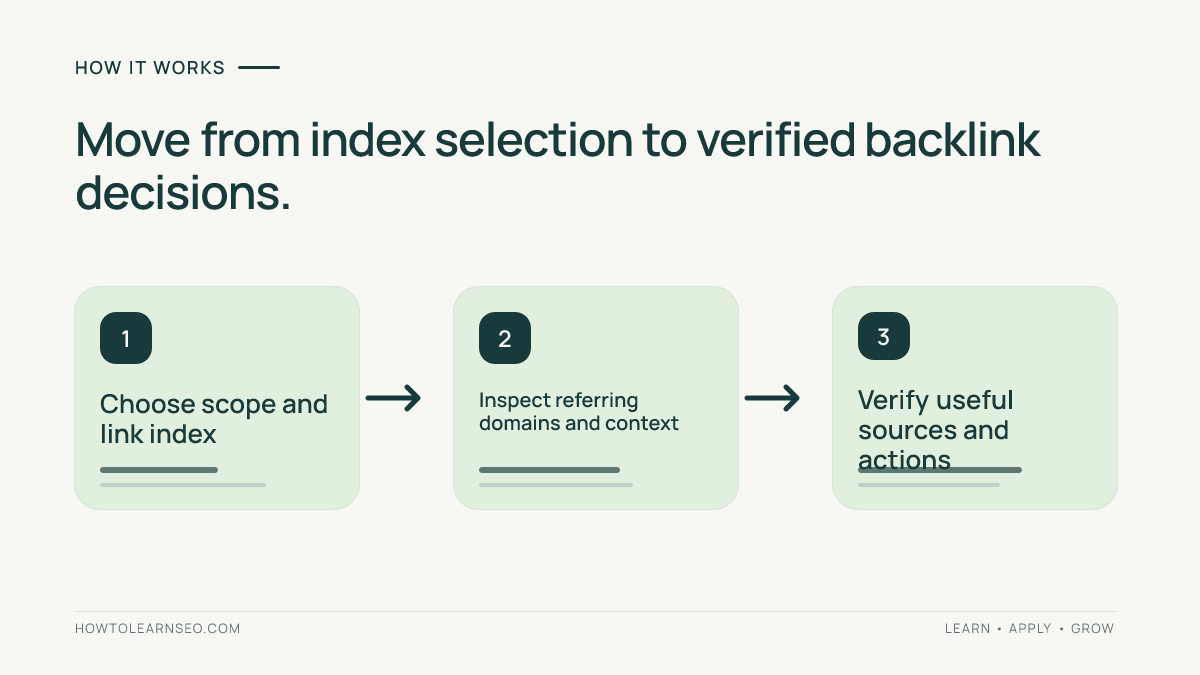
Site Explorer is a common starting point for examining a domain or URL in Majestic. Before running an analysis, decide whether the question concerns the whole domain, a subdomain or one specific page. These scopes can yield very different findings. Select the appropriate index and record it. Review referring domains and linking pages, then filter toward sources that relate to your business or content. Inspect representative pages manually rather than treating all detected links as equal. Note whether links point to the homepage, a research article, a product page or an outdated resource. A strong report should explain what the linking relationship means and whether action is warranted. Do not infer that the tool’s complete backlink count equals Google’s internal link graph. Majestic observes its own crawl data and provides a useful, but partial, view of the web.
A reproducible competitor link example
Imagine a local cycling shop comparing its maintenance guide with a competitor’s guide. The example is hypothetical; no live Majestic account or measured link counts are claimed. First, select the two exact guide URLs rather than comparing unrelated homepages. Second, inspect their referring domains using the same index and observation date. Third, classify potential sources as cycling clubs, local news, manufacturers, directories or unrelated sites. Fourth, open the most relevant linking pages to understand why the competitor earned a citation. The decision rule is to pursue sources where your guide provides a genuinely useful resource, not merely where a competitor has a link. Expected output: a short outreach plan identifying a missing safety checklist or original illustration that would help the audience. Verification: confirm that your improved guide is published, outreach is appropriate and any subsequent citation is live. Edge case: a competitor’s link may be from a paid sponsorship; do not copy it as an editorial tactic without checking disclosure and link policies.
Referring domains versus backlink totals
One website can link to another many times, especially through repeated navigation, footers or templates. Therefore, a raw backlink total and the number of distinct referring domains answer different questions. A sudden increase in links might come from one site adding a sitewide link, not from hundreds of new editorial endorsements. Segment by source domain, linking page and context. Consider whether the relationship is relevant to the linked content and useful to visitors. For competitive comparisons, use consistent domain or URL scope and the same index. A smaller set of relevant editorial sources can be more informative than a huge collection of repeated links. Avoid turning either count into a standalone performance target. The objective is to understand meaningful relationships between useful resources and the websites that cite them.
Anchor text interpretation
Anchor text describes the clickable wording of a link. It can help reveal why a page is referenced, but a backlink index may contain incomplete or changing observations. Review anchors in context. Brand names, article titles and natural descriptive phrases often reflect ordinary editorial behavior. An unusually repetitive exact-match phrase can justify closer examination, especially when paired with questionable source pages, but it is not proof of manipulation by itself. Do not contact publishers to force keyword-rich anchors or attempt to engineer unnatural patterns. For internal links, use clear wording that helps users anticipate the destination; our internal linking guide
Link context and placement
A backlink’s surrounding content can matter more to a human reviewer than a domain-wide score. Open the source page and ask why the link appears. Is it a citation supporting a claim, a relevant resource for readers, a paid placement or an automated directory entry? Does the page have a clear topic and credible editorial purpose? Is the destination still useful and accessible? A link in a relevant guide can have a different practical role from a repeated footer link. Majestic’s available context features may assist investigation, but current capabilities should be verified on the selected plan. Record the page URL, placement, subject, likely audience and reason for inclusion in an outreach shortlist. If the link would look strange to a reader who knew nothing about SEO metrics, reconsider its value.
Link gaps and competitor research
A competitor link gap identifies websites observed linking to competitors but not to your chosen domain or page. That difference is a lead, not a mandate to request a link. Competitors may have sponsorships, historical partnerships, news coverage or proprietary datasets you do not share. Select close organic competitors for the same topic, then inspect the most relevant linking pages. Ask what resource earned the citation and whether you can create a different, useful contribution. Our local backlink partnerships guide describes relationship-based opportunities. Avoid mass emailing every domain from a gap export. A short list of relevant publications with a genuine reason to reference your work is more valuable than a long list filtered only by a proprietary score. Record outreach outcomes separately from discovered links so the analysis remains auditable.
Broken backlinks and reclaiming references
Link reclamation begins with an observed citation pointing to a page that no longer serves its intended purpose. Check whether the destination returns an error, redirects unexpectedly or has been replaced by a more useful page. Then determine whether you control the destination and whether a relevant replacement exists. If you do, fixing the destination or adding an appropriate redirect may restore a useful reader journey. If a third-party article links to an outdated resource, a polite correction request may be appropriate when you can provide an accurate replacement. Do not automatically redirect every missing URL to the homepage. Verify that the final page matches the original context. A backlink tool helps locate candidates, but the repair must be confirmed through direct page inspection. The outcome is a working citation and a better experience for readers, not merely a recovered row in a report.
Investigating suspicious links responsibly
Unusual link patterns can arise from spam, scrapers, hacked pages, syndication or legitimate sitewide references. A high volume of low-quality-looking links does not automatically mean a site is penalized. Begin by inspecting representative sources, dates and destinations. Distinguish links you created or purchased from links outside your control. Review Google’s official spam policies before making claims about manipulative practices. Do not treat a proprietary score as a toxic-link verdict. If considering disavowal, consult Google’s specific guidance and understand that it is not a routine housekeeping task for every site. Maintain evidence for any action and avoid sending threatening removal requests based on an automated export. The safest approach is to prioritize confirmed violations and real risks rather than trying to eliminate every unfamiliar referring domain.
Historic links and migration investigations
Historical backlink observations can be useful during a domain migration, site redesign or content consolidation. Start with a list of important old URLs and identify which had meaningful external citations. Verify whether the source pages still exist and whether their links remain live. Map old destinations to the most relevant current resources rather than sending everything to the homepage. Test redirect paths and check that the final pages satisfy the original user intent. Historic index entries may include links that no longer exist, so direct verification is essential. For a migration, coordinate with technical SEO and development teams to maintain consistent redirects and internal navigation. Our SEO audit guide offers broader diagnostic context. Use historical data to prioritize important legacy URLs, not to promise that every old link’s search value can be recovered.
Majestic reports for digital PR
Digital PR teams can use backlink observations to understand which publications cite original research, expert commentary or useful tools. Group referring sources by editorial theme rather than ranking them only by a proprietary metric. For a new research asset, define the intended audience and why a journalist or specialist would find it worth referencing. After publication, track relevant coverage, inspect the context of citations and verify that the destination works. Separate genuine earned media from syndicated copies and paid placements. A successful campaign can produce brand awareness, referral visits and relationships even when a third-party link count changes slowly. Avoid presenting an index’s discovery date as the exact date a journalist published an article unless independently confirmed. Link intelligence supports PR evaluation, but it does not replace audience, coverage and business-impact reporting.
How Majestic fits with Search Console
Google Search Console offers first-party reporting for verified properties, including search performance and some link information. Majestic provides a separate, independently crawled backlink dataset with its own definitions and coverage. Counts may differ substantially without either source being defective. Compare the purpose of each report before reconciling numbers. Use Search Console to understand Google Search clicks and impressions for your property, and Majestic to explore a broader set of observed linking relationships. Do not assume a link found in one system must appear in the other. Google’s Search Console links report documentation explains its reporting scope. Record dates and dataset limitations when presenting a comparison. For a business decision, combine link observations with relevant referral traffic, brand mentions and content outcomes instead of treating a backlink count as a complete success metric.
Majestic versus Ahrefs and Semrush
Ahrefs and Semrush offer broad SEO ecosystems that include backlink analysis alongside other research and monitoring capabilities. Majestic is more specialized in link intelligence. This distinction may make Majestic appealing to a team whose main recurring questions concern referring domains, link context and historical relationships. A generalist team may prefer fewer subscriptions if its existing platform already supports the necessary link research. Test all candidates using the same URLs, index dates where possible and specific tasks. Compare whether the tools surface relevant sources, whether analysts can verify them, how exports support work and what each subscription costs. Our Ahrefs review offers a separate evaluation. Do not treat different vendors’ authority metrics as interchangeable. They use different models and link indexes, so identical-looking numbers can represent different assumptions.
Pricing and subscription limits
Majestic pricing, index access, export allowances and subscription tiers can change. Check the official vendor pages for current plans, currencies, billing terms and any feature restrictions. Consider how many domains or URLs you investigate each month, how many rows you need to export and whether team access is required. If your workflow depends on historical research or bulk data, confirm those allowances explicitly. Include analyst time, verification effort and other software costs in the purchase decision. A low advertised monthly price may be poor value if the required research capacity is unavailable. A more expensive plan may be unnecessary for occasional link checks. This review intentionally avoids quoting an unverified current price. Save the plan name and date checked in the evaluation worksheet so future readers know which terms supported the decision.
Seven-day Majestic evaluation
Day one: define three backlink research questions and select representative domains and URLs. Day two: compare Fresh and Historic views, recording the chosen index and observation date. Day three: inspect referring domains for one important page and manually verify a sample. Day four: examine anchors and link context without assuming every unusual pattern is manipulative. Day five: compare a close competitor’s editorial citations and identify a legitimate content opportunity. Day six: create a short report separating verified findings, uncertain observations and recommended actions. Day seven: compare time spent, actionable sources found, export usability and current subscription cost with existing tools. This is a suggested test plan, not a claim that a paid Majestic account was tested. If a plan blocks a necessary check, document the limitation rather than inventing results. The goal is one defensible decision and a repeatable research process.
Decision worksheet with an edge case
Use columns for question, input, rule, expected output, verification and caveat. Example question: which publication should receive an outreach pitch about a new cycling safety guide? Input: competitor referring domains, a shortlist of relevant articles and the new guide’s original contribution. Rule: choose publications whose readers would benefit from the resource and whose editorial policies permit an appropriate citation. Expected output: three personalized pitches explaining the actual value, not generic requests for links. Verification: check whether editors respond and whether any resulting citation is live and contextually relevant. Edge case: one apparent competitor link is a sponsored placement, so exclude it from an earned-editorial outreach benchmark. A second worksheet can track reclaimed links by old destination, relevant replacement and redirect verification. These examples demonstrate decisions without claiming measured results from a live tool.
Common mistakes
Do not treat Trust Flow or Citation Flow as Google ranking factors. Do not assume a link index contains every backlink. Do not compare Fresh and Historic totals without identifying the dataset. Do not label a domain toxic based only on a metric ratio. Do not pursue irrelevant sites merely because they link to competitors. Do not confuse a link’s discovery date with its publication date. Do not redirect every old URL to the homepage in the name of link reclamation. Do not report a rising backlink count as guaranteed organic traffic growth. Most importantly, do not buy a specialist subscription without a clear owner and recurring decisions it will improve. Each mistake can be prevented with documented scope, representative manual verification and a distinction between modeled observations and confirmed facts.
Strengths and limitations
Majestic’s strength is its focus on relationships between websites and the ability to explore link profiles through multiple views and proprietary metrics. For specialists, that focus can support more detailed research than a general dashboard used only occasionally. The limitations are equally important. Link indexes are incomplete, metrics are modeled, and feature availability depends on the chosen plan. A backlink profile cannot explain every ranking movement. Editorial relevance and reader usefulness require human judgment. Historical observations may no longer represent live pages. Some organizations will still need a general SEO suite, Search Console, analytics and manual outreach records. The platform is best understood as one evidence source within a larger SEO process. Its value should be measured by better research decisions, not by the number of rows exported.
Buying verdict
Majestic is worth evaluating if backlink research is a recurring, specialized task and its data helps your team make better outreach, competitive research or link-reclamation decisions. It is less compelling when link research is occasional or an existing suite already provides enough evidence. Test the actual queries and exports your team needs, inspect source pages manually and verify current plan terms. Choose the subscription only if it improves the speed or quality of decisions that matter to your website or clients. A useful link intelligence platform helps explain relationships between resources; it cannot replace editorial judgment or guarantee rankings.
Frequently Asked Questions
What is Majestic SEO mainly used for?
Majestic is primarily used for backlink research, referring-domain analysis, link context investigation and competitor link-profile comparisons.
Is Trust Flow a Google ranking factor?
No. Trust Flow is a proprietary Majestic metric and is not a ranking score supplied or directly used by Google.
What is the difference between Fresh and Historic Index?
They provide different views of Majestic’s observed link data, emphasizing more recent observations or longer historical coverage. Check current vendor definitions.
Does Majestic find every backlink?
No third-party link index finds every link. Crawl coverage, discovery timing and access restrictions affect the backlinks reported.
Can Majestic replace Ahrefs or Semrush?
It may meet specialist link research needs, but broader platforms also provide keyword, technical and other SEO workflows that Majestic may not replace.
How should I evaluate Majestic before buying?
Test representative domains and pages, verify useful linking sources manually, compare exports and workflows, and confirm current plan limits and costs.
Conclusion
Majestic can be valuable for teams that routinely investigate backlinks and need a specialist view of linking relationships. Use its metrics as context, verify important sources, and check current subscription limits. Choose the tool if it improves legitimate outreach, link reclamation or competitor research—not because a proprietary score promises rankings.