
Link building can help a useful page earn wider recognition, but it is also one of the easiest parts of SEO to misunderstand. The goal is not to collect the largest possible number of links. It is to earn relevant, editorially chosen links that help real readers discover a resource worth visiting.
This guide explains link building for SEO from the ground up: how links support discovery and ranking, what makes one backlink more useful than another, which methods are sustainable, how to plan outreach, and how to measure progress without becoming distracted by vanity metrics.
Quick Answer: What Is Link Building for SEO?
Link building for SEO is the process of earning links from other websites to pages on your own site. A strong link is usually relevant to the surrounding content, useful to the reader, placed by an editor or site owner, and connected to a page that genuinely deserves attention. Effective link building combines valuable content, sensible promotion, relationship building, and careful measurement. It does not depend on buying ranking credit or mass-producing low-quality links.
Key Takeaways
- A backlink is the individual link; link building is the strategy used to earn suitable backlinks.
- Relevance, editorial choice, context, and destination quality matter more than a raw link count.
- The best campaigns begin with a useful page and a clear audience, not a list of websites to email.
- Outreach works best when it explains a specific benefit for the recipient and their readers.
- Paid, sponsored, and user-generated links need the appropriate link attributes.
- Measure qualified referring domains, referral value, target-page performance, and business outcomes together.
How Link Building Fits Into SEO
Search engines use links for several purposes. Links help crawlers discover pages, give context about the relationship between pages, and contribute to systems that assess which pages may be useful for a query. Google explains that its core ranking systems still include link analysis systems and PageRank, although links are only part of a much larger ranking process.
This is why link building belongs within off-page SEO. You are improving signals and awareness beyond your own website. It is different from internal linking, where you connect pages on the same domain and control both the placement and destination.
It also helps to separate two terms that are often used as if they mean the same thing:
- Backlink: a link from another website to your website.
- Link building: the research, content, promotion, and relationship work used to earn appropriate backlinks.
If you are new to the subject, first understand what backlinks are and why they matter. Link building is the practical next step: deciding which pages should attract links and how the right publishers might discover them.
What Makes a Backlink Valuable?
No single metric can tell you whether a link is good. A useful evaluation considers the page, the website, the placement, and the reason the link exists.
Topical relevance
A link makes more sense when the source page and destination share a genuine subject relationship. A bookkeeping guide linking to a tax calculator has an obvious reader benefit. A link to the same calculator from an unrelated celebrity directory is harder to justify, even if the directory reports an impressive third-party authority score.
Editorial choice
The strongest links are normally included because an author or editor decided the destination adds evidence, explanation, or utility. The site owner was not forced to include it, and the link was not inserted automatically across hundreds of pages.
Useful context and anchor text
The words and sentences around a link should make its purpose clear. Descriptive anchor text helps readers understand what they will find after clicking. It should sound natural rather than repeatedly forcing the same commercial phrase. The site’s guide to anchor text SEO explains how branded, descriptive, partial-match, and other anchors fit into a natural link profile.
A destination worth recommending
Outreach cannot compensate for a weak target page. A thin sales page, vague article, or copied list gives publishers little reason to link. A complete tutorial, original dataset, useful template, calculator, visual explanation, or carefully maintained reference is easier to recommend because it solves a clear problem.
A credible source and real audience
Look beyond a domain score. Review the source site’s editorial quality, topical focus, ownership transparency, publishing pattern, and whether its pages appear built for people. A smaller specialist publication with an engaged audience can be more valuable than a large general site with irrelevant, low-quality pages.
Practical rule: if you would still want the link for relevant referral visitors even if search engines ignored it, the opportunity is usually worth serious consideration.
A Step-by-Step Link Building Process
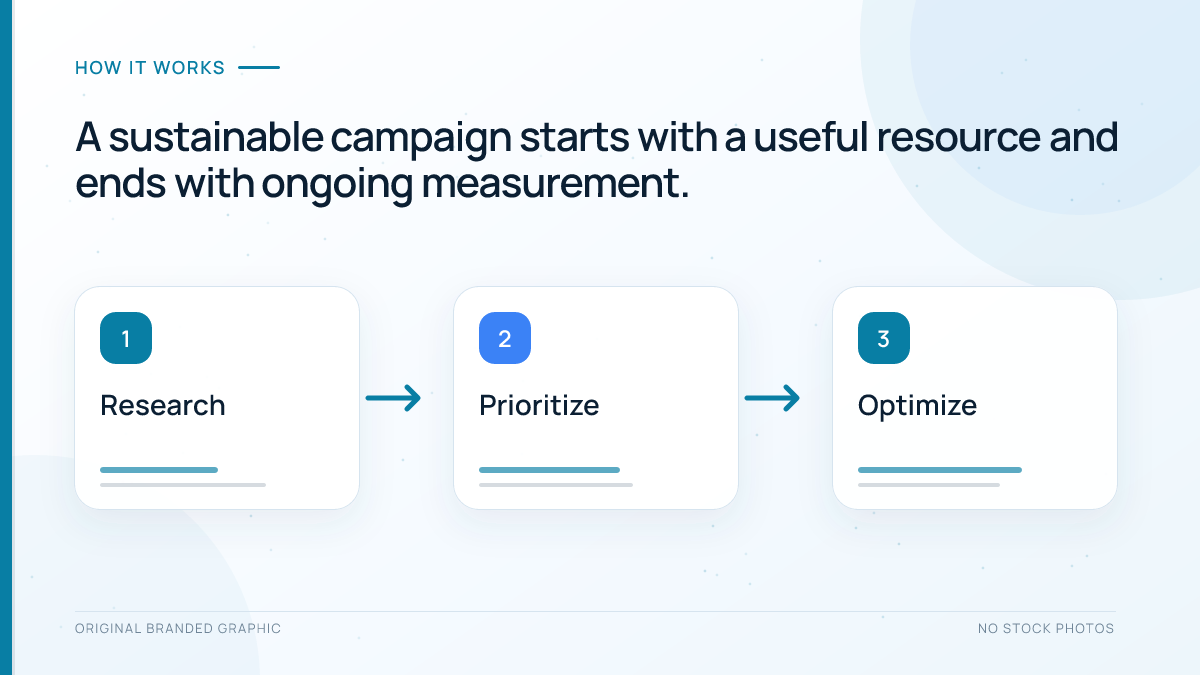
1. Set a goal and choose the right target page
Begin with the outcome you want. You might need to establish a new resource, help a priority category become more discoverable, attract qualified referral visitors, or strengthen a topic cluster. Choose a page that serves that goal and is complete enough to deserve a recommendation.
A common mistake is sending every backlink to the homepage. Deep links to relevant guides, tools, studies, and category resources can create a more useful path for readers. They also spread recognition across the site instead of concentrating every opportunity on one URL.
2. Create or improve a link-worthy resource
Ask why a publisher would cite your page instead of one of the many alternatives. The answer should be visible on the page. Useful linkable assets include:
- Original research, surveys, or carefully documented data
- Free calculators, templates, checklists, and worksheets
- Definitive tutorials that make a difficult process easier
- Expert commentary that adds a clear, defensible perspective
- Statistics pages that cite original sources and stay maintained
- Visual diagrams that explain a process accurately
You do not need a large study for every campaign. A genuinely useful comparison table, downloadable template, or clearer explanation can be enough when it fills a real information gap.
3. Find relevant prospects
Prospecting means finding pages and people for whom your resource could be helpful. Start with audience overlap rather than authority thresholds. Search for resource pages, articles that cite older information, relevant newsletters, trade publications, associations, podcasts, and authors who regularly cover your subject.
Review each candidate manually. Confirm that the site is active, the content is credible, the page is related, and a link would make editorial sense. A shorter list of suitable prospects is usually more productive than thousands of scraped email addresses.
4. Choose a reason for contacting each prospect
Outreach needs a specific reason. “Please link to my article” places all the work on the recipient. A better message explains where the resource fits and why it improves the reader’s experience. For example, you might point out that a cited study has been replaced, offer a clearer diagram for a complex section, or share original data that supports a claim the author already discusses.
5. Write concise, personalized outreach
Use the recipient’s name, mention the exact page you reviewed, and explain the fit in a few sentences. Do not pretend to be a loyal reader if you discovered the site five minutes ago. Do not hide the fact that the suggested resource is yours. Honest, relevant outreach protects your reputation even when the answer is no.
A simple structure works well:
- Identify the specific article, page, or audience connection.
- Explain the gap, update, or extra value you noticed.
- Introduce your resource and state why it may help.
- Let the editor decide without pressure or repeated chasing.
6. Track responses, placements, and lost links
Record who was contacted, why the opportunity was relevant, when you followed up, and what happened. When a link goes live, confirm that it points to the intended URL and that the destination works. Continue monitoring because pages are edited, moved, and removed. A lost link may simply require a polite note or an appropriate redirect if your own URL changed.
Sustainable Link Building Methods
| Method | How it works | Best fit | Main caution |
|---|---|---|---|
| Digital PR | Offer original data, timely expert commentary, or a strong story to relevant journalists and publishers. | Brands with credible expertise, data, or newsworthy insights | A press release alone does not create editorial value. |
| Resource-page outreach | Suggest a genuinely useful guide or tool for a curated list of resources. | Educational content, tools, templates, and reference pages | The resource must closely match the page’s audience. |
| Unlinked brand mentions | Find existing mentions of your brand, research, or product and request a link where it helps readers. | Established brands and named experts | Not every mention needs or deserves a link. |
| Broken-link replacement | Find a relevant dead resource, create or identify a suitable replacement, and alert the publisher. | Evergreen reference content | A loosely related page is not a true replacement. |
| Expert contributions | Provide useful commentary, examples, or an article to a relevant publication with full editorial control. | Practitioners with real subject knowledge | Avoid scaled guest posting created mainly for keyword-rich links. |
| Relevant directories and associations | List a legitimate organization where customers or members would reasonably expect to find it. | Local businesses, professionals, and industry members | Avoid low-quality directories built only to sell links. |
For a practical list of tactics that do not require purchasing placements, see these free backlink strategies. Treat each tactic as a starting point, then apply the relevance and editorial-value checks in this guide.
Anchor Text and Link Placement
You usually control anchor text on your own site, but you should not try to dictate every word used by an independent publisher. Natural link profiles contain variation because different authors describe resources differently.
When suggesting a placement, prioritize clarity. A descriptive phrase inside a relevant paragraph is easier for readers to understand than “click here,” but an exact-match keyword repeated across many arranged placements can look unnatural. Branded anchors, page titles, plain URLs, partial descriptions, and contextual phrases can all be appropriate.
Placement matters for people, too. A contextual link in the section where the resource solves a question is more useful than an unrelated footer link. Google’s SEO Starter Guide recommends clear anchor text and linking when another resource adds value or corroborates the content.
Link Building Practices to Avoid
Link building becomes risky when the main purpose is to manipulate rankings rather than help readers. Google’s spam policies identify practices such as buying or selling links for ranking purposes, excessive link exchanges, automated link creation, low-quality directory links, optimized links in scaled guest posts, and low-value content created mainly to manipulate linking signals.
Do not confuse advertising with an editorial endorsement
Advertising, sponsorships, affiliate relationships, and product partnerships are normal. The issue is whether a paid placement passes ranking credit as if it were independent. Google advises marking paid placements with rel="sponsored"; nofollow is also acceptable. Links added by users in comments or forums can use rel="ugc". The official guide to qualifying outbound links explains these relationships.
Avoid shortcuts that cannot survive manual review
- Do not purchase bundles promising hundreds of permanent dofollow links.
- Do not use automated comments, profiles, or forum posts to manufacture links.
- Do not build private networks of thin websites to link to yourself.
- Do not exchange links at scale without a genuine editorial reason.
- Do not publish near-duplicate guest articles across unrelated sites.
- Do not judge an opportunity only by a third-party authority score.
If a tactic would be difficult to explain honestly to a search quality reviewer, client, or reader, it is probably not a sustainable tactic.
How to Measure Link Building Results
Links can take time to be discovered, processed, and reflected in performance. Rankings also change for many reasons, so avoid claiming that one new backlink caused every movement. Use a group of measures and look for trends.
Campaign activity metrics
- Qualified prospects researched
- Personalized messages sent
- Positive replies and editorial conversations
- Links earned and links lost
Link quality and coverage metrics
- New relevant referring domains
- Topical fit of the linking pages
- Editorial and contextual placement
- Distribution across important destination pages
- Natural variation in anchor text
Performance and business metrics
- Referral visits and engaged sessions
- Organic visibility for the target page and related topic cluster
- Conversions, subscriptions, leads, or other meaningful actions
- Mentions, partnerships, and repeat publisher relationships
Domain Authority and similar scores can help compare prospects consistently, but they are third-party estimates rather than Google ranking scores. The guide to Domain Authority explains how to use that metric without treating it as a target in itself.
Common Link Building Mistakes
Starting outreach before the page is ready
Editors often make a decision within seconds. Broken layouts, unclear authorship, unsupported claims, aggressive pop-ups, and shallow content reduce trust. Review the destination on mobile and desktop before promotion begins.
Sending the same message to everyone
Templates can provide structure, but mass messages with no page-specific reason feel disposable. Personalization is not merely inserting a first name; it is showing that you understand the recipient’s content and audience.
Targeting only very large websites
Major publications can be valuable, but niche sites, associations, suppliers, educators, and community resources may have stronger topical relevance. A balanced campaign considers editorial fit before prestige.
Expecting the target page to do all the work
A backlink can point to a research page while the commercial page benefits indirectly through a logical site structure. Strengthen the path between the linkable asset and related priority pages with relevant internal links. Do not force publishers to link directly to a sales page when a supporting resource is more useful.
Stopping after a link is published
Link building can create relationships, not just URLs. Thank the publisher, keep the cited resource current, share their work when appropriate, and remain available as a reliable source. That reputation can lead to future mentions without another cold pitch.
Link Quality Checklist
Before pursuing or celebrating a backlink, check the following:
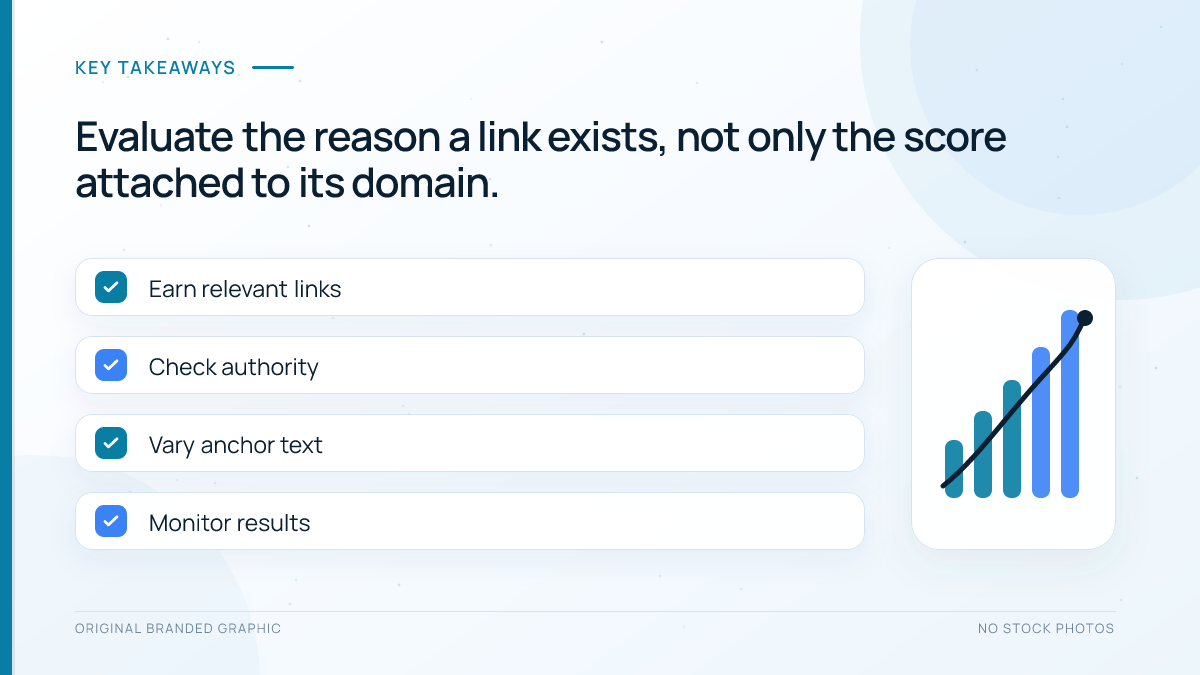
- The source page is relevant to the destination and its readers.
- The linking site publishes original, credible content for a real audience.
- The link has a clear editorial or practical reason to exist.
- The anchor and surrounding text accurately describe the destination.
- The destination page is useful, accessible, current, and indexable.
- Any paid, sponsored, affiliate, or user-generated relationship is disclosed and qualified correctly.
- The opportunity does not depend on automation, deception, or artificial scale.
- You would value the placement even without a reported authority score.
Frequently Asked Questions
How long does link building take to show results?
Link building is usually a long-term activity rather than an immediate ranking switch. Time is needed to create a useful resource, find suitable prospects, earn placements, and allow search engines to discover and process the links. Results also depend on competition, site quality, content, technical health, and search intent. Measure progress over months using several indicators instead of expecting a fixed ranking change after one link.
Should beginners buy backlinks?
Beginners should not buy links that pass ranking credit. Paid editorial-looking links can violate Google’s spam policies and expose a site to wasted budget or manual action. Paying for legitimate advertising or sponsorship is different when the relationship is transparent and the link is qualified with rel=”sponsored” or nofollow. Invest first in useful content, relevant outreach, partnerships, and promotion that can earn genuine attention.
Are nofollow links useless for SEO?
No. A nofollow link can still send qualified visitors, increase brand discovery, lead journalists or creators to your work, and support a natural mix of mentions. It should be evaluated by its audience and context, not dismissed solely because it does not function like a regular unqualified link. A relevant mention that attracts customers or future citations can be valuable even when direct ranking credit is limited.
How many backlinks does a page need to rank?
There is no universal number. The need varies with the query, competition, search intent, content quality, website reputation, internal linking, and the relevance of each backlink. Counting links without evaluating them can be misleading because one editorially earned, relevant link is not equivalent to dozens of automated directory entries. Compare competing pages for context, then focus on creating the best answer and earning appropriate recognition.
Can a website build links without cold outreach?
Yes, although promotion still matters. Original research, free tools, useful statistics, distinctive visuals, expert commentary, strong brand visibility, communities, and digital PR can attract links organically. Existing partnerships and unlinked brand mentions can also create opportunities. Cold outreach is one distribution method, not the definition of link building. The underlying goal is to make the right audience aware of a resource they may genuinely choose to reference.
What should I do about random spammy backlinks?
Do not panic over every unfamiliar link. Websites naturally receive irrelevant or low-quality links they did not create, and manually chasing each source can waste time. Monitor patterns and make sure your team or agency is not responsible for manipulative activity. If you have a manual action or a substantial history of links created to influence rankings, investigate carefully and follow Google’s official remediation guidance before considering advanced tools such as disavowal.
Conclusion
Link building for SEO works best when it is treated as useful publishing and responsible promotion, not a hunt for shortcuts. Build something worth citing, identify publishers whose readers will benefit, explain the fit honestly, and evaluate every opportunity by relevance and editorial value. Combined with strong content, sound technical foundations, and thoughtful internal linking, that approach can earn lasting visibility while protecting the trust of readers and search engines.