
Anchor text is the clickable wording inside a link. It may be only a few words long, but it helps readers decide whether a link is worth following and gives search engines context about the destination page. Used well, anchor text makes a website easier to navigate, strengthens relationships between related pages, and supports a clear site structure.
This guide explains anchor text SEO from the ground up. You will learn the main anchor text types, how internal and backlink anchors differ, how to write useful link text, which optimization shortcuts create risk, and how to audit anchors without chasing artificial percentages.
Quick Answer: What Is Anchor Text in SEO?
Anchor text is the visible, clickable text of a hyperlink. It describes—or should describe—the page a user will reach after selecting the link. Good anchor text is specific enough to set a clear expectation, concise enough to scan, and relevant to both the current page and the destination.
For example, beginner’s guide to keyword research gives more useful context than click here. The goal is not to place an exact keyword in every link. The goal is to make each link understandable and helpful in its sentence.
Key Takeaways
- Anchor text should help a reader understand the destination before clicking.
- Descriptive internal anchors can improve navigation, page discovery, and topical relationships.
- Exact-match anchor text is not automatically harmful, but forced or manipulative repetition creates unnecessary risk.
- There is no universal “safe” anchor text ratio that every website must follow.
- Backlink anchors are less controllable than internal anchors, so evaluate patterns rather than individual links.
- When an image is used as a link, its alternative text can provide the anchor context.
How Anchor Text Works
A standard HTML link contains a destination URL and the words shown to the user:
<a href="https://example.com/seo-audit/">complete SEO audit guide</a>In this example, complete SEO audit guide is the anchor text. The URL tells the browser where to go, while the anchor tells the reader what to expect.
Search engines also use links to discover pages and understand how documents relate to one another. Google’s link best-practices documentation recommends crawlable <a href> links and describes useful anchor text as descriptive, reasonably concise, and relevant to both pages.
Anchor text is therefore a contextual signal, not a command. It contributes to understanding alongside the destination page’s title, headings, body content, surrounding link context, other links, and broader site structure. A link cannot make an irrelevant page relevant simply by using a keyword-rich anchor.
Why Anchor Text Matters for SEO and Users
It sets an expectation before the click
Readers scan pages quickly. A meaningful anchor reduces uncertainty by explaining what the next page contains. That makes the link more useful and helps people choose their next step without guessing.
It helps search engines understand page relationships
Internal links connect individual pages into a larger topic structure. When their anchors accurately describe their destinations, they reinforce the relationship between supporting articles, category pages, and cornerstone resources. This works alongside the broader internal linking fundamentals that help crawlers find content and readers move through a website.
It improves accessibility and navigation
People using screen readers may navigate from link to link without reading every surrounding paragraph. Repeated anchors such as read more or click here provide little information when heard out of context. Descriptive wording makes the destination clearer for more users.
It supports a coherent on-page experience
Links should feel like part of the explanation rather than interruptions inserted for rankings. Relevant anchors, sensible placement, and useful destinations strengthen the reader journey—one of the practical principles behind effective on-page SEO.
The Main Types of Anchor Text
Anchor text is often grouped into types. These labels are useful for audits, but they are not targets that must be distributed according to a fixed formula.
| Anchor type | Example destination | Example anchor | Typical use |
|---|---|---|---|
| Exact match | A page about technical SEO | technical SEO | When the exact phrase naturally names the destination |
| Partial match | A page about technical SEO | technical SEO fundamentals | To add useful context around the main topic |
| Branded | A company or publication page | HowToLearnSEO | Brand references, citations, and navigation |
| Brand plus topic | A branded resource | HowToLearnSEO’s technical SEO guide | When both source and subject are helpful |
| Naked URL | A cited webpage | https://example.com/report/ | References where displaying the address is useful |
| Generic | Any page | learn more | Occasionally acceptable when surrounding context is unmistakable |
| Image anchor | A page linked by an image | The image’s alt text | Image navigation, product cards, logos, and visual calls to action |
Is exact-match anchor text bad?
No. An exact-match anchor can be the clearest label for a page. If a sentence refers to a technical SEO guide, linking the words technical SEO may be entirely natural.
The concern begins when exact-match anchors are forced into unrelated sentences, repeated mechanically across many pages, or acquired through paid and coordinated links intended to manipulate rankings. The problem is not that the words match a keyword; it is the artificial pattern and the reason the links exist.
Are generic anchors always wrong?
Generic wording is not automatically an SEO error. A button labeled View plans may be perfectly clear in a pricing section. However, vague phrases such as click here usually waste an opportunity to communicate the destination and can be confusing when several appear on one page.
Internal, External, and Backlink Anchor Text
The best approach depends partly on who controls the link and what purpose it serves.
Internal anchor text
Internal anchors connect pages on the same website. You control the destination, placement, and wording, so these links should be especially clear. Use them to guide readers toward genuinely related resources and to show how supporting pages fit within a topic cluster.
Internal optimization should focus on consistency of meaning, not identical wording. A guide about backlinks might naturally be linked as what backlinks are, backlink basics, or how links from other websites work, depending on the sentence. Each variation can be useful if it describes the same destination honestly.
External anchor text
External links point to another website. Their anchors should explain what the cited source, study, tool, or documentation contains. External linking is not something to avoid automatically; a relevant primary source can help readers verify a claim and explore a topic in more depth.
Backlink anchor text
A backlink is a link from another website to yours. Its anchor is chosen by the linking publisher, which means you normally have less control over it. Natural backlink profiles often contain a mixture of brand names, page titles, topic descriptions, URLs, and other editorial wording.
For a fuller explanation of these inbound links, start with what backlinks are and why they matter. Anchor text is only one part of backlink evaluation; relevance, editorial purpose, placement, source quality, and the linked page all matter too.
How to Write Helpful Anchor Text
1. Describe the destination accurately
Choose words that would still make sense if someone saw the link without the rest of the paragraph. The wording does not need to repeat the destination title exactly, but it should communicate the same subject and purpose.
Weak: To understand backlinks, click here.
Better: Read this beginner’s explanation of backlinks.
2. Keep it reasonably concise
An anchor can contain several words when that is necessary for clarity, but linking an entire long sentence makes the destination difficult to scan. Select the shortest phrase that accurately communicates the next page.
3. Make the surrounding sentence useful
The words around a link provide context too. Introduce why the resource is relevant instead of dropping a keyword into a disconnected sentence. Avoid placing several links side by side with no explanation of how they differ.
4. Match the reader’s likely next question
A link is most helpful when it answers a natural follow-up question. After explaining that links from other websites influence off-site signals, for example, a reader may benefit from a broader guide to off-page SEO. This placement serves the learning journey rather than merely increasing link count.
5. Use crawlable links
Place the anchor inside a genuine HTML <a> element with a resolvable href. A styled <span>, an empty link, or a click handler without a crawlable URL may not provide the same dependable discovery path.
6. Avoid forced keyword lists
Do not try to fit several related keywords into one anchor. Phrases such as best affordable professional SEO services and search optimization company are difficult to read and usually reveal that optimization has replaced communication. Use the wording a human editor would naturally choose.
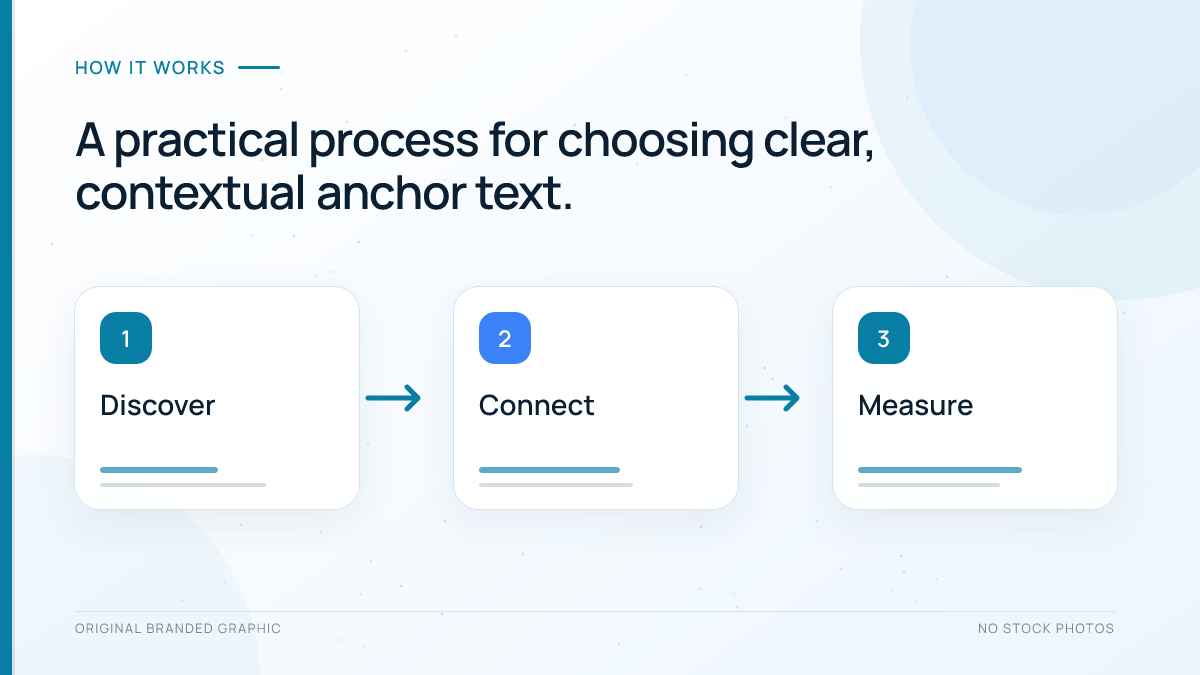
How to Optimize Internal Anchor Text Step by Step
- Choose the correct destination. Confirm that the linked page is the best answer to the concept mentioned in the sentence.
- Identify the reader’s next need. Ask what useful detail, definition, or process the destination adds.
- Write a descriptive phrase. Name the destination naturally without stuffing several keywords into the link.
- Check surrounding context. Make sure the full sentence explains why the link is useful.
- Verify the URL and status. Avoid links that redirect unnecessarily, return an error, or point to a non-canonical version.
- Review competing destinations. If several pages receive nearly identical anchors for the same topic, confirm that each page has a distinct purpose.
- Test the reader experience. Read only the anchor and then the whole sentence. Both should make sense.
Imagine a website has a cornerstone page about ecommerce SEO and separate pages about product pages, faceted navigation, and product schema. The cornerstone can link to each specialist guide with distinct anchors. The specialist guides can link back with wording such as complete ecommerce SEO guide. This creates a meaningful hierarchy without repeating one exact phrase everywhere.
Anchor Text for Backlinks: What You Can and Cannot Control
Backlink anchors require a different mindset because editorial websites choose their own wording. A genuine recommendation may use your brand, article title, a partial description, or a bare URL. That variety is expected when independent publishers link for independent reasons.
Do not ask every publisher to use the same commercial keyword. Do not buy links with optimized anchors or place keyword-rich links in low-value content created mainly to influence rankings. Google’s spam policies address link practices designed to manipulate ranking signals.
If a placement is paid, sponsored, or supplied as part of an advertising arrangement, the relationship should be disclosed to search engines. Google recommends rel="sponsored" for paid placements, while nofollow remains acceptable in relevant situations. User-generated links can be marked with rel="ugc" or nofollow. The full distinctions are explained in Google’s guidance for qualifying outbound links.
Do You Need a Perfect Anchor Text Ratio?
No universal percentage tells every website how many branded, exact-match, partial-match, generic, or URL anchors it should have. A local business, a news publication, a software company, and a personal blog earn links in different ways. Their natural patterns will not look identical.
Fixed ratio advice often creates the wrong objective: manufacturing a chart instead of earning and placing useful links. Use categories diagnostically. A sudden concentration of repeated commercial anchors from unrelated websites may deserve investigation, but a relevant exact-match link is not a problem merely because it changes a percentage.
For internal links, the same principle applies. Variation should arise from context, not from swapping synonyms at random. If one phrase is the clearest description in several places, it can be used more than once. The final test is whether each link helps the reader and accurately represents its destination.
How Image Links Use Anchor Text
When an image is the clickable part of a link, there may be no visible text between the anchor tags. In that situation, Google can use the image’s alt attribute as anchor text. The alt text should describe the purpose or destination of the linked image in context.
For example, a linked cover image could use alt="Beginner’s guide to image SEO" when it opens that guide. A decorative image next to an already descriptive text link may need different treatment to avoid repetition. Effective decisions combine link purpose with the broader image SEO best practices for useful alternative text.
Common Anchor Text Mistakes
Using vague wording everywhere
Generic anchors make pages harder to scan and provide little standalone meaning. Replace them when a concise descriptive phrase fits naturally.
Stuffing several keywords into one link
An anchor should label a destination, not act as a miniature keyword list. Overloaded wording damages readability and can look manipulative.
Linking the same phrase to different competing pages
If the same anchor repeatedly points to multiple pages with nearly identical intent, readers and search engines receive an unclear signal about which page is the main resource. Clarify each page’s purpose, update anchors, and consolidate content only when genuine duplication exists.
Ignoring redirects and broken destinations
Even excellent anchor text cannot rescue a poor destination. Update internal links to point directly to the current canonical URL and repair links that lead to errors.
Treating every external link as nofollow
Normal editorial links to trustworthy sources do not need a special attribute merely because they leave your website. Use the appropriate qualification for paid, user-generated, or untrusted links rather than applying one rule to everything.
Judging a site from one backlink anchor
A strange anchor may result from a scraper, an old citation, or another publisher’s editorial choice. Review the source and the broader pattern before assuming a penalty or taking action.
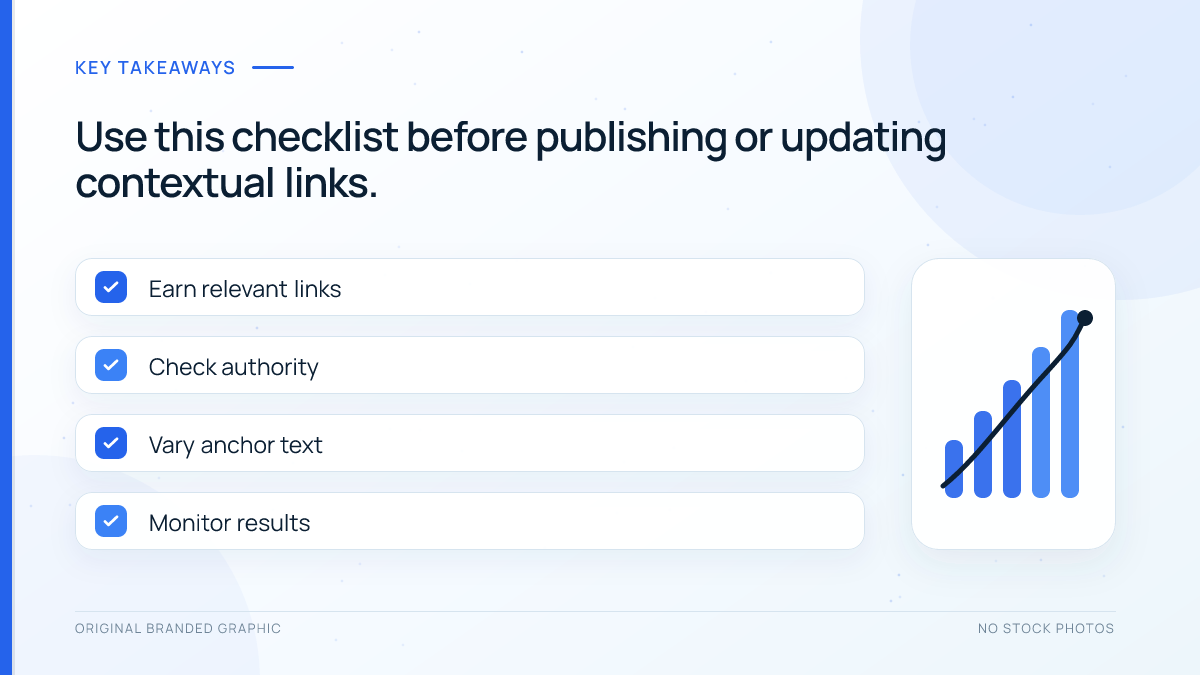
How to Audit Anchor Text
An anchor text audit should identify usability problems, misleading links, technical defects, and unnatural patterns. It should not exist merely to force every page toward the same distribution.
Audit internal anchors
- Crawl the website with a tool that exports source pages, destination URLs, status codes, and anchor text.
- Separate navigational links from contextual links so repeated menu labels do not distort the review.
- Find empty anchors, image links with missing alt text, generic wording, broken URLs, and unnecessary redirects.
- Group links by destination and compare the anchors used for each important page.
- Check whether different destinations are being described as though they answer the same query.
- Improve only the links that are unclear, misleading, technically broken, or genuinely over-optimized.
Audit backlink anchors
- Export backlinks and referring domains from the tools available to you.
- Review repeated commercial phrases, sudden pattern changes, and links from irrelevant or obviously manipulated pages.
- Inspect the source pages instead of making decisions from anchor text alone.
- Separate links you created or arranged from links earned editorially.
- Correct controllable paid or partnership links that lack appropriate qualification.
- Avoid contacting legitimate publishers merely to manufacture a preferred ratio.
Document what you changed and why. A good audit produces a short list of defensible improvements, not hundreds of cosmetic rewrites.
Anchor Text SEO Best-Practices Checklist
- Does the anchor accurately describe the destination?
- Can the wording make sense when read on its own?
- Is the link useful at this point in the reader’s journey?
- Is the anchor concise without becoming vague?
- Does the surrounding sentence explain why the link matters?
- Does the link use a crawlable
<a href>element? - Does the destination return the expected page without an avoidable redirect?
- For a linked image, does the alt text communicate the link’s purpose?
- Are paid and user-generated links qualified appropriately?
- Are you improving clarity rather than chasing an artificial ratio?
Frequently Asked Questions
How long should anchor text be?
There is no fixed character or word limit. Use enough text to describe the destination clearly, then stop. A short phrase is usually easier to scan than a sentence-long link, but a one-word anchor may be too vague. Read the anchor without its surrounding paragraph: if the destination is still understandable, the length is probably appropriate.
Can I use the same anchor text more than once?
Yes. Repetition is normal when the same phrase remains the clearest description of a page. The concern is mechanical or manipulative repetition, especially when anchors are forced into irrelevant contexts or coordinated across external websites. For internal links, prioritize accurate descriptions and a natural sentence rather than changing words solely to create variation.
Should every internal link contain a keyword?
No. Every internal link should contain wording that helps the reader understand its destination. Sometimes that wording includes the page’s primary topic; sometimes a brand name, feature, question, or descriptive phrase is clearer. Adding keywords that the sentence does not need can make the anchor awkward and reduce trust.
Does changing anchor text improve rankings immediately?
Usually not. A clearer anchor can improve navigation and help search engines interpret page relationships, but it is only one part of a much larger system. Search engines must recrawl the source page, and performance also depends on content quality, relevance, site structure, competition, technical accessibility, and many other signals.
What should I do if another website uses a strange anchor to link to me?
Review the linking page and the broader backlink pattern before acting. One unusual anchor is rarely enough to justify concern. If the link is legitimate and editorial, you usually do not need to request a change. Focus attention on links you arranged, paid for, or control, particularly when they use manipulative wording or lack proper qualification.
Is image alt text always treated as anchor text?
Alt text can provide anchor context when the image itself is inside a link. When an image is not linked, its alt text serves its normal accessibility and image-understanding purpose rather than functioning as link text. Write alt text for the image’s role in context, and avoid stuffing keywords into linked or unlinked images.
Conclusion
Anchor text SEO works best when optimization and usability point in the same direction. Use wording that accurately describes the destination, place links where they support the reader’s next question, and keep the surrounding context natural. For internal links, maintain a clear topic structure and fix misleading or broken paths. For backlinks, evaluate relevance and intent instead of chasing a perfect ratio.
A simple rule covers most situations: if the anchor helps a reader predict what comes next, it is probably doing its job. Build from that principle, apply the technical checks in this guide, and let useful language—not a percentage formula—shape your link text.