
Quick answer: First-party data can make AI search content more useful when it answers a real reader question with information your organization legitimately collected. Choose one decision, use an appropriate aggregated dataset, document the method, protect privacy, and explain the limits. Original data may strengthen a page, but it does not guarantee indexing, rankings, AI mentions, or citations.
Key takeaways
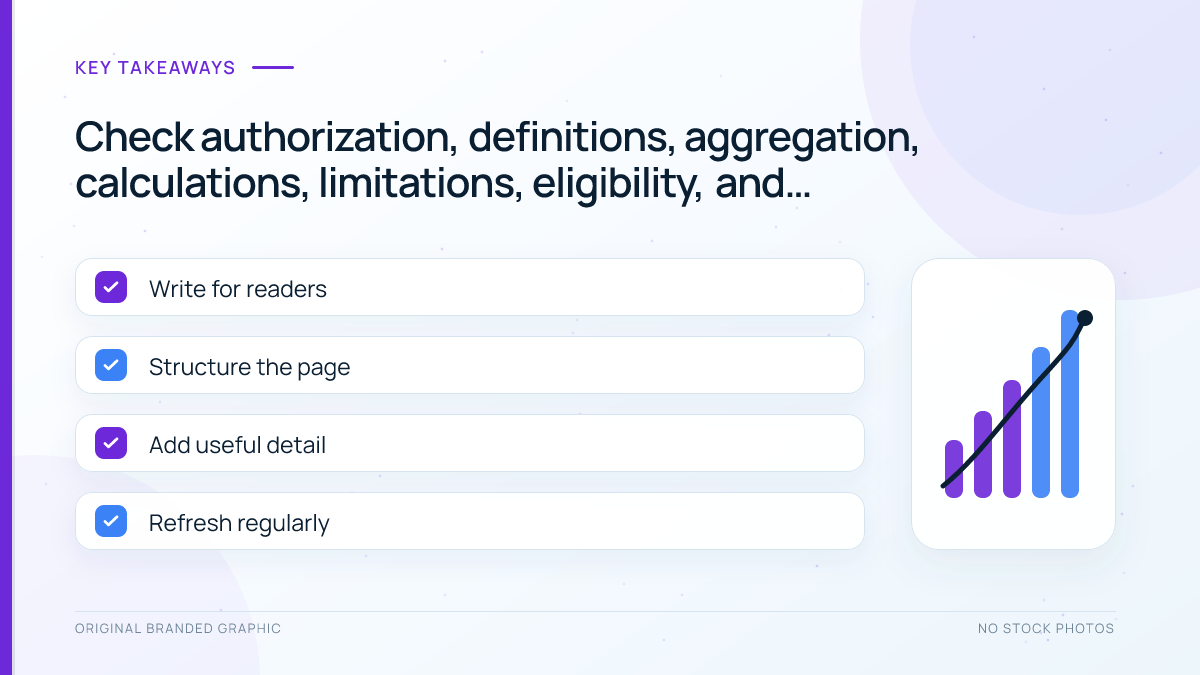
- Start with a reader decision, not with a spreadsheet you want to publish.
- Use data you are authorized to analyze and share; remove personal or confidential information.
- Publish the timeframe, definitions, sample size, exclusions, and calculation.
- Separate what the data shows from your interpretation and recommendations.
- Measure search visibility, referred visits, engagement, and business outcomes as different signals.
What counts as first-party data?
First-party data is information collected through your own website, products, customers, or operations. Useful sources can include aggregated Search Console performance, GA4 landing-page and event data, anonymized site-search terms, support themes, product returns, surveys, inventory records, or documented internal processes.
The purpose is not to manufacture “research.” It is to answer a question better than a generic summary can. Google’s current generative AI guidance encourages unique, non-commodity content and warns against simply recycling what is already online. Google also says established SEO foundations still apply.
Prerequisites before using first-party data
- A specific audience question and a decision the article will help them make.
- Permission to use the dataset for analysis and public content.
- A defined date range, population, metric, and exclusion rule.
- Enough observations to describe the sample honestly without presenting it as universal.
- A privacy review appropriate to your country, industry, and consent obligations.
- A published-page plan covering sources, internal links, indexability, and later measurement.
Start with an AI search content brief so the data supports the reader task instead of taking over the article.
Choose a data source that matches the question
| Reader question | Possible first-party source | Main caution |
|---|---|---|
| Which problems confuse readers most? | Anonymized site search or support themes | Remove names, emails, account details, and rare identifying combinations |
| Which guides attract search demand? | Search Console query and page aggregates | Respect reporting limits and do not treat impressions as visits |
| Which landing pages lead to useful actions? | GA4 sessions, engagement, and key events | Use the correct scope and do not publish user-level records |
| Which product issue occurs most often? | Aggregated returns or service records | Define the population and avoid exposing customers or staff |
| Which workflow saves time? | A documented internal process | Record the method; do not invent testing or results |
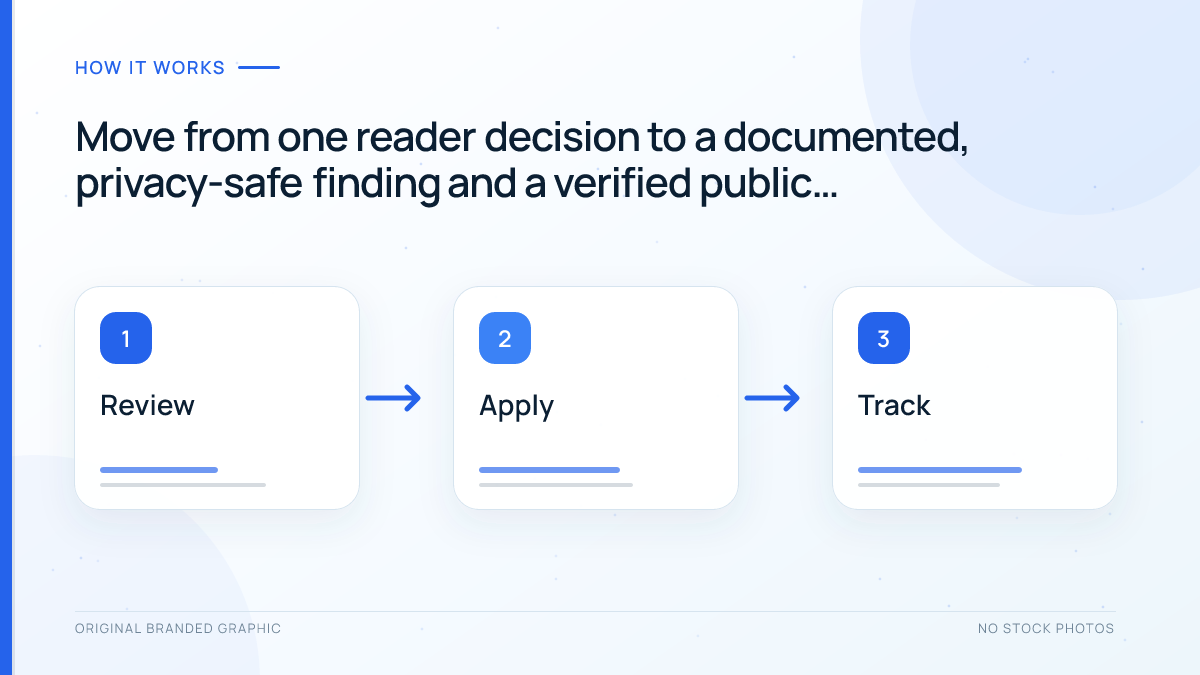
How to turn first-party data into AI search content
1. Define one useful decision
Write a question the evidence can actually answer, such as “Which technical SEO issue should a beginner check first?” Avoid vague goals such as “prove our expertise” or “get cited by AI.” Map the task to one URL and confirm that another published or draft page does not already serve the same intent.
2. Create a data dictionary
For every field, record its name, meaning, unit, source, timeframe, and known limitation. Define terms such as session, engaged session, ticket, error, or conversion before calculating anything. If you combine sources, state why their scopes and date ranges are comparable.
3. Remove sensitive and unnecessary fields
Work with aggregates whenever possible. Delete names, email addresses, phone numbers, account IDs, free-text details, precise locations, and combinations that could identify a person. Google’s Analytics privacy guidance says personally identifiable information must not be sent to Google and specifically warns about PII in URLs, titles, site-search terms, events, and campaign dimensions. Legal or regulated datasets require qualified review, not an SEO shortcut.
4. Clean the data without hiding inconvenient results
Standardize labels, remove exact duplicates, document exclusions, and preserve the original export separately. Do not discard rows merely because they weaken the story. If the sample is small or incomplete, say so. A transparent limitation is more trustworthy than false precision.
5. Calculate only what the dataset supports
Show the formula for percentages, rates, medians, or changes. Avoid causal language unless the design can support causation. Search Console impressions do not equal visits, crawler requests do not equal citations, and identifiable AI-assistant referrals do not represent every AI mention.
6. Present evidence with context
Use a compact table or chart, followed by a plain-language finding, interpretation, and practical action. Add a method box containing the source, dates, sample size, exclusions, and calculation. Link external factual claims to primary documentation using the AI content source-audit workflow.
7. Review the finished page
Confirm that the headline describes the actual evidence, the example is labeled, and the recommendation does not extend beyond the sample. Check the public URL, canonical, robots directives, visible text, image alt text, and mobile presentation. Technical eligibility is necessary for discovery, but it cannot guarantee selection by Google or another AI system.
Illustrative worked example
Imagine an SEO education site reviews 50 anonymized support questions received during one complete month. After defining categories before counting, the editor records 18 indexing questions, 12 crawling questions, 8 structured-data questions, and 12 other questions.
| Category | Questions | Share of sample | Content action |
|---|---|---|---|
| Indexing | 18 | 36% | Add a diagnostic decision tree to the indexing guide |
| Crawling | 12 | 24% | Clarify robots, access, and discovery differences |
| Structured data | 8 | 16% | Add a visible-content matching checklist |
| Other | 12 | 24% | Keep grouped unless a repeated task emerges |
The defensible statement is: “In this illustrative 50-question sample, indexing was the largest category at 36%.” It would be misleading to claim that 36% of all SEO beginners struggle with indexing. The sample is fictional, the timeframe is limited, and support questions reflect people who asked for help rather than every reader.
Troubleshooting common problems
- The dataset has no clear story: publish only if it answers a useful question. Do not force a trend from random variation.
- Categories overlap: define one primary classification rule and record ambiguous items separately.
- The sample is tiny: present counts, avoid sweeping percentages, and label the work as an observation rather than a study.
- GA4 traffic looks like AI growth: check the channel rules. GA4’s current default channel definitions classify recognized non-Google assistant visits under AI Assistant, while Google AI Overviews and AI Mode visits remain within Organic Search. Direct traffic is not proof of hidden AI exposure.
- A crawler appears in logs: treat it as an access signal only. OpenAI’s crawler documentation distinguishes OAI-SearchBot for search from GPTBot for potential model training; neither log entry proves a mention or citation.
Measurement and limitations
Record a pre-publication baseline and review the page after 14 and 28 days. Use the free AI visibility workflow to keep Search Console visibility, available generative-AI reporting, GA4 AI Assistant referrals, engagement, conversions, sampled citations, and crawler activity separate. Compare only complete periods and avoid attributing short-term changes to one content update.
First-party data can be biased, incomplete, seasonal, or unrepresentative. It may also become outdated. State the collection dates and refresh or retire claims when the underlying process changes. Publication does not grant permission to disclose confidential information, and originality alone does not guarantee search or AI visibility.
Frequently Asked Questions
Does first-party data improve AI search visibility?
It can make an article more distinctive and useful, but it does not guarantee indexing, ranking, inclusion, mentions, or citations. Quality, eligibility, relevance, and system selection still matter.
Can I publish data from Google Search Console?
You can publish appropriate aggregated findings that you are authorized to share. Explain the property, date range, metric, filters, and limitations, and avoid exposing confidential queries or business information.
Can I use GA4 data in an article?
Yes, when you have authority to use it and publish only suitable aggregated findings. Do not expose personal information or treat AI Assistant referrals as a complete measure of AI exposure.
How large should the dataset be?
There is no universal minimum. Use enough observations for the narrow claim, report the sample size, and reduce certainty when the sample is small, incomplete, or biased.
Do I need special schema for original research?
No special schema guarantees AI inclusion. Use structured data only when Google supports the relevant feature and the markup accurately matches the visible page.
Conclusion
To turn first-party data into AI search content, begin with one reader decision, document the dataset, protect privacy, calculate transparently, and publish the method beside the finding. Keep interpretations within the sample and measure outcomes separately. The goal is not to look scientific; it is to give readers trustworthy information they could not get from another generic summary.