International SEO URL structure is the decision about where a website hosts its language and regional versions. Country domains, subdomains and subdirectories can all work, but they carry different costs, deployment needs and maintenance risks. This comparison explains what each structure actually changes, how to choose one and how to verify that visitors and crawlers can reach the correct version.
Quick Answer
Choose an international SEO URL structure that your team can maintain consistently. A country-code domain such as example.de clearly targets a country; a subdomain such as de.example.com separates regional hosting; and a subdirectory such as example.com/de/ keeps languages under one host. Google documents these options in its international site guidance; none is a guaranteed ranking shortcut.
Key Takeaways
- Separate language and region requirements before selecting URLs.
- Use distinct, crawlable URLs for materially different language versions.
- Compare operational cost and content governance, not only SEO theory.
- Implement hreflang only among genuine alternative pages.
- Test navigation and indexing before migrating an existing international site.
Clarify countries, languages and customer differences
A multilingual website publishes content in more than one language; a multi-regional website serves users in different countries. These are related but not identical requirements. An English-language product page for Canada may need Canadian dollar prices and local shipping details, while an English page for the United Kingdom may need different warranty terms. Conversely, one Spanish-language guide may serve readers in several countries without requiring a duplicate for each location.
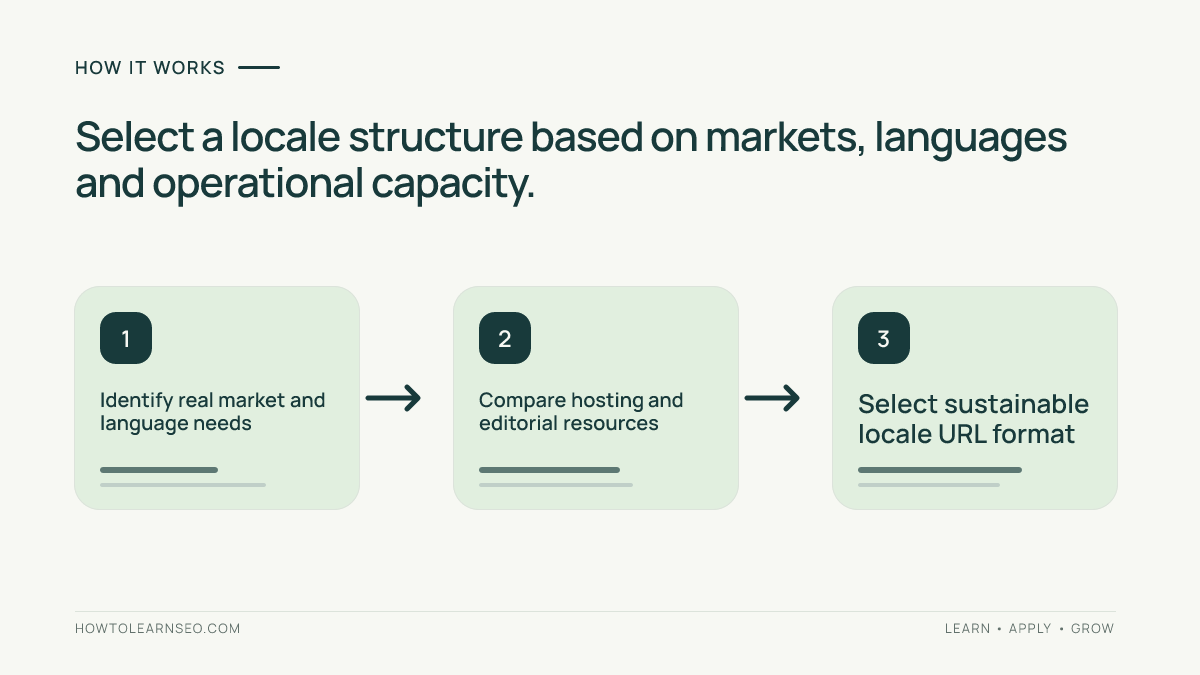
Write a locale matrix listing language, market, pricing, fulfillment, legal notices and responsible content owner. Decide which pages truly require independent versions. A translated homepage alone does not constitute a usable localized website if the navigation and checkout still lead to another language unexpectedly. Our international SEO overview provides the broader foundation for these decisions.
Country domains: clear targeting with separate overhead
A country-code top-level domain, such as example.de, is a strong geographic cue for many markets. It may suit established country teams operating with separate legal obligations, marketing budgets or publishing systems. However, separate domains bring additional registration, security, hosting, analytics and content-governance work. Some ccTLDs have eligibility restrictions, and not all short extensions work as country-targeting signals.
Do not assume buying a local domain makes content relevant or automatically authoritative. The site still needs local language quality, accurate commercial information and discoverable pages. If a retailer has limited maintenance resources, maintaining three domains with inconsistent hours or broken links can be worse than publishing coherent subdirectories. The Google URL structure guidance includes examples for international sites and cautions against unnecessarily complex URL patterns.
Subdomains: operational independence without a separate domain
A subdomain such as fr.example.com can host a separate localization stack or deployment pipeline. This may help when different country teams use different platforms or infrastructure. It also creates governance questions: who maintains shared navigation, translation updates, analytics conventions and consistent branding? A technical separation that nobody owns may create mismatched content between regions.
Some teams incorrectly believe that subdomains always rank worse or better than directories. Search engines evaluate pages and signals in context, and outcomes depend on implementation, linking, content and competition. Choose subdomains when operational separation is genuinely useful, then make sure primary navigation offers clear links to other available language or country versions.
Subdirectories: simpler shared maintenance
A structure such as example.com/fr-ca/ keeps regional content on one host and can simplify shared hosting, design and analytics. It is often practical when one team manages translations and uses one content system. Google describes subdirectories as relatively low maintenance on the same host, although they provide less separation when countries require different publishing and infrastructure arrangements.
Keep URL labels consistent and documented. A path like /en/ describes a language, while /en-ca/ can identify a language-region pairing when that distinction is meaningful. Avoid creating placeholder locale folders with the same generic English text translated only in the header. A directory must contain useful content and navigation, not simply exist to capture a region keyword.
Use hreflang and localized links carefully
Google recommends distinct URLs for different language versions and supports hreflang to identify alternatives. Each annotation should point to a genuine counterpart, and the alternatives should be checked for correct locale codes and reciprocal relationships. Hreflang is not a substitute for a valid canonical strategy or for translated content that visitors can actually use. Our hreflang audit walkthrough covers technical validation after the structure has been chosen.
Do not automatically redirect every user based on IP address or browser language. Google’s guidance notes that such handling can hide alternate pages from crawlers and visitors. Offer visible language or region switching, preserve a user’s deliberate selection and ensure each localized URL can be opened directly. The official multi-regional guidance warns that Googlebot often crawls without a browser’s language header.
Illustrative choice: a growing outdoor retailer
Input: Imagine a fictional US retailer expanding into Canada and France. One central team uses a single commerce platform. Canada needs English and French content with Canadian shipping terms, and France needs French content with European delivery information. These are hypothetical business requirements, not findings from an actual site migration.
Rule and decision: Choose subdirectories such as /en-us/, /en-ca/, /fr-ca/ and /fr-fr/ because the platform and team are shared. Create genuinely localized shipping and product information, set suitable alternatives and link to a working locale selector. A company with separate country subsidiaries and systems might reasonably choose subdomains or country domains instead.
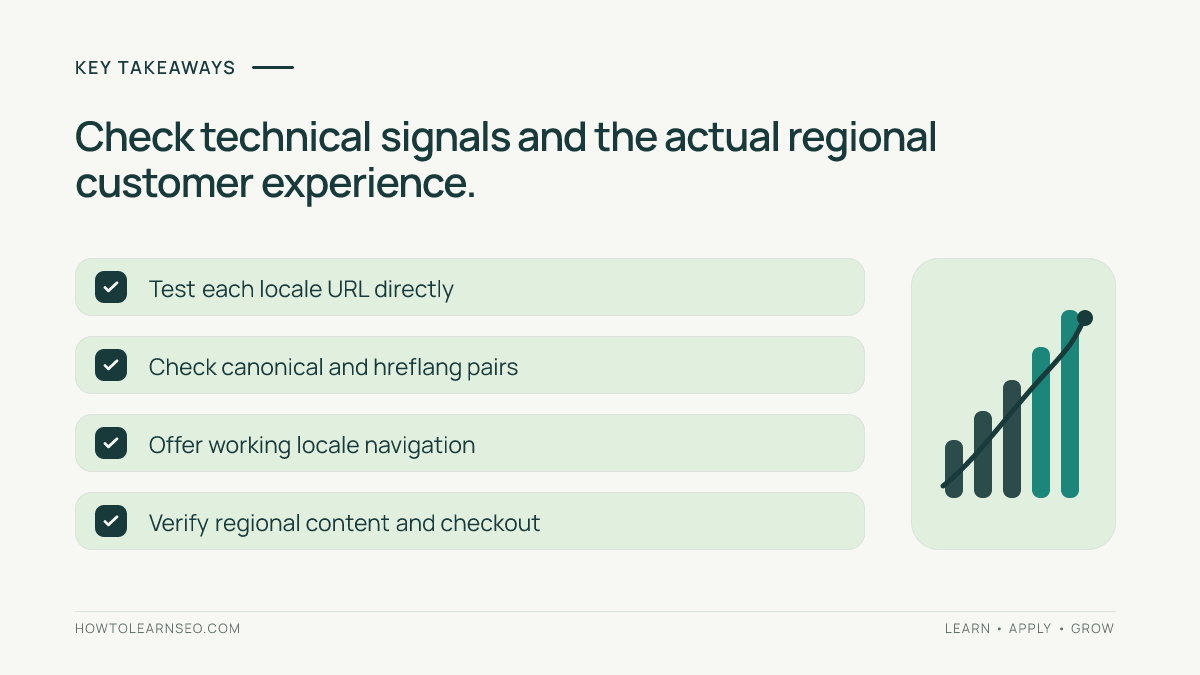
Expected output: Each customer can open a stable locale URL with appropriate language and market information. Verify: Test direct page access, visible language switching, hreflang annotations, canonical tags and region-specific checkout details. Edge case: If a product cannot ship to France, do not publish a misleading French purchase page merely to complete a locale matrix; explain availability or omit that regional offer.
Plan migration and ongoing quality control
Changing an established international URL structure is a migration, not a cosmetic preference. Map every old page to the most relevant new page, preserve useful internal links, implement appropriate redirects and check for accidental cross-language canonicals. Create a rollout checklist and test representative locale pairs before changing thousands of URLs. Our 301 redirect guide explains when permanent redirects are appropriate.
Monitor regional landing pages in Search Console and investigate unexpected locale mismatches rather than assuming that all traffic changes come from the URL format. Review actual customer experience: language switching, currencies, delivery information, consent notices and support paths. A successful international structure makes regional content easier to discover and maintain; the domain format alone cannot repair an incomplete localization strategy.
Frequently Asked Questions
Are subdirectories better than subdomains for international SEO?
Neither structure guarantees better rankings. Subdirectories can simplify shared management, while subdomains provide operational separation; choose based on audience, resources and maintenance needs.
Do country-code domains signal a target country?
Yes. Google treats most country-code top-level domains as strong location signals, although ownership restrictions, costs and brand considerations vary.
Should language versions have separate URLs?
Google recommends distinct URLs for language versions rather than depending entirely on cookies or browser-language redirects.
Is hreflang a ranking boost?
No. Hreflang helps Google identify appropriate language or regional alternatives; it does not replace useful localized content or guarantee visibility.
Can an English page target several countries?
Yes, when the content genuinely meets those audiences’ needs. Separate regional pages make more sense when prices, shipping, terminology or services materially differ.
Should users be automatically redirected by IP address?
Avoid forcing redirects solely from assumed location. Google warns that locale-adaptive redirects can prevent crawlers and users from accessing alternative versions.
Conclusion
The best international SEO URL structure is one that matches real markets and stays accurate as the site grows. Country domains, subdomains and subdirectories each offer tradeoffs. Identify where content actually differs, use distinct accessible URLs, connect true alternatives and validate the implementation before a migration. Prioritize sustainable localization over assumptions about an inherently winning format.