An AI-generated hreflang audit checks whether suggested language and regional annotations match live WordPress pages. AI can draft plausible tags but cannot confirm that translated URLs exist, serve the right content, or reference their alternates. Verify the published pages.
This tutorial focuses on technical validation, not translating the article itself. For the separate editorial checks, use our AI translation SEO checklist.
Quick Answer
Audit AI-generated hreflang by listing real equivalent URLs, inspecting published annotations, validating language-region codes, confirming self-references and return links, and checking canonicals and crawlability. Fix the tag generator and recheck every affected page. Correct annotations do not guarantee rankings.
Key Takeaways
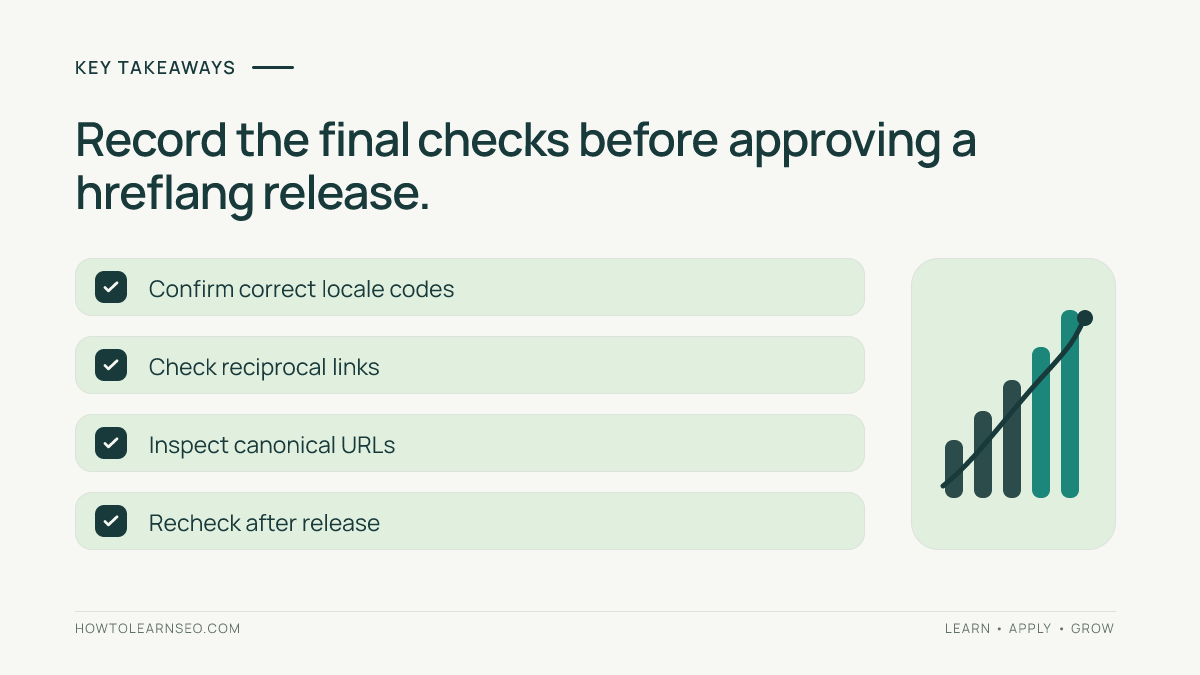
- Validate against published URLs, not an AI-generated list of assumed translations.
- Each language page should name itself and its actual equivalents.
- Reciprocal annotations and suitable canonical URLs matter as much as syntax.
- Keep an audit record so later translation updates do not silently break the cluster.
What to Collect Before an Hreflang Audit
Choose equivalent pages in different languages or regions. Record each public URL, intended locale, approval status, and canonical. Collect live HTML or the XML sitemap, multilingual configuration, and HTTP responses. Never give an AI tool administrator credentials.
Separate language from geography. English for Canada is en-CA; French for Canada is fr-CA. A country code alone does not express a language. Google’s localized-version documentation explains supported codes, alternate methods, and reciprocal links. Verify unusual codes there rather than accepting a model’s guess.
Check that each URL is a real equivalent, not a related page or draft. Our international SEO guide covers the broader decision to create regional or language-specific URLs.
Step-by-Step: Audit AI-Generated Hreflang Tags
1. Compare the proposed tags with live pages
Inspect each live page’s HTML for rel="alternate" and hreflang, or check your XML sitemap if that is the implementation. Google supports HTML, HTTP headers, and sitemaps; combining them brings no additional Search benefit and increases maintenance. Record the source.
Check each href is an absolute HTTPS URL leading to the correct localized article. Follow redirects; a plausible AI-generated path may be obsolete. Confirm the visible language. Tags cannot prove translation quality.
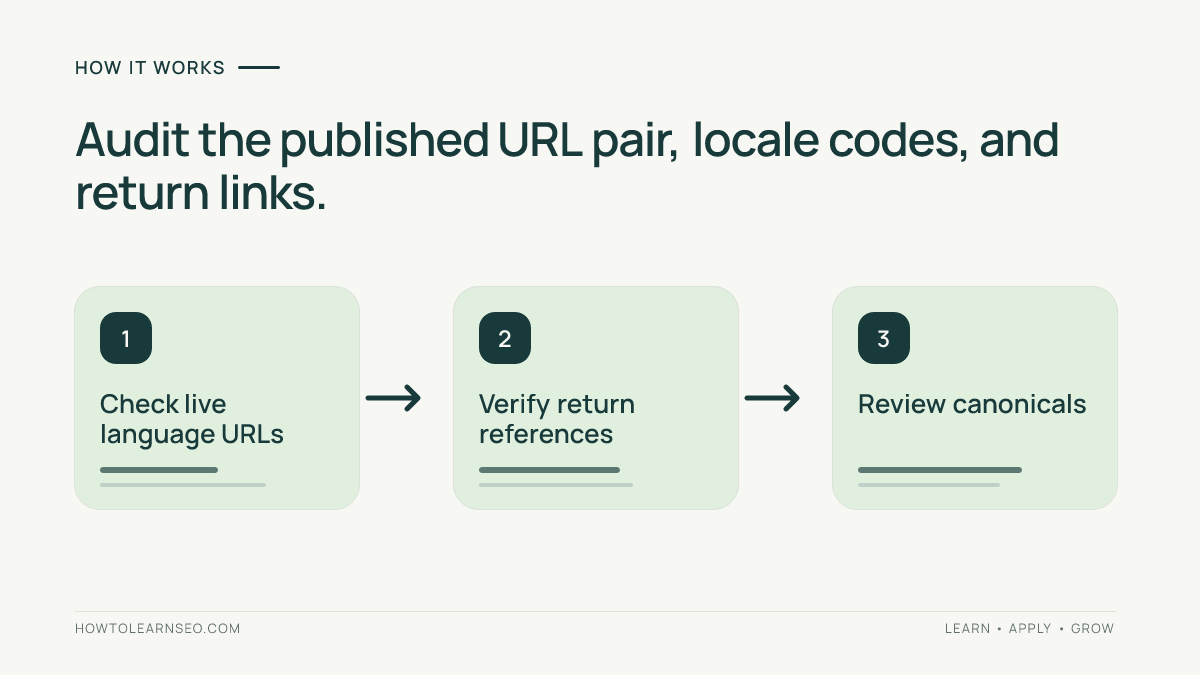
2. Validate codes, self-links, and return links
For each page, compare the declared language and region with your approved URL inventory. Google’s supported format uses a language code and optionally a region code, such as en-US. Do not substitute UK for GB, or assume EU is a supported country target. The special x-default value can identify a suitable fallback URL when appropriate, but it is not mandatory for every cluster.
Check each member’s full set. Both English and French pages should reference themselves and each other. Google requires bidirectional confirmation; a missing return link may invalidate the intended pair.
3. Check canonical and indexability signals
Check canonicals, crawl access, and indexing directives. Distinct translated pages usually warrant self-referencing canonicals; automatically pointing every translation at English can contradict the alternate relationship. Assess near-duplicate regional variants individually.
Google’s canonicalization guidance recommends a canonical in the same language, or the best substitute when that is unavailable. A robots.txt block, noindex directive, redirect, or conflicting canonical can undermine your intended outcome. Check the final rendered and indexed state rather than trusting an AI-generated spreadsheet.
Worked Example: An English and French Cluster
Imagine a fictional tutorial with two approved, publicly accessible URLs: https://example.com/en-us/guide/ and https://example.com/fr-ca/guide/. Both pages should contain an equivalent alternate set. The following is illustrative markup, not output observed on a real website:
<link rel="alternate" hreflang="en-US" href="https://example.com/en-us/guide/" />
<link rel="alternate" hreflang="fr-CA" href="https://example.com/fr-ca/guide/" />
Suppose the English page has both links, but the French page only references itself. Repair the missing return link in the multilingual configuration and recheck live source. If the French URL redirects to English, fix that routing issue first.
Keep a small evidence table for each check:
| Check | Pass evidence | Action if failed |
|---|---|---|
| URL and language | Live equivalent page in the intended language | Correct or remove the alternate |
| Return reference | Both pages list the same eligible pair | Repair the missing reciprocal entry |
| Canonical | Canonical choice fits the localized version | Resolve conflicting signals |
| Code | Supported language and optional region | Replace invalid code |
WordPress Implementation and Release Checks
WordPress has no universal hreflang setting. A plugin, theme, sitemap, or server configuration may generate the tags. Identify the source before editing; otherwise the error may recur.
Make the smallest documented change, preferably in staging. Compare affected pages before and after release. Avoid adding a second generator to compensate for a broken one. The canonical tag guide explains why canonical choices deserve their own review.
Save URLs, codes, date, defects, owner, and approval. Recheck after translation, slug, redirect, or template changes. A documented audit is more reliable than an outdated AI response.
Troubleshooting Hreflang Errors
- One page omits an alternate: compare the full cluster on both pages and repair the generator’s mapping.
- A code looks plausible but fails validation: check the official supported language and region codes; do not infer a code from a market name.
- The destination redirects: inspect the final URL and update the cluster to the intended live equivalent.
- Canonical and alternate disagree: review which page should be canonical before changing either signal.
- The page is not discoverable: investigate crawl access, indexing directives, and internal links separately from hreflang.
Use the Google Search Console guide for foundational page inspection. Search Console can help investigate a specific URL’s indexing state, but it does not replace a complete reciprocal-link audit across all language versions.
What This Audit Can and Cannot Prove
A passing audit demonstrates that the checked live pages expose coherent alternate-language signals at the time of inspection. It does not prove that translations are accurate, that every URL is indexed, or that Google will always choose the intended regional result. It also does not establish AI search citations, traffic growth, or ranking improvements.
After deployment, recheck live source and indexing. Monitor performance without attributing every movement to hreflang. Keep AI suggestions as drafts and the verified URL map as the record.
Frequently Asked Questions
Can AI generate hreflang tags that are ready to publish?
AI can draft the syntax and suggest a URL map, but publication requires checking the live destinations, supported codes, reciprocal links, and canonical choices. A plausible URL can still be missing or redirect unexpectedly. Treat generated tags as an editable proposal, not proof of a valid implementation.
Does every language page need to reference itself?
Yes. Google’s localized-version guidance says each language version should list itself along with the other versions. Check the actual output on every eligible page, not just the first one you inspect. If one page omits its own entry, repair the shared mapping and revalidate the entire cluster.
Should translated WordPress pages canonicalize to the English page?
Not automatically. Distinct translated pages commonly need their own canonical URLs, while near-duplicate regional pages may require a more nuanced choice. Review the actual content and Google’s canonicalization guidance before changing anything. A blanket cross-language canonical rule can conflict with the alternate relationship you intended.
Is x-default required for every hreflang cluster?
No. It is an optional way to identify a fallback page for users whose language is not otherwise targeted. Use it only when you have an appropriate destination, such as a language selector or general page. Do not create a fake fallback URL merely to fill out an AI-generated template.
Will correct hreflang improve my AI search rankings?
There is no guaranteed ranking or AI citation benefit. Hreflang helps Google understand which localized versions correspond to one another. Accurate content, crawlability, indexing, and the search system’s own selection process remain separate concerns. Measure observed results rather than treating a technical validation pass as a performance promise.
Conclusion
An AI-generated hreflang audit requires live-page evidence. Verify approved equivalents, reciprocal links, and canonicals, then repair the underlying generator. Save the findings for future WordPress translation releases.