
To evaluate link opportunities, inspect the proposed page, audience, editorial context, destination, anchor wording, and commercial relationship before outreach or acceptance. The goal is not to find a perfect authority score. It is to decide whether the placement would help real readers, represent the destination honestly, and avoid manipulative link practices.
Quick answer: Approve an opportunity only when the source is relevant, independently edited, transparent, safe, and able to reference a genuinely useful page. Hold it when information is missing. Reject it when the seller guarantees rankings, demands reciprocal links, hides sponsorship, or offers unrelated bulk placements.
What Is a Link Opportunity Evaluation?
A link opportunity evaluation is a documented approve, hold, or reject decision for one possible mention or backlink. The candidate may come from digital PR research, an unlinked mention, a resource page, an expert request, a partnership, or an unsolicited offer. Evaluation begins after the opportunity is found and before anyone pitches, pays, agrees, or supplies content.
This is narrower than a complete link-building strategy. It answers one operational question: does this specific source, page, context, and destination create legitimate value for the same audience?
Prerequisites Before You Evaluate Link Opportunities
Record the candidate domain, exact page or proposed section, publisher name, discovery source, intended destination, likely reader, proposed anchor wording, and whether money, products, services, or reciprocal promotion are involved. Save the date because pages and ownership can change.
You also need a published destination that adds information beyond the surrounding mention. If the destination is still being developed, complete a linkable asset audit first. Do not approve a promising source and then send its readers to a thin, private, broken, or unrelated page.
How to Evaluate a Link Opportunity Step by Step
1. Check audience and topic relevance
Read the candidate page and several surrounding articles. Identify who the publication serves, what decision the page supports, and why your destination would improve that page. A narrow trade publication can be more relevant than a large general site. Reject opportunities where the only connection is a broad keyword or where the proposed link interrupts an unrelated topic.
2. Verify editorial ownership and transparency
Look for a clear publisher identity, real contact information, named authors where readers would expect them, correction or editorial information, and consistent subject coverage. Inspect whether articles are written for readers or assembled mainly to host outbound links. A polished design or high third-party metric does not prove editorial quality.
Red flags include unrelated categories published in rapid succession, copied text, false biographies, undisclosed advertorials, pages filled with exact-match anchors, and a sales message promising followed links on many domains. Document what you observe; do not label a site deceptive without evidence.
3. Inspect the proposed page and placement
Evaluate the exact context, not only the homepage. The link should support a claim, definition, example, source, or next step that readers can reasonably use. Footer, template, author-bio, and isolated list placements may have a different purpose from an editorial citation inside a relevant explanation.
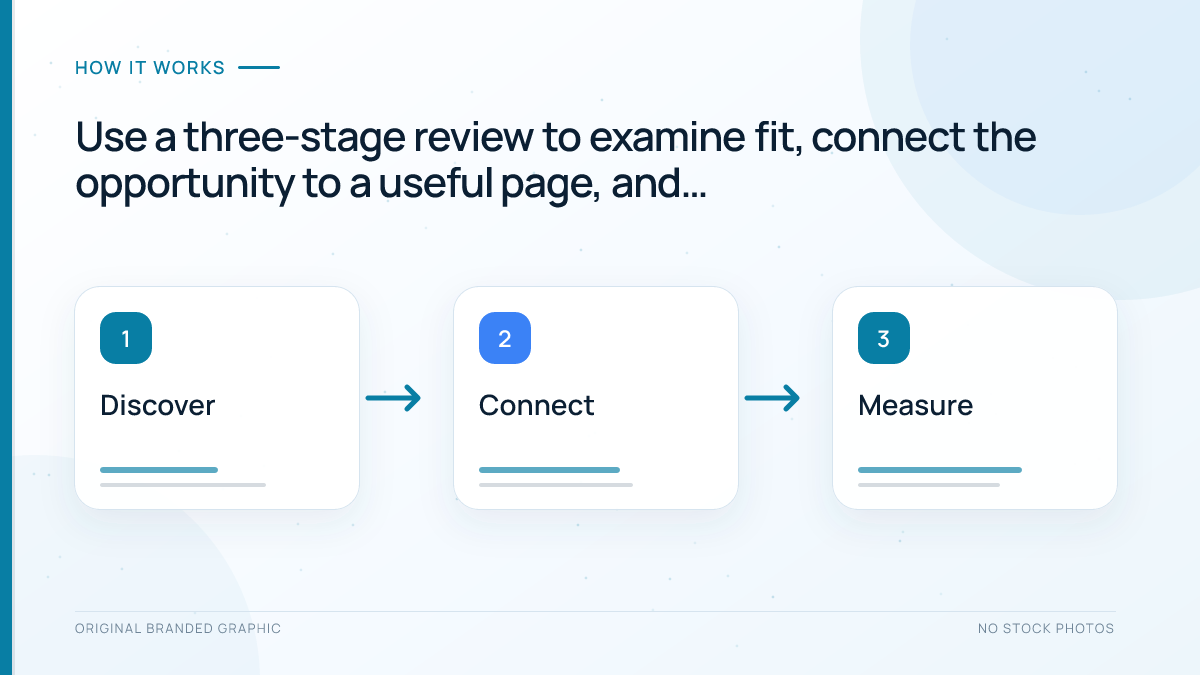
4. Match the destination to the reader need
Choose the most useful public page, not automatically the homepage or highest-converting page. A methodology discussion should lead to the methodology; a definition should lead to the clearest explanation. The site’s unlinked mention workflow applies the same principle when asking whether an existing mention needs a link.
5. Review anchor text and link attributes
Google recommends descriptive, concise anchor text that is relevant to both pages in its link best practices. Natural editorial wording matters more than inserting a target keyword. The publisher should control the final language. If the placement is paid or otherwise compensated, appropriate sponsored or nofollow qualification is more important than passing ranking credit.
6. Check the relationship against spam policies
Google defines link spam as creating links primarily to manipulate rankings. Its spam policies list paid ranking links, excessive exchanges, automated link creation, required links, and optimized anchors in distributed content among the examples. Reject any opportunity that depends on those conditions.
For AI search, do not treat placements as citation shortcuts. Google’s generative AI guidance warns that seeking inauthentic mentions is not helpful. Relevant coverage may support discovery, but no backlink guarantees a mention or citation in an AI-generated answer.
Link Opportunity Decision Table
| Decision | Evidence | Next action |
|---|---|---|
| Approve | Relevant audience, useful context, credible editing, suitable destination, no manipulative condition | Prepare a focused pitch or confirm participation |
| Hold | Potential fit, but page, relationship, ownership, or destination information is incomplete | Verify the missing fact before contact |
| Reject | Unrelated placement, bulk guarantee, hidden payment, forced anchor, unsafe page, or no reader value | Record the reason and stop |
Do not convert the table into an invented authority percentage. A single serious failure can outweigh several positive signals. Likewise, a small publication should not be rejected merely because it lacks a familiar third-party score.
Illustrative Worked Example
Suppose a payroll software company finds a trade publication preparing a guide to correcting timesheet errors. This is an illustrative evaluation, not a reported placement.
- Audience: The publication serves payroll administrators who face the exact problem.
- Editorial evidence: The page has a named editor, clear ownership, consistent payroll coverage, and cited primary sources.
- Context: A section explains how correction rules differ from prevention procedures.
- Destination: The company has a public template that documents the prevention procedure without requiring a login.
- Relationship: No payment, exchange, or required anchor is involved; the editor controls the reference.
- Decision: Approve a concise pitch explaining the template and why it helps this article’s readers.
The same domain would be rejected for a casino article offering a paid exact-match link to the payroll template. Domain-level reputation cannot make an irrelevant page useful.
Troubleshooting Common Evaluation Problems
| Problem | What it means | Response |
|---|---|---|
| No exact page exists yet | The context cannot be reviewed | Hold the candidate until the proposed page or section is known. |
| A high metric conflicts with poor content | The metric is masking weak editorial evidence | Judge the real page, ownership, relevance, and reader value. |
| The publisher requests payment | The opportunity is advertising, not an earned citation | Evaluate it as advertising and require appropriate disclosure and link qualification. |
| The destination is only loosely related | The link would not complete the reader’s task | Choose a better page or reject the opportunity. |
Limitations and Measurement
This evaluation cannot predict rankings, referral volume, link persistence, or AI visibility. Editors can change pages, remove links, or select another source. Google’s Search Console Links report is a sample rather than a comprehensive list, so absence from one report is not proof that a live link does not exist.
After publication, verify the live URL, context, destination, anchor, and attribute. Then measure coverage, links, referred visits, identifiable assistant traffic, search performance, and business outcomes separately using the Digital PR measurement process. Do not attribute every later change to one placement.
Frequently Asked Questions
What makes a link opportunity relevant?
A relevant opportunity serves an audience that genuinely needs the destination and places the reference inside useful supporting context. Shared keywords or a broadly related domain are not enough when the exact page and reader task do not match.
Should I trust a domain authority score?
Treat any third-party score as one optional clue, not proof of quality or ranking value. Review the exact page, editorial ownership, topical consistency, audience fit, placement context, and commercial relationship before making a decision.
Is a paid link opportunity always prohibited?
Paid promotion can be legitimate advertising when it is disclosed and the link is appropriately qualified. It should not be purchased to pass ranking credit, presented as independent editorial coverage, or tied to guaranteed search results.
Can I request my preferred anchor text?
You may explain the destination clearly, but the publisher should control natural editorial wording. Do not require a keyword-rich anchor, followed link, or reciprocal placement as a condition of participation.
Does a relevant backlink guarantee AI search visibility?
No. Relevant coverage may support discovery and public understanding, but a backlink does not guarantee an AI mention, citation, ranking, or visit. Report only outcomes that your available tools can identify.
Conclusion
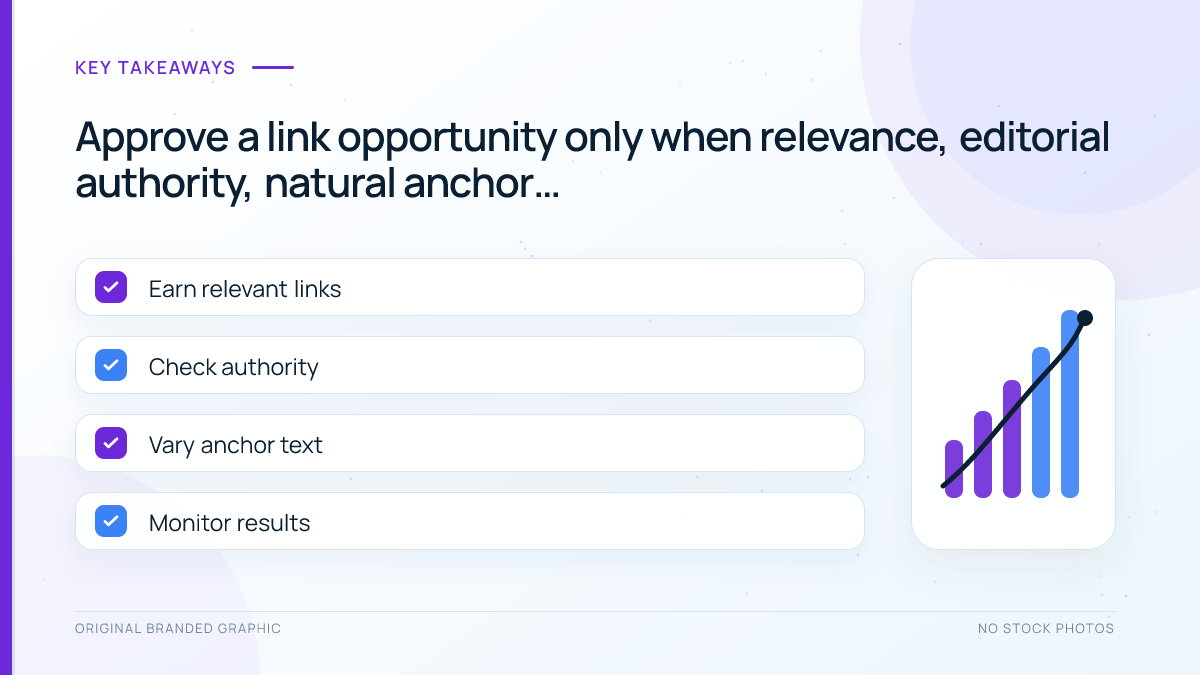
Evaluate link opportunities one candidate at a time. Confirm audience fit, editorial transparency, page context, destination value, natural anchor wording, and a policy-safe relationship. Approve when the placement helps readers, hold when evidence is incomplete, and reject any offer built around manipulation or guarantees. This discipline protects both the audience and the integrity of the wider outreach campaign.