An unlinked brand mention is a published reference to your organization, product, research, or expert that does not include a clickable link to your website. Reclaiming it means finding a relevant mention, confirming that a link would help the publisher’s readers, and politely suggesting the most useful destination.
Quick answer: Build a list of brand variations, find existing mentions, remove false positives, verify each page, map it to a relevant published resource, and send one concise request. The publisher should retain full editorial choice. A mention is not automatically a backlink, referral visit, or AI citation, and a successful link does not guarantee rankings.
Key Takeaways
- Prioritize recent, relevant mentions on legitimate pages that already discuss your work.
- Request a link only when it gives readers useful evidence or a logical next step.
- Suggest the destination, not keyword-rich anchor text or a mandatory followed link.
- Record mentions, links, visits, assistant referrals, and business outcomes as separate signals.
- Do not turn reclamation into mass outreach or a scheme for artificial mentions.
Prerequisites
Prepare a canonical list of your brand name, former names, product names, distinctive research titles, public experts, and common misspellings. Add terms that help disambiguate a common name, such as the industry, city, founder, or product category.
You also need a small set of published destination pages. Each page should be accessible without a login, directly support the mention, and offer more value than a homepage. Useful destinations include an original methodology, research report, official product page, expert biography, or detailed guide.
Create a tracker with the source URL, publication, mention text, date found, context, proposed destination, contact route, outreach date, reply, link status, and next check. If the claim involves data or expertise, use a source-audit process before asking another site to cite it.
How to Find and Reclaim Unlinked Brand Mentions
1. Define the exact entities you are monitoring
Start with a manageable panel rather than every possible phrase. Include quoted brand and product names, an expert name paired with the organization, and a research title paired with its topic. Record ambiguous terms you will exclude. This prevents a common-name match from entering the outreach list.
2. Find candidate mentions
Use manual searches for exact names and distinctive phrases, then exclude your own domain. Review relevant news, trade publications, podcasts with transcripts, newsletters with web archives, resource pages, and articles that discuss your data. Alerts can help with future discovery, but manually verify every result before recording it.
Do not automate queries against Google without permission. Google’s spam policies identify unauthorized machine-generated search traffic as a prohibited practice. A free manual workflow is slower, but it is sufficient for a focused campaign and produces a reviewable evidence trail.
3. Verify that the mention is real and suitable
Open the live page. Confirm the mention refers to your entity, appears in the main content, and is not already linked through the name, an image, a nearby source, or a redirect. Check whether the page is original, relevant, publicly accessible, and useful to real readers.
Reject scraped pages, copied press releases, unrelated directories, spam, and pages that demand payment for ranking credit. Google warns that links created mainly to manipulate rankings can violate its link spam policy.
4. Match the mention to the best destination
Choose the page that substantiates the reference. A quoted statistic should lead to its methodology; an expert mention may lead to a biography or the cited analysis. A generic homepage is appropriate only when it genuinely answers the reader’s next question.
Google’s link best practices recommend descriptive, concise anchor text that gives people context. Suggest a destination and explain its value, but leave wording and placement to the editor. For broader evaluation criteria, use this link-building guide and review what a backlink can demonstrate.
5. Send one concise editorial request
Thank the author or editor, identify the exact page and passage, and explain why the supporting resource helps readers verify or extend the information. Provide the clean destination URL. Do not demand a followed link, prescribe an optimized anchor, or imply an existing relationship that is not real.
One polite follow-up may be reasonable if the request is still timely. Stop after that unless the publisher replies. Repeated messages, copied templates, or contacting unrelated staff turn a useful correction into spam.
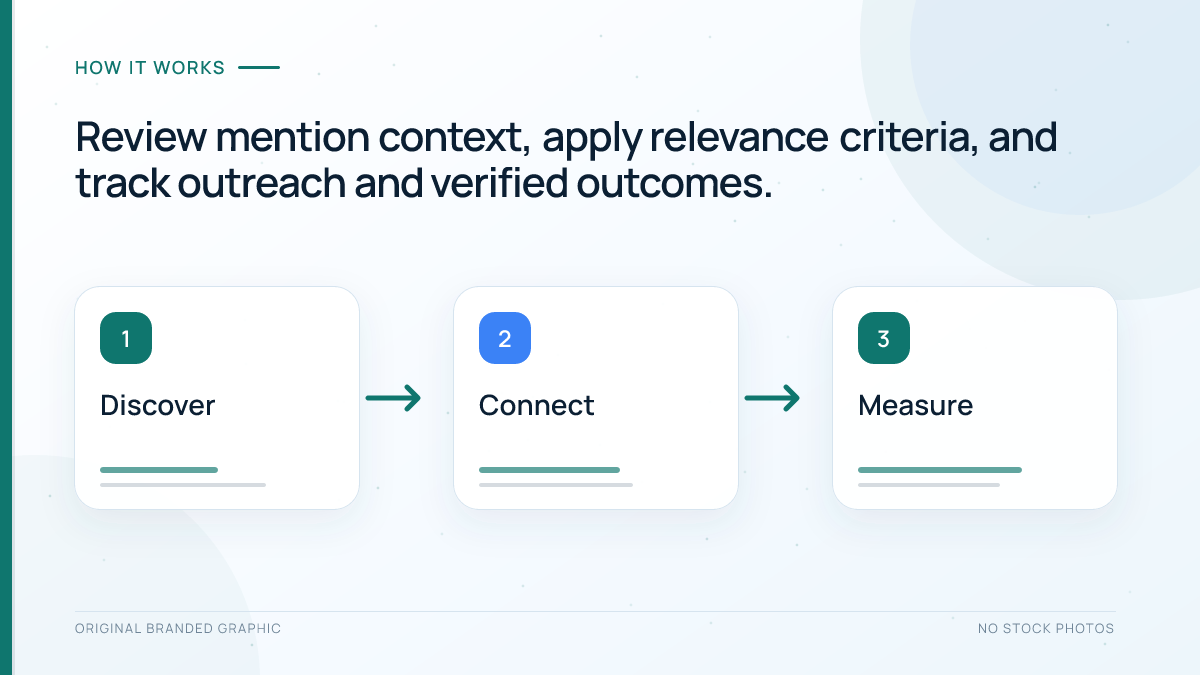
6. Verify and track the outcome
Reopen the page if the publisher confirms a change. Test the link, record its destination and visible anchor, and note whether it is sponsored, nofollowed, or standard. Do not ask for an attribute change merely to obtain ranking credit.
Search Console’s Links report is not a comprehensive list, so absence there does not prove a backlink is missing. Check the live page first. Use the Digital PR measurement workflow to separate placements, referral sessions, identifiable AI Assistant traffic, search visibility, and outcomes.
Prioritization Table
| Candidate | Priority | Reason |
|---|---|---|
| Current article cites your original data | High | The methodology helps readers verify the claim |
| Relevant guide names your tool | High | An official product page may clarify the reference |
| Old article mentions a discontinued name | Medium | A current company page may reduce confusion |
| Positive social post without a web page | Low | There may be no stable editorial page to update |
| Scraped or irrelevant page | Reject | A link would not help readers or your campaign |
Link Quality Checklist
- The source page is topically relevant and serves a real audience.
- The proposed destination directly supports the existing mention.
- The anchor can remain natural and under editorial control.
- The link is not purchased, exchanged, hidden, or contractually required.
- The live result and later outcomes can be verified without overclaiming.
Illustrative Worked Example
Imagine a trade article quotes a company’s 2026 survey finding but names only the company. This example is illustrative, not a reported campaign result.
- Verify that the statistic and company attribution are accurate.
- Confirm that the published methodology page contains the sample, dates, definitions, and limitations.
- Record the article URL, quoted passage, author, and methodology URL.
- Email the editor with the exact passage and explain that the methodology lets readers verify the figure.
- If a link is added, test it and record the outcome without prescribing its anchor or attribute.
The request is defensible because it improves source transparency. It would not be defensible if the destination were an unrelated sales page or the statistic could not be verified.
Troubleshooting and Limitations
If searches return noise, add an industry or product qualifier and maintain an exclusion list. If a publisher declines, mark the result and stop; a mention can remain valuable without a link. If a link appears but analytics show no visits, check its context and destination rather than declaring failure.
Unlinked-mention discovery is incomplete. Search results, alerts, backlink tools, and Search Console can all omit pages. A reclaimed link may help discovery or referral traffic, but it cannot prove that an AI system mentioned or cited the site. Google’s generative AI guidance explicitly discourages inauthentic mentions and offers no special mention-building shortcut.
Frequently Asked Questions
What is an unlinked brand mention?
An unlinked brand mention is a published reference to a company, product, expert, research project, or other identifiable entity that does not contain a clickable link to the relevant website.
Should every brand mention become a backlink?
No. Request a link only when a suitable destination helps readers verify the reference or continue their task. Some mentions are complete without a link, and the publisher retains editorial control.
Can I request specific anchor text?
You may explain which destination is relevant, but avoid demanding keyword-rich wording. Natural anchor text should fit the publisher’s sentence and accurately describe what readers will find after clicking.
Do unlinked mentions prove AI visibility?
No. A public mention does not prove that an AI system found, used, or cited it. Treat visible mentions, backlinks, assistant referrals, platform reports, and citations as separate evidence.
How many follow-ups should I send?
One concise follow-up is usually enough when the request remains timely. If the publisher does not respond or declines, update the tracker and stop rather than sending repeated messages.
Conclusion
Reclaiming unlinked brand mentions works best as a focused editorial correction, not a volume tactic. Verify the mention, match it to a genuinely useful page, explain the reader benefit, respect the publisher’s choice, and track outcomes separately. That approach can earn relevant links without manufacturing mentions or making unsupported promises about search and AI visibility.