An AI SEO report audit checks whether a generated summary matches its source data, uses the correct calculations, and makes claims the evidence supports. A polished paragraph can still average percentages incorrectly, compare partial periods or describe ordinary search traffic as measured AI visibility.
Quick Answer
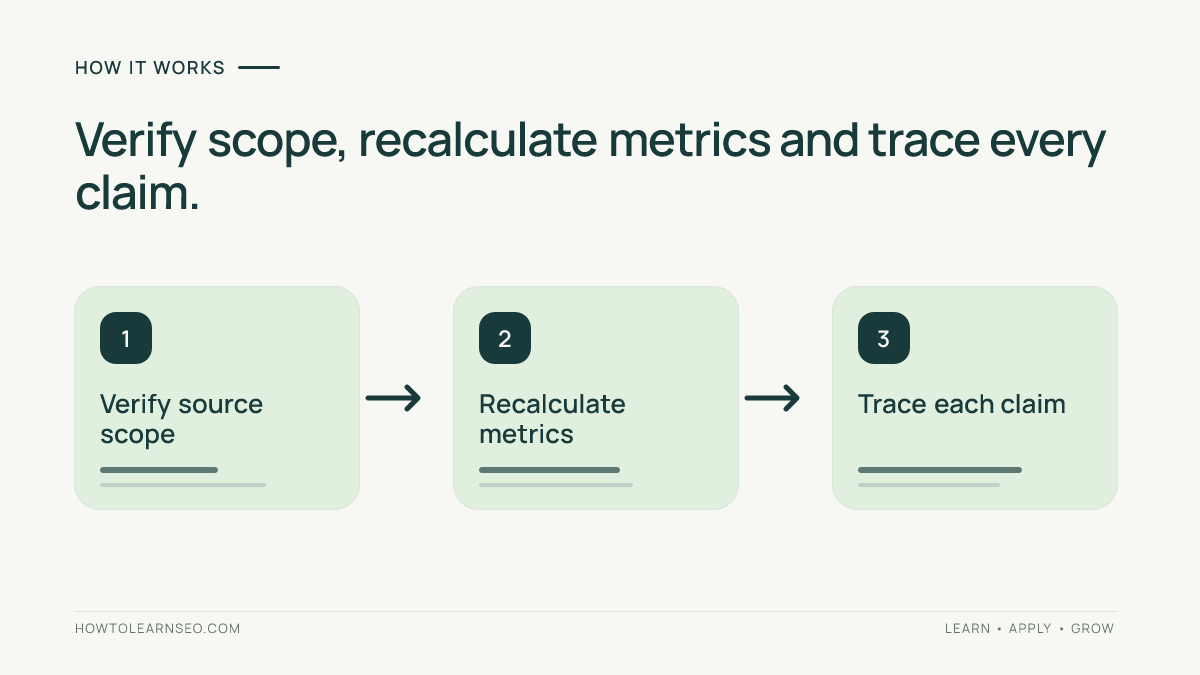
Audit the report in three passes: verify the source and scope, recalculate important metrics, then trace each conclusion to evidence. Keep unsupported statements marked for review. Approve the final narrative only after the numbers, definitions and limitations agree with the underlying exports.
Key Takeaways
- Freeze source exports before reviewing the generated narrative.
- Recalculate ratios from their component counts.
- Separate percentage changes from percentage-point changes.
- Distinguish an observed change from a claim about its cause.
Prepare the Source Packet
You need the generated report, its original GSC and GA4 exports, a calculator or spreadsheet, and read access to verify disputed values. Use synthetic examples when asking an assistant for calculation help; client data should remain in approved systems.
For each dataset, record property, dates, timezone, search type or channel, filters, grouping dimension, export time and completeness notes. Preserve original files. Check the Search Console guide if the property or report scope is unclear.
A Domain property and a URL-prefix property can overlap. Do not add them together as independent sites. Likewise, avoid comparing a complete week with a current partial week. Google’s Performance report documentation identifies preliminary data and explains metric and dimension selection.
Assign each important statement a claim ID, such as C01. Beside it, record the source file, relevant row or total, calculation and review decision. This makes a report review reproducible rather than a discussion about whether the wording sounds plausible.
Check Metric Definitions Before Arithmetic
GSC clicks describe search-result interactions; GA4 sessions describe website activity. They are not interchangeable. A report that calls sessions “Google clicks” has a definition error even when its sum is correct. Use the landing-page reconciliation workflow when connecting the systems.
Do not label a returned query-row count as every keyword the site ranks for. Google’s Search Analytics API reference explicitly says it does not guarantee every row. Privacy omissions and reporting limits also affect query tables. Name the evidence honestly: “returned query rows in this export.”
For a top-ten count, state the dataset and rule, such as returned query rows with average position at most ten. This is a reporting band, not proof of a fixed rank for every searcher. Without adequate row coverage, hold the count rather than presenting it as exhaustive.
Recalculate CTR, Position and Change
Google defines CTR as clicks divided by impressions in its clicks, impressions and position guidance. For a compatible set of rows, recompute the ratio from summed counts instead of averaging the displayed percentages.
Illustrative Two-Day Calculation
These invented daily rows describe the same property and filters. They demonstrate arithmetic, not observed traffic, live testing or an actual assistant response.
| Day | Clicks | Impressions | CTR | Average position |
|---|---|---|---|---|
| A | 100 | 1,000 | 10% | 2 |
| B | 1 | 100 | 1% | 10 |
Combined CTR is 101 / 1100 = 9.18%, rounded. The simple mean of 10% and 1% is 5.5%, which gives the smaller day too much influence. With clicks in B2:B3 and impressions in C2:C3, use =SUM(B2:B3)/SUM(C2:C3) and format the result as a percentage.
For these compatible daily rows, the impression-weighted position is (2 × 1000 + 10 × 100) / 1100 = 2.73, rounded. With position in E2:E3, use =SUMPRODUCT(C2:C3,E2:E3)/SUM(C2:C3). The unweighted answer, six, misrepresents the exposure. Rounded source positions can introduce small differences from the original report.
Do not extend this arithmetic across incompatible groupings. Page-level and property-level aggregation can differ. Recombining selected page rows does not automatically reconstruct the property chart, and overlapping exports can double-count records. Google’s data-discrepancy guidance explains these reporting boundaries.
When impressions total zero, label CTR and weighted position unavailable instead of dividing by zero. For change, calculate (current - previous) / previous only when the previous value is nonzero. A move from zero to three clicks has an absolute increase of three; its percentage increase is undefined. A CTR increase from 4% to 6% is two percentage points and a 50% relative increase. Label both units clearly.
Run the AI SEO Report Audit Against Evidence
Ask the assistant to review a bounded evidence packet rather than invent explanations. An illustrative prompt is:
Review claims C01–C05 against the supplied source totals and definitions. Preserve each ID. Return source reference, recomputed value, discrepancy and supported wording. Mark missing evidence explicitly. Do not infer causation, AI citations, search volume, rankings or completed repairs from a traffic change alone.
Compare every returned calculation yourself. A second model answer is another proposal, not independent evidence. Keep critical claims on hold if the source cannot be reproduced.
For example, replace “the content edit caused a 20% traffic gain” with the verified observation and its limits. Review release dates and overlapping changes using an SEO change log. A before-and-after association alone does not establish the edit’s contribution.
Check AI claims separately. Google’s current GA4 channel definitions use the ai-assistant medium for AI Assistant; Organic Search includes Google AI Overviews and AI Mode. Neither a broad organic total nor an unidentified Direct visit measures comprehensive AI citations. Crawler requests are also separate from referred visitor sessions.
Resolve Exceptions Before Sharing
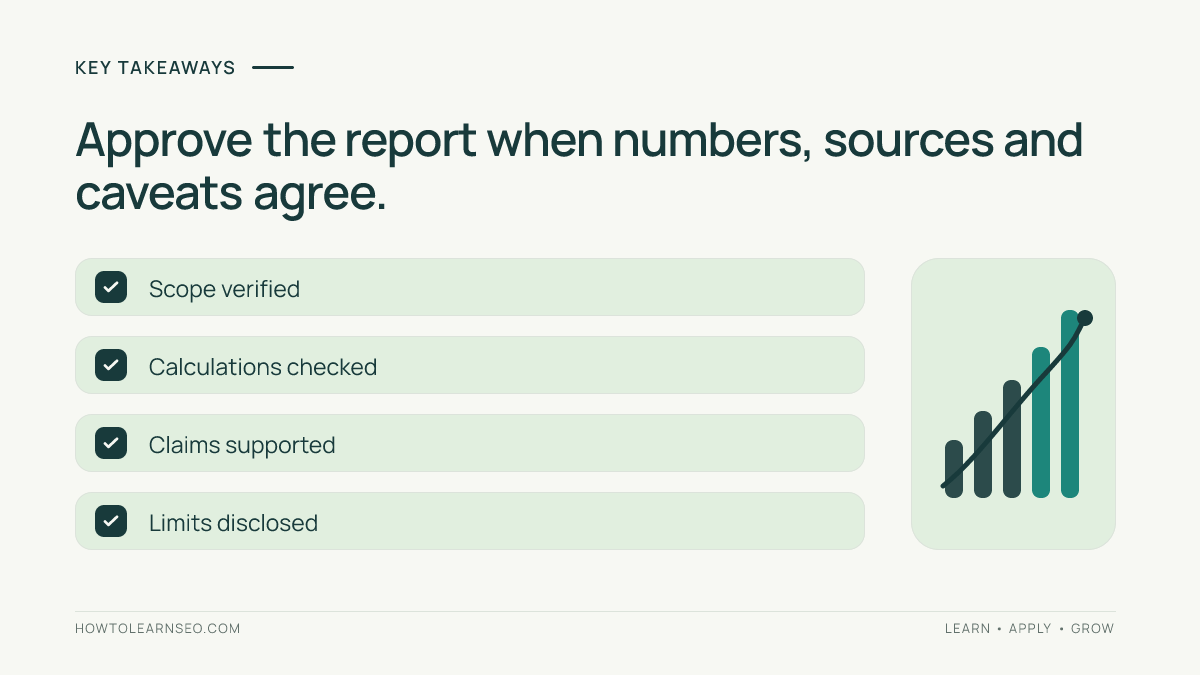
Use three decisions: supported, revise, or insufficient evidence. Fix the source mapping or calculation before polishing the sentence. If a chart, headline and body use different totals, choose the correct scope and regenerate all affected references together.
For mismatched totals, inspect date boundaries, filters, missing rows and aggregation. For surprising GA4 movement, check collection and acquisition scope before calling it growth. For tiny samples, report counts and uncertainty rather than dramatic percentage headlines. Do not silently replace absent data with zero.
Save the approved report alongside its source packet and correction record. This audit verifies reporting quality; it does not prove SEO effectiveness, establish backlink quality or forecast future traffic. Keep any unsupported market demand or difficulty claim out of the final narrative.
Frequently Asked Questions
Should I audit every number in a long report?
Check every headline metric and every number supporting a decision. Then sample supporting tables and expand the review when errors appear. Verify repeated figures across charts, summaries and recommendations together. A correct dashboard total does not establish that every generated explanation uses the same scope or definition.
What if the AI output is correct but the export is incomplete?
Describe the result as applying to the available rows and disclose the limitation. Correct arithmetic cannot restore omitted queries or missing periods. If the business decision depends on complete coverage, obtain an appropriate source before approving that claim. Keep unknown values unknown rather than asking the assistant to estimate them.
Can I average daily engagement rates the same way as CTR?
Use the metric’s actual numerator and denominator, not an unweighted average of displayed rates. Different metrics have different definitions and scopes. Confirm those definitions before combining them, and preserve compatible counts when available. If you only have rounded percentages without the necessary counts, disclose that an exact aggregate cannot be reconstructed.
How should I report a zero baseline?
Show the previous and current counts, the absolute difference and a note that relative percentage change is undefined. Do not substitute a denominator of one unless you are explicitly describing a separate modeling convention. Small new totals can be useful evidence without being presented as an enormous growth percentage.
Does a passing report audit mean the recommended edits are approved?
No. Reporting approval means the reviewed metrics and claims match their evidence. Website changes still need their own content, technical and authorization checks. Keep recommendations separate from completed actions, and verify any later implementation publicly before marking it done. A persuasive report is not a deployment record.
Conclusion
A reliable AI SEO report audit connects every important number and conclusion to a reproducible source. Verify scope, recalculate ratios, label uncertainty and correct unsupported wording before sharing. AI can help organize the review; evidence determines what the report can responsibly say.