
Publishing a page does not automatically place it in Google’s search results. Google must first discover the URL, crawl it, understand its content, decide which version is canonical, and determine that the page is useful enough to store in its search index.
This guide explains Google indexing from beginning to end. You will learn how indexing differs from crawling and ranking, how to check whether a page is indexed, what common Search Console statuses mean, and what to do when an important page remains excluded.
Quick Answer: How Do You Get a Page Indexed by Google?
To make a page eligible for Google indexing, give it a stable public URL that returns a successful HTTP status, allow Googlebot to crawl it, remove any unintended noindex directive, use a consistent canonical URL, add genuinely useful and distinct content, link to the page from other relevant pages, and include the canonical URL in an XML sitemap. Then inspect the URL in Google Search Console and request indexing if the page is new or has been materially fixed.
These actions make indexing possible; they do not guarantee it. Google decides which eligible pages to index, and submitting the same unchanged URL repeatedly does not make the process faster.
Key Takeaways
- Crawling and indexing are different. Google can crawl a page without adding it to the index.
- Indexability is only the starting point. A technically accessible page can still be excluded if it is duplicative, thin, low-value, or not clearly canonical.
- Not every excluded URL is a problem. Redirects, duplicates, filtered URLs, and intentional
noindexpages often should remain outside the index. - Search Console provides the most useful diagnosis. Use the URL Inspection tool for one URL and the Page indexing report for site-wide patterns.
- Discovery signals work together. Crawlable internal links and a clean sitemap help Google find and prioritize important pages.
- Request Indexing is a prompt, not a command. Fix the underlying issue before asking Google to process the page again.
What This Guide Covers
- What Google indexing means
- How discovery, crawling, rendering, and indexing connect
- The requirements a page should satisfy
- How to check a URL’s index status
- How to interpret common Search Console exclusions
- A step-by-step workflow for resolving indexing problems
- Common mistakes and a final indexing checklist
What Is Google Indexing?
Google indexing is the process of analyzing a crawled page and potentially storing information about it in Google’s search index. That index is the organized collection of web content Google can consider when it assembles search results.
During indexing, Google processes the page’s primary content and signals. It may render JavaScript, interpret text and media, evaluate language and relevance, identify links, compare the page with similar URLs, and select a canonical version. If Google decides to index the content, the canonical page becomes eligible to appear in Search.
Being indexed does not mean a page will rank for a particular query, and it does not guarantee impressions or traffic. Indexing only makes the page available for Google’s retrieval and ranking systems to consider. For the broader sequence, read how search engines work through crawling, indexing, and ranking.
Crawling vs. Indexing vs. Ranking
These terms describe separate stages. Mixing them together often leads to the wrong diagnosis.
| Stage | What happens | Typical question |
|---|---|---|
| Discovery | Google learns that a URL exists through links, sitemaps, redirects, or other sources. | Does Google know this URL exists? |
| Crawling | Googlebot requests the URL and downloads the available resources. | Can Google access the page? |
| Rendering | Google processes the page, including relevant JavaScript-generated content. | Can Google see the main content? |
| Indexing | Google analyzes the content, chooses a canonical, and may store the page in its index. | Is the canonical page eligible to appear in Search? |
| Ranking and serving | Google evaluates indexed pages for a specific query and orders suitable results. | Does this page deserve to appear for this search? |
A page can pass one stage and fail at the next. For example, “Crawled – currently not indexed” means Google successfully reached the URL but did not add it to the index at that time. Improving crawl access alone will not necessarily solve that situation.
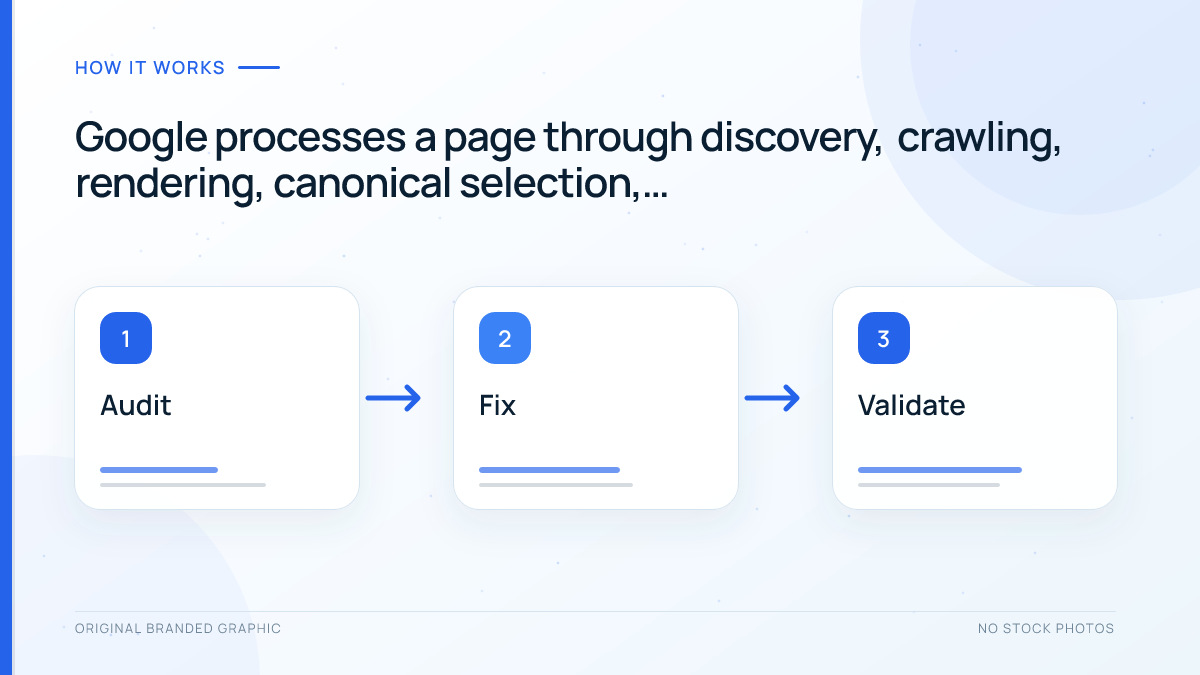
How Does the Google Indexing Process Work?
1. Google Discovers the URL
Google can find a URL through an ordinary HTML link, an XML sitemap, a redirect, or a URL it encountered previously. A page that is absent from navigation, internal links, and the sitemap may remain unknown or be discovered slowly.
The strongest discovery path is usually a crawlable link from a relevant indexed page. That link also provides context through its surrounding text and anchor text. A sitemap is a useful secondary signal, especially for new or large sites, but it is not a replacement for a coherent site structure.
2. Googlebot Crawls the Page
After discovery, Google schedules the URL for crawling. Googlebot must be able to reach the server, access the URL, and receive a usable response. A login wall, repeated server failures, an inaccessible robots.txt file, or an unintended robots.txt rule can prevent or delay this stage.
The crawl date is not a promise that indexing will follow. It only confirms that Google fetched a version of the URL.
3. Google Processes and Renders the Content
Google parses the HTML and may render JavaScript to see content that is added after the initial response. If essential copy, links, or directives appear only after an unreliable script runs, Google may receive an incomplete version of the page.
For important SEO content, server-rendered or readily available HTML is the safest baseline. JavaScript can enhance the experience, but the main content and navigational links should remain accessible and stable.
4. Google Groups Duplicates and Selects a Canonical
If several URLs contain the same or very similar primary content, Google groups them and chooses one representative URL. Your rel="canonical" element, redirects, sitemap entries, HTTPS use, and internal-link consistency all help communicate your preference, but canonicalization signals are not absolute commands.
A page may therefore be crawlable and indexable yet excluded as an alternate or duplicate. If Google selected the wrong version, compare all competing URLs and review the practical guidance in the canonical tag SEO guide.
5. Google Evaluates the Page for Indexing
Google assesses whether the canonical page belongs in the index. Technical eligibility matters, but so do distinct purpose, useful main content, and the absence of misleading or spammy behavior. A page that adds little beyond another indexed page may not be stored separately.
This is why a successful live test does not guarantee inclusion. The live test can confirm that Google’s inspection crawler can access the current version, but some decisions—especially canonical selection and whether a crawled page should be indexed—happen later.
6. The Indexed Page Becomes Eligible for Search
Once indexed, the page can be considered for relevant searches. Google may recrawl it, update the indexed version, consolidate signals with another canonical, or remove it later if its availability or usefulness changes. Indexing is an ongoing state, not a one-time certificate.
What Makes a Page Eligible for Google Indexing?
Google’s published technical requirements for Search provide a useful baseline. In practical terms, an important page should satisfy all of the following conditions.
The Page Is Publicly Accessible
The URL should work for a signed-out visitor without requiring a password, account, or private network. Test it in an incognito window. If ordinary users cannot access the page, Googlebot generally cannot index it as a public search result.
The URL Returns the Intended HTTP Response
An indexable content page should normally return 200 OK. A 301 or 308 response tells Google that the content lives elsewhere, so the destination—not the redirecting URL—is the indexing candidate. A genuine missing page should return 404 or 410, while repeated 5xx errors signal a server problem.
Also watch for soft 404s: pages that return 200 but look empty, unavailable, or equivalent to an error page. Adding a header and a few generic sentences does not turn a non-existent or valueless page into a useful index candidate.
Googlebot Is Allowed to Crawl the Page
Review your robots.txt rules when Search Console reports that crawling is blocked. Do not use robots.txt as a dependable method for removing a URL from the index. If crawling is blocked, Google cannot fetch the page to see a noindex directive, and the URL may still appear with limited information if Google discovers it elsewhere.
No Unintended Noindex Directive Exists
Check both the HTML robots meta tag and the X-Robots-Tag HTTP header. A staging setting, SEO plugin option, template rule, or server header can add noindex without it being obvious on the visible page.
If you want the page indexed, remove the directive and allow Googlebot to crawl the page again. The meta robots tag guide explains where these directives appear and how they differ from crawl controls.
The Canonical Signals Point to the Correct URL
A unique page commonly uses a self-referencing canonical. Internal links, sitemap entries, redirects, mobile or regional variants, and canonical tags should consistently support the same preferred URL. Mixed signals—such as linking to one version while canonicalizing to another—make consolidation harder.
The Main Content Is Available and Worth Indexing
The page should have a clear purpose and provide enough original value to stand independently. This does not mean every page must be long. A short calculator, definition, product page, or reference can be valuable when it satisfies its purpose better than alternatives.
Evaluate substance rather than a word-count target. Ask whether the page answers a distinct need, whether its main content differs meaningfully from nearby pages, and whether a visitor would choose to keep or share it.
Google Can Discover the Canonical URL Reliably
Link to the page from relevant hubs, category pages, or articles using standard HTML links. Good internal linking prevents important content from becoming orphaned and helps both users and Google understand how it fits into the site.
Include the preferred URL in a current XML sitemap as well. Submit only canonical URLs that you want indexed, and keep the lastmod value accurate rather than changing it when the page has not materially changed.
How to Check Whether a Page Is Indexed
Use URL Inspection for a Specific Page
Open Google Search Console, select the correct property, and paste the exact canonical URL into the inspection bar. The indexed result can show whether the URL is on Google, the last crawl date, whether crawling and indexing were allowed, the user-declared canonical, and the Google-selected canonical.
If the report reflects an older version, click Test Live URL. The live result checks the current accessible version, but it does not predict every indexing decision. Google’s URL Inspection documentation specifically notes that a valid live result is not a guarantee of indexing.
Use the Page Indexing Report for Patterns
Go to Indexing → Pages in Search Console. This report groups known URLs by indexed and not-indexed reasons. Open a reason to view examples, determine whether the exclusion is intentional, and look for a shared template or technical cause.
The report is most useful at the pattern level. One intentionally redirected URL is normal; thousands of unexpected redirects or duplicate pages may reveal a site-wide configuration problem. Google’s Page indexing report guide also cautions that you should not expect every known URL to be indexed.
Use Search Operators Only as a Secondary Check
A search such as site:example.com/page-slug can provide a quick clue, but it is not a complete or authoritative inventory. Search operators may omit indexed URLs or show results differently from Search Console. Use URL Inspection when the status of a particular page matters.
What Common Page Indexing Statuses Mean
| Search Console status | What it usually means | Best next action |
|---|---|---|
| URL is unknown to Google | Google has not recorded the URL yet. | Add a relevant crawlable internal link, include the canonical URL in the sitemap, test the live page, and request indexing. |
| Discovered – currently not indexed | Google knows the URL but has not crawled it yet. | Improve discovery and prioritization, check server health, reduce low-value URL clutter, and allow time for crawling. |
| Crawled – currently not indexed | Google fetched the page but did not add it to the index at that time. | Review uniqueness, usefulness, duplication, canonical signals, rendering, and site-wide quality. Do not repeatedly resubmit an unchanged page. |
| Excluded by noindex | Google found a robots directive that prevents indexing. | Keep it if intentional; otherwise remove the directive, confirm the live page, and request indexing. |
| Blocked by robots.txt | Google is not allowed to crawl the URL. | Remove the blocking rule if the page should be crawled. If removal is the goal, allow crawling and use an appropriate noindex method. |
| Alternate page with proper canonical | Google treats this URL as a duplicate and indexes the selected canonical. | Usually no action is needed if the correct canonical is indexed. |
| Duplicate without user-selected canonical | Google found duplicate content, but the site did not clearly declare a preference. | Consolidate duplicates or add consistent canonical signals and internal links. |
| Duplicate, Google chose different canonical | Google disagrees with the canonical preference supplied by the site. | Compare the URLs, remove conflicting signals, and make the preferred page substantially clear and useful. |
| Soft 404 | The URL returns a successful status but appears empty, missing, or not useful as a standalone result. | Restore meaningful content or return a genuine 404/410 when the resource no longer exists. |
| Page with redirect | The inspected URL redirects elsewhere. | Confirm that the destination is correct and use the destination in internal links and sitemaps. |
| Server error (5xx) | Google could not obtain a usable response from the server. | Fix availability, timeout, firewall, hosting, or application errors before requesting another crawl. |
How to Get an Important Page Indexed: Step by Step
Step 1: Decide Whether the URL Should Be Indexed
Start with purpose, not tooling. Index the canonical version of pages that provide search value: original articles, useful category pages, products, services, tools, and important reference pages. Do not try to index every filter, sort order, tracking parameter, internal search result, duplicate print view, or empty archive.
This distinction keeps the index focused and prevents you from treating intentional exclusions as failures.
Step 2: Inspect the Exact Canonical URL
Use the complete preferred URL, including the correct protocol, hostname, path, and trailing-slash format. Review the indexed result and note the stated exclusion, last crawl, referring sitemap, crawl permission, indexing permission, and canonical selection.
Then run a live test if you have changed the page since Google’s last crawl. Compare the live result with the indexed result rather than assuming that an old error still exists.
Step 3: Confirm Access and HTTP Behavior
Open the URL while signed out and verify that it loads without a password, consent loop, geographic block, or intermittent server error. Follow any redirect chain and confirm that the final destination is the URL you intend to index.
Check that important resources are not blocked and that the rendered page contains the primary text, headings, links, canonical, and robots directives. If a live inspection screenshot or rendered HTML lacks the main content, address rendering before focusing on content quality.
Step 4: Remove Conflicting Indexing Signals
Confirm that robots.txt permits crawling, the page has no accidental noindex, the canonical identifies the correct preferred version, internal links use that same version, and the sitemap does not list conflicting alternatives.
Technical consistency matters. A self-canonical page linked internally through redirected or parameterized versions sends a less coherent signal than a site that always references the final canonical URL.
Step 5: Evaluate the Page Against Nearby Content
Search your own site for pages with the same purpose. If two articles answer the same question with similar content, improving both may not solve the problem. Choose the stronger destination, combine unique value where appropriate, and redirect or canonicalize the redundant version only when that accurately reflects the relationship.
For a page marked “Crawled – currently not indexed,” ask:
- Does it satisfy a distinct search intent?
- Does it provide information beyond the title and a generic summary?
- Is the content substantially different from another URL?
- Does the page demonstrate why a user would need this specific result?
- Are the main content and supporting elements visible in the rendered HTML?
- Is the page part of a useful topic structure, or is it an isolated doorway-like URL?
Step 6: Strengthen Internal Discovery
Add links from one or more relevant published pages. Use anchor text that describes the destination naturally. A new page linked only from a large sitemap has weaker contextual discovery than one connected from a topical hub and a closely related article.
Do not manufacture dozens of site-wide links solely to force crawling. A few useful, prominent connections are more sensible than repetitive links that do not help readers.
Step 7: Keep the Sitemap Accurate
Include the final canonical URL in the XML sitemap. Remove redirected, duplicate, noindex, missing, and non-canonical URLs. Submit the sitemap in Search Console once and let Google process it; repeatedly submitting the unchanged file does not create an indexing guarantee.
Step 8: Request Indexing After a Meaningful Change
If the page is new, or you corrected a real issue, use URL Inspection and click Request Indexing. For many URLs, rely on a clean sitemap rather than submitting each one manually. Google’s guidance on requesting a recrawl explains that submissions are limited and repeated requests for the same URL do not accelerate crawling.
Step 9: Monitor the Result Without Constant Resubmission
Record the request date, wait for Google to revisit the page, and inspect it again after a reasonable interval. For a group of URLs with the same fix, use Search Console’s validation workflow where appropriate. Monitor patterns rather than checking the site: operator every few hours.
If the URL remains “Crawled – currently not indexed,” do not make cosmetic edits merely to change the timestamp. Reassess whether the page is truly distinct, useful, internally supported, and aligned with the site’s overall quality.
Practical Indexing Scenarios
A New Article Is Unknown to Google
Suppose a useful article was published today but URL Inspection says Google does not know it. Confirm that the article is public and canonical, link to it from an appropriate topic page or related article, verify that it appears in the sitemap, run a live inspection, and request indexing. The status is not alarming immediately after publication; discovery and crawling take time.
A Page Is Crawled but Still Not Indexed
A successful crawl rules out some access problems, but it does not prove that Google saw a strong indexing candidate. Compare the page with similar URLs, inspect the rendered content, review canonical selection, and look for template-level thinness or duplication. Improve the page only where it improves user value. If the content is already strong and newly published, waiting may be more appropriate than repeated technical changes.
Google Chose a Different Canonical
Inspect both the submitted URL and Google-selected canonical. If Google’s choice is correct, update links and the sitemap to reinforce it. If your preferred page should be canonical, eliminate conflicting redirects and tags, link consistently to it, and make the content relationship unmistakable. Remember that a canonical tag is a strong hint, not permission to maintain contradictory site signals.
Many Low-Value URLs Are Consuming Attention
An ecommerce or publishing site may expose filters, parameters, archives, tags, searches, and duplicate paths. The goal is not to force all of them into the index. Define which URL types deserve search visibility, consolidate duplicates, keep navigation crawlable, and remove non-canonical URLs from the sitemap. A cleaner indexable set makes monitoring easier and communicates the site’s priorities more clearly.
Common Google Indexing Mistakes
- Expecting same-day indexing: publication and indexing are separate events, and timing varies.
- Requesting indexing repeatedly: another submission does not repair weak content, duplication, or contradictory canonicals.
- Assuming “URL can be indexed” means it will be indexed: a live test checks important access conditions but cannot guarantee the later indexing decision.
- Trying to index every generated URL: duplicate filters, parameters, searches, and thin archives often should not be indexed.
- Blocking a noindex page in robots.txt: Google must crawl the page to see the
noindexdirective. - Listing poor URLs in the sitemap: a sitemap should reinforce canonical, index-worthy URLs rather than act as a dump of every URL the CMS creates.
- Ignoring the Google-selected canonical: the page you submitted may be excluded because Google indexed another version.
- Making superficial freshness edits: changing a date or a few words does not create distinct value.
- Leaving important pages orphaned: sitemap discovery alone does not explain a page’s relationship to the rest of the site.
- Treating every exclusion as an error: redirects, alternates, deleted pages, and intentional noindex URLs can be healthy exclusions.
Google Indexing Checklist
Use this checklist for every important page before escalating an indexing issue:
- The URL is public and works while signed out.
- The final content URL returns
200 OK. - Googlebot is not unintentionally blocked by robots.txt or a firewall.
- No unwanted robots meta tag or
X-Robots-Tag: noindexis present. - The rendered page contains the primary content.
- The user-declared canonical identifies the intended URL.
- Internal links, redirects, HTTPS, and sitemap entries support the same canonical.
- The page satisfies a distinct purpose and is not a near-duplicate.
- At least one relevant published page links to it with descriptive anchor text.
- The canonical URL appears in a valid, current XML sitemap.
- URL Inspection shows the expected live content and directives.
- An indexing request is made only after publication or a meaningful fix.
Frequently Asked Questions
How long does Google indexing take?
There is no fixed indexing time. A page may be processed within days, while another can take weeks or remain excluded. Timing depends on discovery, crawl scheduling, server reliability, canonical signals, content value, duplication, and the site’s broader crawl patterns. For a new page, verify the fundamentals, submit it once through Search Console if appropriate, and monitor rather than repeatedly requesting indexing.
Does requesting indexing guarantee that my page will appear on Google?
No. Requesting indexing places the URL into a processing queue; it does not require Google to crawl, index, or rank the page. The request is most useful after publishing an important URL or correcting a genuine issue. If the page is duplicative, blocked, non-canonical, thin, or otherwise unsuitable for indexing, repeated requests will not solve the underlying problem.
Why does Search Console say “Crawled – currently not indexed”?
This status means Google fetched the URL but did not add it to the index at that time. The page may still be indexed later. Review the rendered content, canonical selection, uniqueness, usefulness, and overlap with other URLs. If the page is new and strong, waiting may be reasonable. Google specifically indicates that there is no need to keep resubmitting the unchanged URL for crawling.
Should every page on my website be indexed?
No. Google generally needs the canonical versions of pages that provide standalone search value. Redirects, duplicate variants, tracking URLs, faceted filters, internal search results, empty archives, private pages, and intentionally excluded utilities often should not be indexed. A healthy site can have many excluded URLs; the important question is whether the correct canonical pages are indexed and the exclusions match your intent.
Can a sitemap force Google to index a URL?
No. A sitemap helps Google discover preferred URLs and understand which pages you consider important, but it is a hint rather than an indexing command. Include only canonical, index-worthy URLs and keep modification dates accurate. Pages listed in a sitemap must still be crawlable, indexable, useful, and consistent with your other technical signals before Google may add them to the index.
Can a page rank if it is not indexed?
A standard web page must be indexed and eligible for serving before it can rank as that page in Google’s organic search results. If the URL is not indexed, focus first on discovery, crawl access, directives, canonicalization, rendering, and content value. Once indexed, relevance, quality, links, and other ranking systems determine whether it appears for particular searches.
Conclusion
Google indexing is not a simple submit-and-wait switch. It is the result of a chain: Google must discover the correct URL, crawl it successfully, process its content, choose the intended canonical, and decide that the page deserves a place in the index.
When an important page is missing, diagnose the exact stage instead of applying every SEO fix at once. Use Search Console to identify the status, make technical signals consistent, strengthen the page’s distinct value and internal connections, submit it after a meaningful change, and allow time for reprocessing. That method solves real indexing problems while keeping intentionally excluded URLs out of the way.