International SEO URL structure determines where a website puts pages for different countries or languages. The common choices are country-code domains, language or country subdirectories, and subdomains. Each can work, but the right decision depends on localization, infrastructure, budgets, analytics and the team’s ability to maintain accurate alternate-language signals.
Quick Answer
For many organizations, subdirectories on one established domain provide a manageable starting point for international SEO URL structure. Subdomains offer operational separation, while country-code domains give a clear country signal but add upkeep. None guarantees search rankings. Publish distinct accessible URLs, localize meaningful content and implement appropriate hreflang annotations. Our international SEO basics guide explains the foundational concepts.
Key Takeaways
- Choose structure for customer experience and long-term operations, not a ranking myth.
- Distinguish language targeting from country-specific offerings.
- Keep translated or localized pages on directly accessible URLs.
- Use reciprocal hreflang annotations when eligible alternate versions exist.
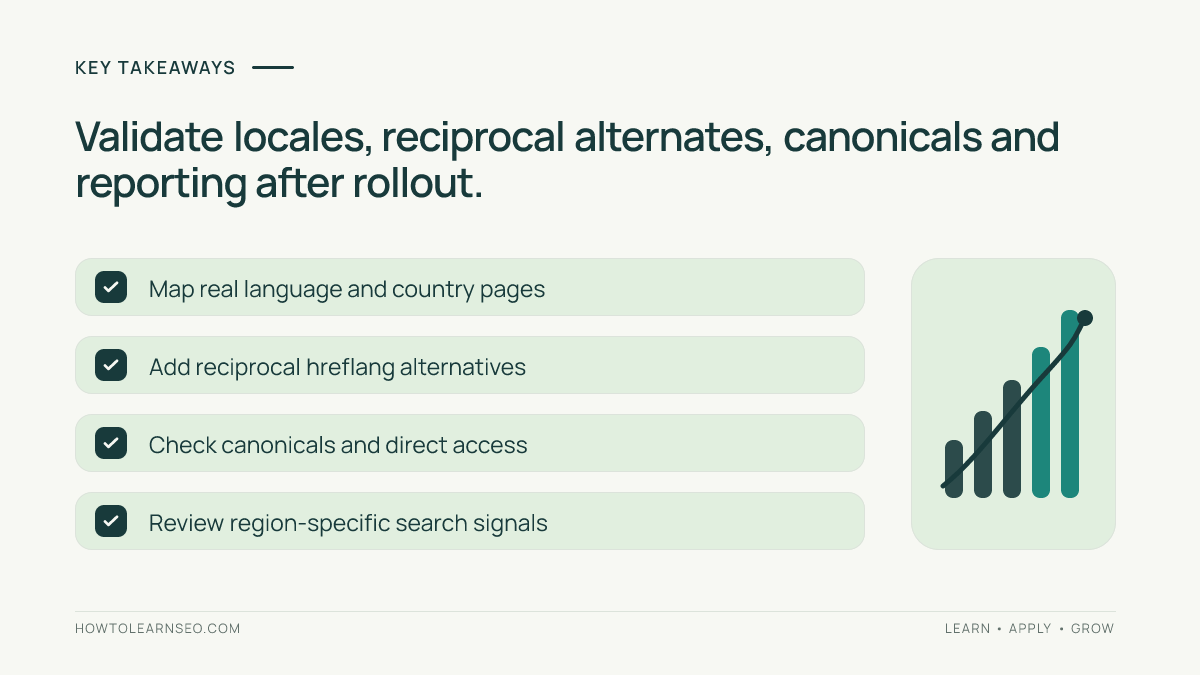
- Test navigation, canonicals, redirects and analytics before migration.
First distinguish languages from regions
A multilingual site supports two or more languages; a multi-regional site targets audiences in distinct countries. They overlap but are not identical. English-speaking visitors in the United States and United Kingdom may need different prices, shipping options or legal notices without requiring a language translation. French-speaking visitors in Canada and France may share a language yet need different product availability.
Decide which combinations genuinely need separate experiences before assigning URL patterns. Google’s multi-regional site guidance recommends distinct URLs for language variants and discusses region signals. Do not publish dozens of nearly identical doorway pages merely because a keyword tool lists country variations. Each version should solve a real audience need.
Compare subdirectories, subdomains and country-code domains
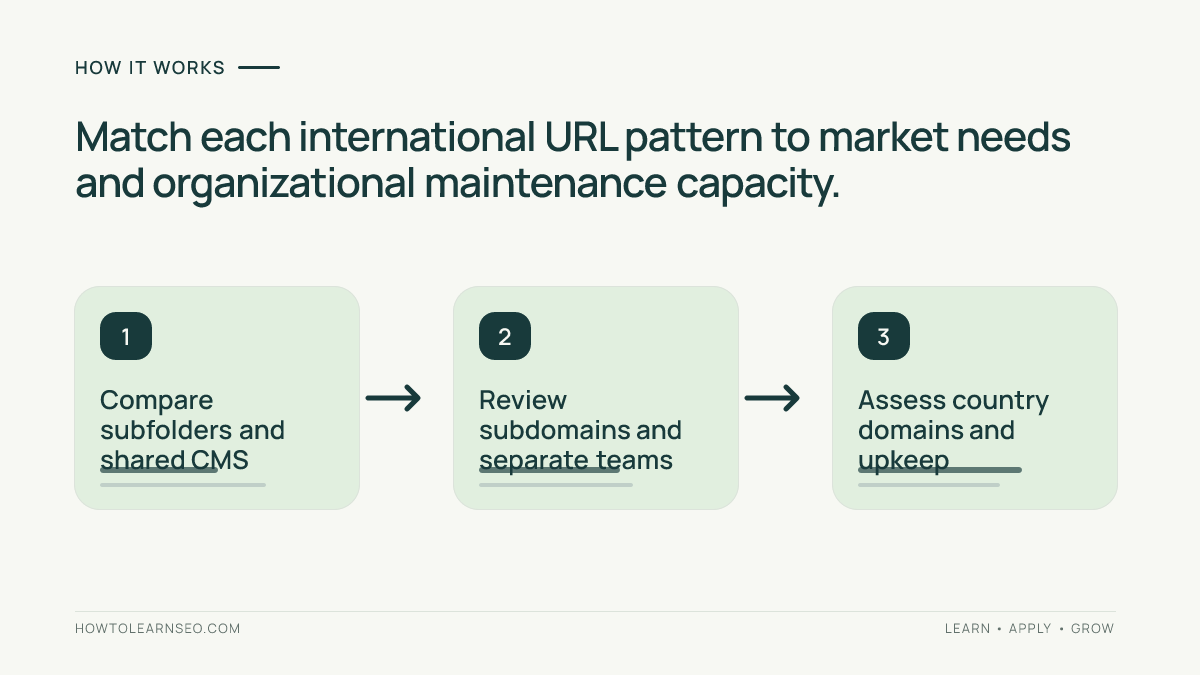
Subdirectories: URLs such as example.com/fr/ or example.com/en-ca/ keep pages under one host and may simplify common publishing, measurement and governance. However, the same infrastructure often serves every market, and teams must coordinate templates and localized content. A folder label is not, by itself, proof that the content suits a particular country.
Subdomains: Patterns such as fr.example.com can support separate teams, hosting or release cycles. They also increase the number of properties, deployment paths and technical checks to monitor. A subdomain is not automatically an SEO disadvantage, and a folder is not automatically superior: architecture and internal links are more useful evaluation criteria than unsupported claims about link authority.
Country-code domains: example.de or example.fr visibly identifies a country target and may fit organizations with separately operated country businesses. But domains can carry registration constraints, distinct brand considerations and higher ongoing maintenance. Google’s URL structure guidance illustrates legitimate country and subdirectory patterns. Select a structure you can support consistently for years.
Build a locale map before selecting the final pattern
Create a table with audience, language, region, product availability, legal requirements, domain or folder, current content owner and analytics reporting owner. For example, a retailer might need en-us and en-gb product pages because fulfillment and currency differ, plus fr-ca because Canadian French is a meaningful distinct experience. Not every geographic market needs its own complete content mirror.
Choose a consistent naming convention and document exceptions. For a new site, folders might be practical; for an organization with separate national operations, existing country domains may be preferable. Analyze potential migration cost if changing live URLs. Our SEO-friendly URL guide covers predictable path design, while the site architecture guide explains the importance of discoverable hierarchies.
Hreflang, canonicalization and language selection
Hreflang tells Google about appropriately matching alternate-language or regional pages; it is not a mechanism for forcing visitors to the right market. Include valid language codes and optional regional subtags as needed, and ensure each alternate relationship is reciprocated. Refer to Google’s localized versions documentation for implementation methods such as HTML, HTTP headers and sitemaps.
Canonical and hreflang signals do different jobs. Canonicalization helps consolidate duplicate URLs, while hreflang identifies corresponding localized alternatives. A substantial French translation is not merely an alias of the English page. Avoid indiscriminately canonicalizing every localized version to one global English URL. Conversely, genuinely duplicate pages in one language may need a defined canonical strategy. Our canonical SEO guide explains the basics; our hreflang audit covers implementation mistakes.
Keep every locale reachable to visitors and crawlers
Provide a language or region selector with ordinary links. Avoid automatic IP-based redirection that prevents Googlebot or international customers from accessing another version. Google’s crawler does not reliably mimic each geographic visitor or send every possible language header. A customer choosing the United Kingdom page should be able to share that URL and reopen the same page later, even while abroad.
Check that navigation labels, currency, contact details and calls to action match the actual audience. Translating only the footer while leaving the product copy and checkout unchanged creates a weak experience. Link important localized pages from localized navigation, not only from a sitemap. Preserve any fallback global page and clarify when a regional product is unavailable rather than silently swapping the visitor to another market.
Illustrative example: a software company expanding markets
Input: A fictional SaaS company runs example.com/en/ for international English content. It plans genuine French pages for France and Canadian French plus an English Canadian pricing page. Its translation team can edit one CMS, but it does not have dedicated national infrastructure. These facts are hypothetical, not a real migration study.
Decision and action: A plausible structure is example.com/fr-fr/, example.com/fr-ca/ and example.com/en-ca/, retaining the original general English page when appropriate. Record each matching page pair and the available payment options. Add only valid hreflang relationships for pages that actually exist, make every page internally linkable and apply consistent self-referencing canonicals where versions are independently meaningful.
Expected outcome: Visitors can reach the correct localized prices and language pages through stable URLs. Verify: Test each URL directly, inspect hreflang reciprocity, check status codes and canonical tags, and sample mobile navigation. Edge case: If a feature is not sold in Canada, do not generate a fake Canadian product page just to complete a language matrix; link to accurate availability information instead.
Measure the rollout without relying on country averages
Set up reporting that can distinguish host or folder and country, then record the publication and redirect dates. In Search Console, review indexed pages, country-specific query groups and performance over comparable periods. In analytics, check whether users in each market reach the intended localized experience and can complete relevant actions. Do not assume a sudden rise in one country’s traffic proves that the URL structure itself caused it.
For migrations, create a one-to-one redirect plan where needed, preserve important links and test a representative set of URLs before switching traffic. Check for accidental cross-country redirect loops, broken alternate relationships and unexpectedly consolidated canonicals. Treat country totals as context; a single important query or landing page can reveal issues that broad dashboards hide.
Frequently Asked Questions
What is the best international SEO URL structure?
There is no universal winner. Subdirectories, subdomains and country-code domains can all work when they serve accessible localized pages and match the site’s operational needs.
Are country-code domains always better for ranking locally?
A country-code domain signals a country target, but it does not guarantee rankings and may require separate resources, maintenance and eligibility.
Do language folders replace hreflang annotations?
No. Separate language URLs help discovery, while correct hreflang annotations help Google understand alternate language or regional versions.
Can I use automatic IP redirects for international pages?
Avoid forcing visitors or crawlers into location-based redirects that hide alternate versions. Provide accessible localized URLs and a visible language or region selector.
Should international pages use the same canonical URL?
Distinct, substantive localized alternatives should normally preserve their intended canonical identity while using hreflang for valid alternates. Duplicate copies need careful canonical design.
How can I verify an international rollout?
Test direct URL access, language content, canonical and hreflang annotations, reciprocal alternate relationships, crawlable navigation and the intended country’s search visibility.
Conclusion
International SEO URL structure is an architecture choice with lasting editorial and technical implications. Start by identifying authentic markets and languages, then choose domains, subdomains or directories according to operational reality. Make each version accessible, localize meaningful details, validate hreflang and canonicals, and monitor the rollout. Sustainable localization is more valuable than an unproven shortcut promising a global ranking boost.