Seasonal SEO landing pages work best when they solve a recurring, time-sensitive task without duplicating an existing page. The practical approach is to verify demand, choose the right stable URL, publish useful details before the season and maintain the page after it ends.
Quick Answer
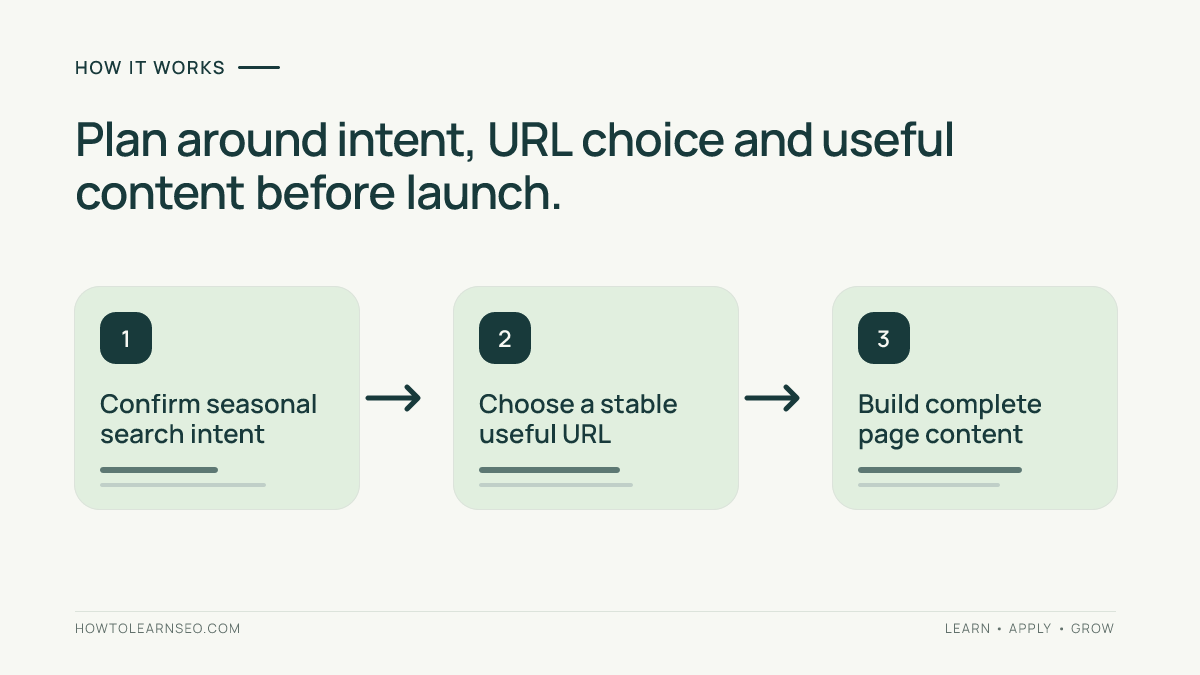
Plan seasonal SEO landing pages by identifying a recurring search need, selecting a stable URL, preparing genuinely useful content before demand rises, and measuring results after the season. Keep the same URL when the underlying intent repeats annually; update dates, availability and examples rather than publishing a near-identical page each year. A seasonal page deserves to exist only when it solves a distinct task better than an evergreen category or service page. This guide walks through demand checks, page decisions, a content calendar, quality controls and post-season maintenance.
Key Takeaways
- Start with the searcher’s seasonal task, not a calendar date.
- Reuse a stable URL for recurring intent and refresh facts before each cycle.
- Publish early enough for discovery without promising an indexing deadline.
- Make every page useful outside its headline through details, choices and constraints.
- Review search performance and conversions separately; impressions are not sales.
Identify the Seasonal Search Task
Seasonality changes what people need, but not every seasonal keyword justifies a new page. Someone searching for “winter running shoes” may want a product selection, while “winter shoe storage tips” needs an instructional article. Write down the exact reader decision before choosing a template. A product category can serve recurring purchase intent; a guide can explain care, comparisons or preparation. A temporary promotion needs accurate offer details and an expiration plan. Mixing these jobs on one generic page often produces an unsatisfying experience. Record the audience, location, seasonal trigger, desired action and evidence that a dedicated page would add value. If an existing page already answers the question, improve that page instead of splitting its audience.
Find Demand Without Inventing Search Volumes
Begin with your own published pages and Search Console query data when accessible. Compare impressions and clicks across comparable date windows, while remembering that seasonality, ranking changes and reporting limitations can affect both. In the site’s Google Trends guide, the distinction between relative interest and absolute demand is important: Trends values are indexed, not monthly search volumes. Check the same region and search type, inspect several years if available, and compare related phrases. A single spike may reflect news rather than a repeatable season. Review the live search results manually for page types and practical expectations. If a query shows mainly shopping categories, do not assume a blog post will satisfy it. Record unknown keyword volume and difficulty as unverified, not zero.
Choose Between a New Page and an Existing URL
Before creating anything, inventory the site’s existing category, product, service and guide pages. Use a new seasonal landing page only if it has a different purpose, a distinct collection or genuinely separate information. If the seasonal phrase merely changes a month or year, an existing evergreen page may be the stronger home. The keyword cannibalization workflow helps identify overlapping intent, but overlapping keywords alone do not prove a problem. For a recurring seasonal collection, favor a stable descriptive slug such as /winter-running-shoes/ over a new /winter-running-shoes-2027/ every year. Dates can appear in visible copy when relevant. Do not redirect a still-useful evergreen page simply because its title lacks the current year. Make the decision based on user value, not a blanket rule about URL age.
Build a Calendar Around Real Work
Work backward from the date people need the answer. Reserve time for product availability checks, content editing, technical QA, publishing and measurement setup. A practical calendar has five columns: intent, URL, content owner, verification date and next review date. For a small site, a manageable schedule is better than dozens of rushed pages. The content owner should know which claims expire, who confirms prices or opening hours, and what happens when the promotion ends. Google’s helpful content guidance emphasizes people-first value rather than pages manufactured for search traffic. There is no official universal number of weeks required before a seasonal page can rank. Publish when the page is accurate and complete, allowing time for discovery without promising a deadline.
Create a Page That Helps Someone Decide
Start with a direct answer and a clear explanation of what the page covers. A shopping page may need filters, sizes, stock status, delivery boundaries and alternatives; an event guide may need dates, eligibility, location and a step-by-step plan. Include firsthand information only when you actually have it. Avoid fabricated product testing, unsupported “best” labels and copied manufacturer descriptions. For commercial categories, the category page SEO guide provides useful context on products and navigation. Give each heading a purpose, make important details readable on mobile, and provide accessible descriptions for meaningful images. Do not hide the only critical instructions inside an image. If stock is unavailable, show relevant alternatives or explain the limitation rather than leaving a misleading purchase call to action.
A Reproducible Winter Collection Example
Consider a fictional retailer with an existing /running-shoes/ category and a planned winter collection. The input is a query set around winter running shoes, a product inventory containing six weather-resistant models, and an existing generic category. The decision rule is: create /winter-running-shoes/ only if the winter selection and guidance are meaningfully different. The action is to publish a curated category with grip information, surface suitability, waterproofing limitations, available sizes and a link back to the general collection. Expected output is a page that lets a shopper compare winter-specific choices without guessing which models are appropriate. Verification means checking that every product link works, inventory labels match the store and mobile filters remain usable. Edge case: if only one ordinary model qualifies, enhance the general category instead of creating a thin seasonal page. These details are illustrative, not results of a live store test.
Design Internal Links Around the Journey
A seasonal page should not be isolated. Link from the relevant evergreen hub when it adds value, and link back to the broader collection or foundational guide. Use descriptive anchor text that identifies the destination rather than repeating an exact keyword mechanically. The internal linking guide explains how to connect related pages without forcing links. During a campaign, update prominent navigation only when the destination is important enough for users. Remove outdated promotional navigation afterward, but preserve useful contextual links to a recurring page. Check links in rendered mobile navigation, not just in an editor preview. Avoid publishing a page that can only be found through an XML sitemap; navigation and contextual links help real visitors discover it.
Check Technical Eligibility Before Launch
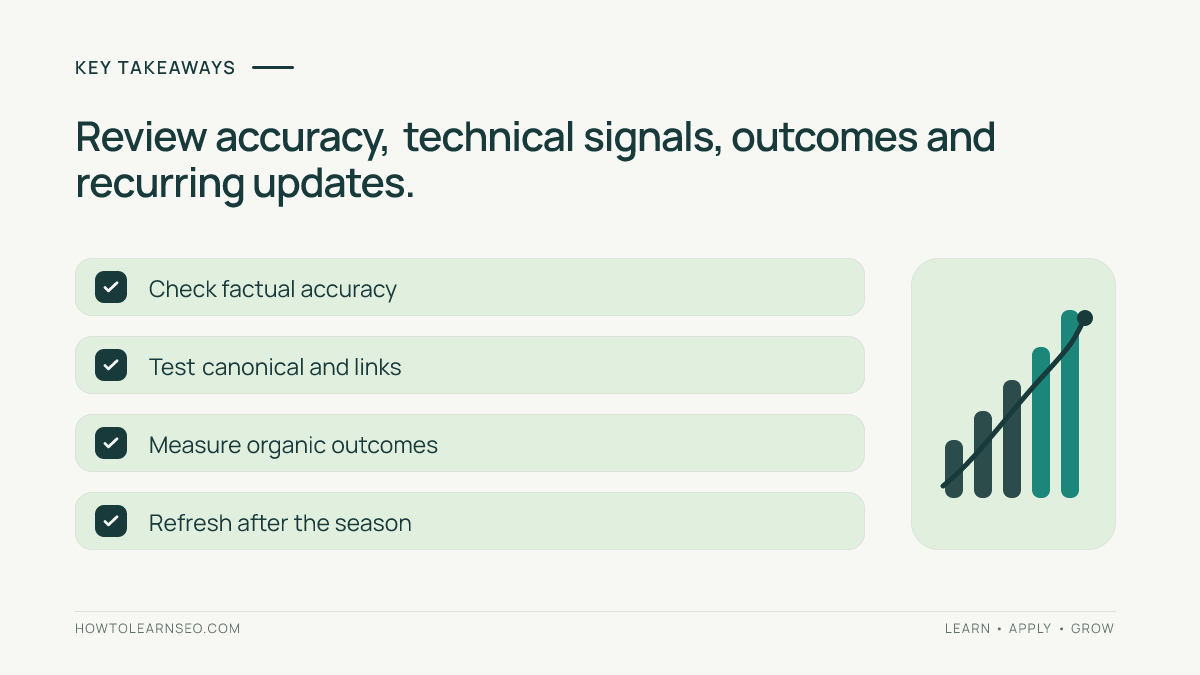
Confirm that the intended canonical URL is indexable, returns a successful response and is not blocked unintentionally. Verify that internal links resolve to the preferred URL and that the page is not a duplicate of a filtered parameter URL. Google’s canonicalization documentation explains why canonical signals should be consistent. A canonical tag is a signal, not an indexing guarantee. Use Search Console’s URL Inspection when available, but distinguish a successful live test from actual indexing. For an expired offer, do not leave a page promising a discount that no longer exists. If the seasonal intent repeats, preserve the helpful evergreen information and update the offer section. If a page is permanently obsolete with no suitable replacement, choose an appropriate retirement response instead of redirecting every old campaign to the homepage.
Measure Outcomes and Learn After the Season
Define success before publishing. For an informational guide, useful measures might include organic landing-page visits and meaningful engagement; for a commercial page, evaluate relevant conversions alongside search visibility. Compare equivalent seasonal periods where possible and annotate major site changes. The GA4 organic conversion tutorial explains the difference between traffic and outcomes. Search Console clicks and GA4 sessions are different metrics and will not necessarily match. Review which queries reached the page, which sections helped visitors decide, and where product availability or content quality failed. Do not call a ranking increase proof that one edit caused it; promotions, competitors and demand can change simultaneously. Keep a short change log so next year’s refresh starts from evidence instead of memory.
Common Mistakes and Practical Limits
The most damaging mistake is treating every holiday and year as a reason to clone another landing page. A second problem is updating a date in the title while leaving expired prices, discontinued products or broken booking links inside. Other pitfalls include relying on Trends as a volume estimator, using misleading urgency, and promising rankings after a fixed number of days. Search engines decide what to crawl and index; publishing is not a guarantee. Google’s SEO Starter Guide offers a broader foundation for making pages discoverable and understandable. If your business has limited inventory or only one annual event, a well-maintained evergreen hub with a seasonal section may be more useful than a standalone URL. Choose the smallest content architecture that completely serves the reader.
Pre-Publish and Post-Season Checklist
- Confirm a distinct reader intent and a genuinely useful page type.
- Check all existing URLs for overlapping tasks and choose a stable slug.
- Verify products, dates, geographic restrictions and claims with the owner.
- Add useful navigation, clear headings, accessible images and contextual links.
- Test mobile layout, internal destinations, canonical signals and indexability.
- Record a baseline and a post-season review date.
- After the season, remove expired offers, refresh recurring details and document lessons.
Frequently Asked Questions
Should I create a new seasonal SEO page every year?
Usually not. Reuse a stable URL when the reader intent repeats, and update time-sensitive details while keeping useful evergreen information.
How early should I publish a seasonal landing page?
Publish once the content is accurate and complete, allowing time for discovery. There is no guaranteed indexing or ranking timetable.
Can Google Trends tell me monthly keyword volume?
No. Google Trends reports normalized relative interest, not absolute monthly search volume. Use it to compare patterns, not to invent counts.
Should I delete a seasonal page when the promotion ends?
Not automatically. Preserve recurring useful content, remove expired claims and retire pages only when they no longer serve a purpose.
What if my seasonal page overlaps an existing category?
Compare the primary reader tasks. If both pages answer essentially the same need, improve the existing category rather than creating a near-duplicate.
How do I measure whether the seasonal page worked?
Review relevant Search Console visibility alongside organic landing-page behavior and conversions, comparing appropriate seasonal periods and noting limitations.
Conclusion
Plan seasonal SEO landing pages around a specific user task, not an annual publishing quota. Choose a stable destination when intent repeats, maintain truthful details, connect the page to the rest of the site and measure outcomes after demand subsides. A smaller collection of useful, updated pages is a stronger foundation than a calendar full of thin duplicates.