An SEO test plan defines what you will change, which pages will remain unchanged and how you will judge the evidence. AI can organize this protocol, but it cannot turn a promising title suggestion into a proven improvement.
This tutorial helps you prepare a bounded title experiment across comparable existing pages. The deliverable is an approved plan, not a claimed result or automatic permission to edit a website.
Quick Answer
Write one falsifiable hypothesis, select suitable pages, assign treatment and comparison groups before deployment, and specify one primary metric. Save the baseline, approved titles, review window, disruption rules and rollback process. Ask AI to check the plan for missing information rather than predict the winner.
Key Takeaways
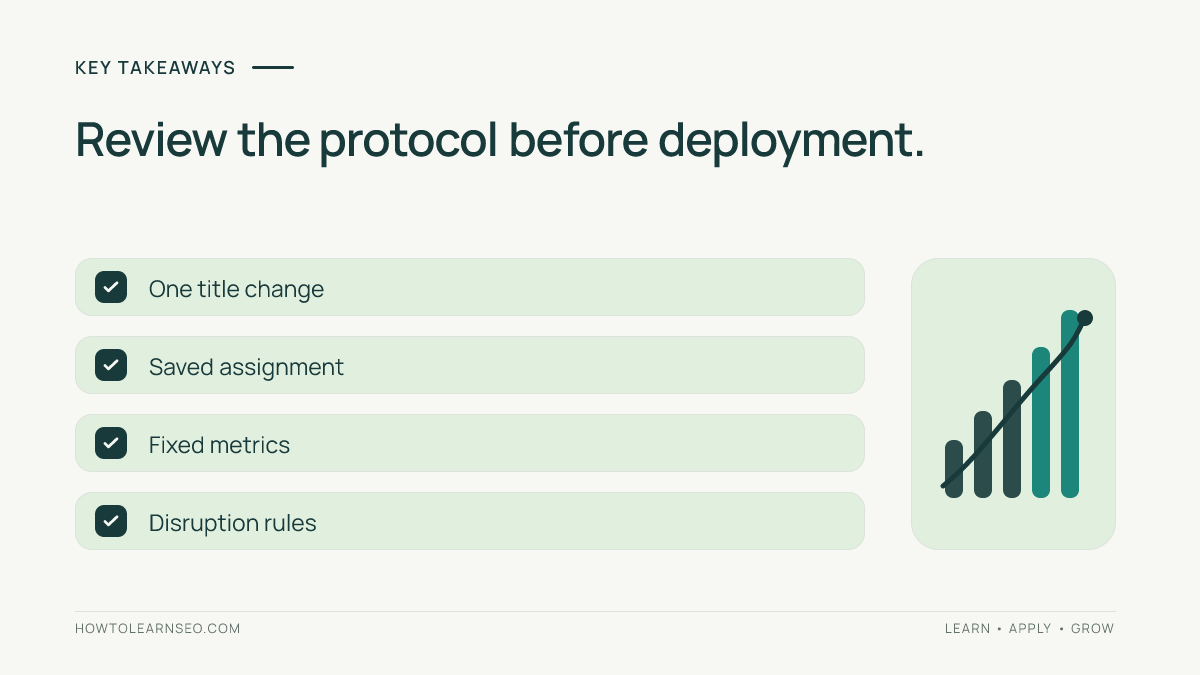
- Plan the comparison before seeing post-change results.
- Change one defined element while keeping other planned work consistent.
- Comparison pages help interpret background movement; they do not eliminate every bias.
- Inconclusive is a valid outcome when evidence is insufficient.
Check Whether a Test Is Appropriate
You need a set of comparable indexed pages, Search Console access, saved historical exports, authority to make and reverse title edits, and a named reviewer. Use an approved AI environment with minimized inputs. The export-preparation tutorial explains how to review files before analysis.
Fix factual errors, broken access or misleading titles directly through your normal editorial process. Do not preserve harmful content as a control. Testing makes sense when both versions are accurate and you genuinely do not know which presentation serves readers better.
If the site has only a few rarely visited pages, a controlled performance test may be impractical. Have an analyst assess baseline variability, the smallest worthwhile effect and available page count before promising a detectable result. There is no universal minimum traffic threshold or guaranteed four-week answer.
Build Your SEO Test Plan
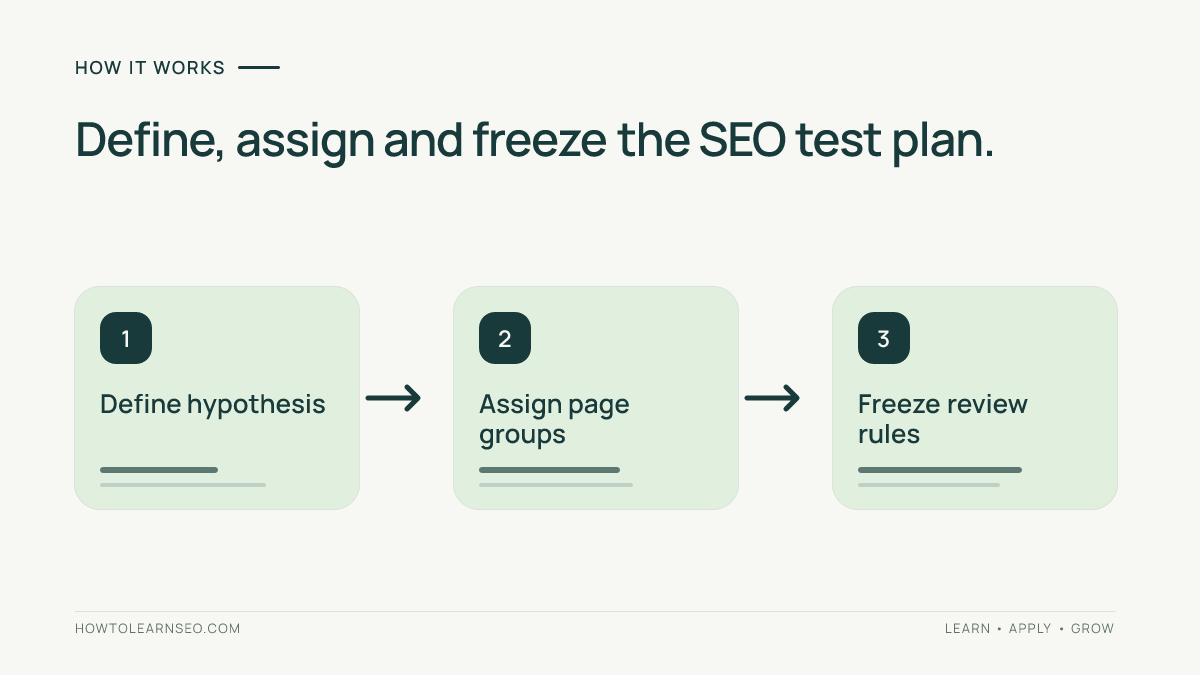
1. Define One Hypothesis and One Change
Use this structure: “For these eligible tutorials, adding an accurate task description to the HTML title will improve organic clicks relative to unchanged comparison pages, without a material loss of useful visits.” Record a numeric guardrail and the business reason for it before launch.
Specify the actual title transformation. For example, replace a vague label with the task the article already teaches; do not add unsupported claims such as “tested” or “best.” The metadata-writing guide covers drafting. Keep headings, descriptions, body text and internal links unchanged for this particular experiment.
2. Select and Assign Comparable Pages
Record eligibility rules before selecting winners: same template, language and audience, stable indexability, no planned migration, and enough historical observations for review. Compare baseline trends, traffic scale, seasonal exposure and query mix. Do not put every declining page in treatment and every rising page in control.
Where feasible, form comparable page pairs and randomly assign one page in each pair to treatment, keeping the other unchanged. For each pair, label pages A and B, flip a coin once, and record heads as A receives treatment, tails as B. Save the assignment; do not reshuffle after reviewing results. Avoid pairs competing heavily for the same queries, because changing one could affect the other.
This adapts the general principle of blocking and randomization described by NIST: account for important background differences, then randomize within comparable groups. Pairing does not make pages identical, and SEO outcomes can remain interdependent. If assignment is based on judgment instead, describe the work as a comparison with additional selection bias.
3. Freeze the Measurement Rules
Choose one primary metric, such as Search Console clicks for the fixed page groups. Record property, search type, country and device scope, exact URL lists, baseline boundaries and follow-up boundaries. Use complete periods with comparable weekdays. Keep impressions, aggregate CTR and average position as diagnostic metrics rather than switching to whichever improves.
Define how the analyst will compare group changes and quantify uncertainty before deployment. A simple before-and-after percentage alone cannot establish causation. Calculate group CTR as total clicks divided by total impressions, not an unweighted average of page CTRs. Google’s page-change guidance cautions that demand and other events can affect observed performance.
Worked Example: A Protocol, Not a Result
This fictional plan illustrates decisions an editor must make. No test was run and no improvement was observed.
| Protocol field | Illustrative decision |
|---|---|
| Question | Does naming the tutorial task in the HTML title improve clicks? |
| Eligible pool | Twenty stable tutorials, subject to an analyst’s adequacy check |
| Assignment | Ten comparable pairs; randomly choose one treatment page per pair |
| Single change | Approved task-led title on ten pages; ten retain accurate original titles |
| Baseline | Twenty-eight complete days before deployment, plus longer trend context |
| Review | A predefined post-processing window, approved before launch |
| Disruptions | Record outages, competing releases, indexing changes and unusual campaigns |
| Decision | Expand, revert or remain inconclusive after evidence and uncertainty review |
Twenty pages and 28 days are illustrative choices, not sufficient sample-size guidance. Complete the protocol with the analyst-approved duration, worthwhile-effect threshold and uncertainty method before approving deployment. If suitable comparisons or sufficient observations are unavailable, narrow the claim to a descriptive pilot rather than calling it a successful experiment.
Use AI to Challenge the Protocol
Supply only reviewed inputs and ask for a critique:
Review this SEO title-test protocol. Identify missing eligibility rules, assignment details, metric definitions, timing, disruptions and decision thresholds. Do not invent data, statistical power or expected uplift. Return each gap, why it matters and what the reviewer must supply. Do not edit the website.
Check the response against your evidence. AI-generated sample-size claims or confidence values need a reproducible method and appropriate analysis, not persuasive wording. Keep approved protocol versions separate from suggestions; the SEO change log workflow records actual deployment later.
Plan Deployment and Review Exceptions
Keep each existing URL stable and serve its approved title consistently to visitors and crawlers. Google’s website-testing guidance prohibits showing special test content only to Googlebot. This page-group plan does not need duplicate URLs or visitor redirects.
Save before-and-after HTML title evidence and record actual deployment times. Google’s title-link documentation explains that displayed titles are selected automatically and changes require recrawling and reprocessing. A live title edit therefore does not prove that every searcher saw it. Predefine how delayed processing affects the measurement window; do not move dates after seeing favorable results.
If controls receive an unrelated redesign, mark the comparison contaminated and apply the recorded disruption rule. If a title becomes inaccurate, correct it immediately and record the deviation. Review technical status separately from content usefulness and business outcomes.
For business guardrails, GA4’s current channel definitions distinguish AI Assistant traffic using the ai-assistant medium. Google AI Overviews and AI Mode belong within Organic Search. Do not label all organic or Direct traffic as measured AI exposure, or treat crawler requests as citations.
Frequently Asked Questions
Can I test two titles on the same page by alternating daily?
That is difficult to interpret for organic search because crawling, reprocessing and changing demand do not follow your daily switch schedule. A visitor-level test also answers a different question from a search-performance test. Choose a design appropriate to the outcome, and avoid presenting daily alternation as a clean controlled comparison.
Should I stop as soon as clicks rise?
No. Repeatedly checking and stopping at a favorable moment can create a misleading winner. Follow the predefined review rules and distinguish emergency corrections from performance decisions. If a planned window produces insufficient evidence, report that limitation rather than extending repeatedly until a desired result appears.
What if Google displays a different title?
Record what you can actually observe, including the query and date of any sampled search result. One observation cannot establish exposure for every impression. The test concerns deploying an HTML title change, while Google’s displayed title may vary. Keep that implementation and exposure limitation in the final interpretation.
Does a positive test prove better AI citations?
No. A change in measured search clicks does not establish a change in AI mentions or citations. Those require separate observations with documented sources and sampling limits. Keep the experiment’s stated outcome narrow, and do not expand a successful click comparison into a claim about all search or AI systems.
Can I reuse the winning rule across the entire site?
Consider whether the tested pages represent the next group. Different templates, audiences or query types may respond differently. Review uncertainty, accuracy and business guardrails before expanding gradually. Preserve the earlier protocol and results, and treat a new population as another decision rather than assuming the original effect is universal.
Conclusion
A useful SEO test plan makes uncertainty reviewable before edits begin. Define the hypothesis, assign comparable pages, freeze measurement rules and document exceptions. Let AI challenge missing details while keeping deployment, analysis and claims grounded in evidence.