
Quick answer: An AI search content refresh updates an existing WordPress page because its facts, instructions, evidence, search intent, or technical presentation have materially changed. Keep the same useful URL and purpose, correct what is outdated, add genuinely better evidence or examples, and document the revision. Do not change dates or rewrite wording merely to make a page look fresh.
Key takeaways
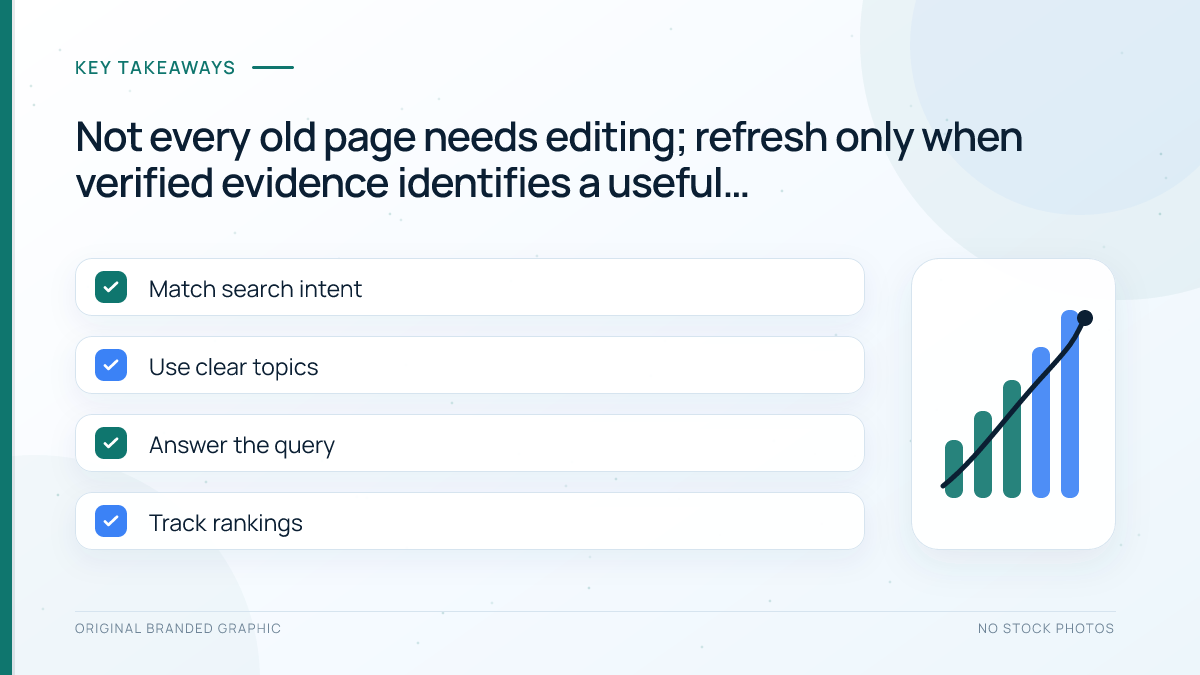
- Choose refresh candidates from evidence, not publication age alone.
- Fix wrong facts and broken instructions before adding more words.
- Preserve the page’s core intent unless a different page already serves it better.
- Update visible dates and
dateModifiedonly after a substantive change. - Measure search and business outcomes separately; a refresh does not guarantee AI citations.
Prerequisites for an AI search content refresh
You need WordPress access, the page’s canonical URL, current Google Search Console data, and the primary sources needed to verify claims. Keep a copy of the current title, body, metadata, internal links, schema, and modification date.
Google’s current generative AI search guidance says ordinary SEO foundations still apply. Pages must be indexed and eligible for a Search snippet, while unique, helpful content matters more than AI-specific tricks. It does not require special AI schema, an llms.txt file, or artificial content “chunking.”
Which pages deserve a refresh?
| Signal | What to verify | Likely action |
|---|---|---|
| Official process or definition changed | Current primary documentation | Correct steps, screenshots, and limitations |
| Impressions remain but clicks or CTR weakened | Query-page pairs, title, snippet, intent | Improve the answer and search presentation |
| Traffic declined across comparable periods | Seasonality, devices, countries, competing URLs | Diagnose before editing |
| Author, brand, product, or policy facts conflict | Approved source of record | Reconcile visible copy and structured data |
| Page is accurate and satisfies its task | User usefulness and current sources | Leave it alone |
Age by itself is not a defect. Google’s people-first guidance specifically warns against changing page dates when content has not substantially changed and against adding or removing content simply to make a site appear fresh. Review the people-first content questions before deciding that every old post needs work.
How to refresh existing content for AI search
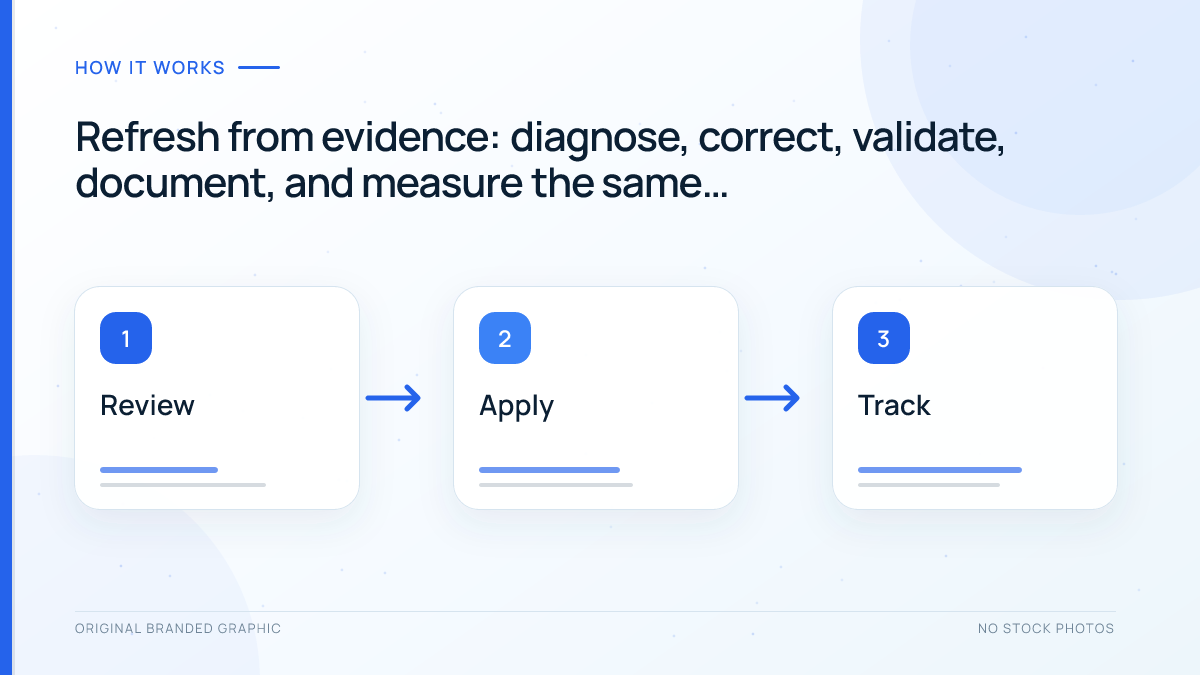
1. Build a small evidence-led queue
In Search Console, compare a settled 28-day period with the previous 28 days, then inspect the Pages and Queries tabs for each candidate. Use weekly or monthly views to reduce day-of-week noise. Add candidates when performance changes align with an observable content issue.
Use the Google Search Console guide for the reporting basics. Do not call every declining page “content decay,” and do not infer AI Overview exposure from ordinary query patterns.
2. Verify the live URL before editing
Confirm HTTP access, indexability, self-canonical status, mobile readability, main heading, images, and structured data. Check whether another page targets the same task. A technical block, redirect, wrong canonical, or duplicate page needs diagnosis before a content rewrite.
3. Write a precise refresh brief
List the reader task, facts that changed, evidence for each correction, sections to preserve, and measurable outcome. Separate mandatory fixes from optional improvements. This prevents a focused page from becoming a generic guide. The existing AI search content brief provides a reusable planning structure.
4. Correct changed facts and instructions
Replace obsolete steps, interface labels, examples, screenshots, and definitions. Place primary references near the claims they support. If a source no longer supports a statement, revise or remove the claim instead of finding a weak source that merely repeats it. The source-audit workflow explains how to check authority, recency, and claim-to-source fit.
5. Add information that only your site can supply
Useful additions include an anonymized workflow, decision table, template, calculation, failure mode, or verified first-party observation. Label fictional examples clearly. Never present an illustrative result as a test, client outcome, or ranking gain. When genuine data exists, the first-party data workflow shows how to publish it without exposing private information.
6. Recheck entities, authors, and schema
Make sure the visible author, organization, product, and service facts agree with the live structured data. Correct the generating page, theme, or plugin rather than layering contradictory markup. Use the entity consistency audit when the mismatch spans several pages.
7. Update dates honestly
Keep the original publication date. Add a visible modified date only when the revision is substantial and useful to readers. If Article markup is present, Google recommends an ISO 8601 dateModified value, including timezone information, to provide more accurate date information. The structured value should match the visible revision rather than manufacture recency.
8. Perform final quality assurance
Read the updated page as a visitor. Confirm the direct answer, heading hierarchy, examples, citations, internal links, captions, alt text, canonical, robots directive, and visible-schema agreement. Record the old and new values, revision reason, date, and responsible reviewer. Request recrawling only when appropriate; indexing and ranking remain Google’s decisions.
Illustrative refresh example
Suppose a fictional WordPress article explains how analytics classifies visits from AI assistants. Search Console still shows impressions, but readers report that its channel instructions are outdated. The page also calls every ChatGPT visit a referral and claims Google AI Mode traffic is an AI-assistant referral. Those claims conflict with current analytics definitions.
| Finding | Repair | Verification |
|---|---|---|
| Old channel label | Replace it with the documented current label and rule | Link to the current Analytics definition |
| Referral claim is too broad | Explain that only identifiable referred visits are measured | Check source, medium, and channel examples |
| Google AI traffic is misclassified | Separate Google Search traffic from assistant referrals | Confirm the current exclusion note |
| No change log | Add a concise “updated” note describing the material revision | Match the visible date and Article markup |
This example updates the reader’s task without changing the URL or padding the article. After publication, compare settled periods, but do not attribute every fluctuation to the edit.
Troubleshooting common refresh problems
- The page declined but nothing is wrong: check seasonality, device and country shifts, query mix, and competing pages before editing.
- The topic changed completely: preserve the existing intent; avoid converting a useful URL into an unrelated article.
- Two pages overlap: map their reader tasks and internal links before deciding which needs revision. Do not publish another synonym page.
- A plugin changes the modified date automatically: verify the visible output and schema after saving; do not claim a manual date you cannot support.
- The refresh is not cited by AI systems: eligibility and quality do not guarantee selection, mention, or citation.
Limitations and measurement
Measure the same canonical URL over a documented 14- and 28-day window using settled data. In Search Console, review clicks, impressions, CTR, average position, queries, and pages; Google notes that the newest data can be preliminary and that table totals may differ because of aggregation. Where available, use its separate generative AI performance report. Track conversions or key events in analytics, but keep assistant referrals, Google organic traffic, crawler requests, and unobserved AI mentions as different concepts.
Frequently Asked Questions
How often should I refresh content for AI search?
Refresh a page when facts, instructions, intent, evidence, or technical output materially change. A fixed monthly rewrite schedule is unnecessary for accurate pages that continue to satisfy readers.
Should I change the publication date after an update?
Keep the original publication date. Add or update a modified date only after a substantive revision, and make the visible date consistent with any Article structured data.
Does adding more words improve AI visibility?
No specific word count guarantees visibility. Add only the explanation, evidence, example, or media needed to complete the reader’s task, then remove repetition and obsolete material.
Should I change the URL when refreshing an article?
Usually not. Preserve a useful canonical URL when the page keeps the same purpose. A URL change introduces migration work and should not be used merely to make content appear new.
How long should I wait before evaluating a refresh?
Use documented 14- and 28-day comparisons with settled data, while considering seasonality and site size. Search systems may process and reassess changes on different timelines, so avoid causal conclusions from a few days.
Conclusion
A strong AI search content refresh is controlled maintenance, not a freshness trick. Select pages from evidence, diagnose the real issue, preserve the URL and intent, correct changed facts, add truthful value, align visible content with metadata and schema, and measure the same page over time.