
ChatGPT keyword clustering can turn a long, untidy keyword list into a workable content plan, but only when the model receives strict rules and the output is checked by a human. This tutorial shows how to keep Google Sheets as the source of truth, use ChatGPT for a bounded classification task, and validate every proposed cluster before it becomes a page brief.
You will build a repeatable workflow that preserves every input row, separates keywords by dominant search intent, flags uncertain decisions, and maps each approved cluster to one page. The process does not pretend that semantic similarity is search-volume data, organic keyword difficulty, or proof that Google will rank the same URL for every query.
Quick Answer: How Do You Cluster Keywords With ChatGPT in Google Sheets?
Prepare one keyword per row in Google Sheets, assign a permanent row ID, clean exact duplicates, and send the rows to ChatGPT with a prompt that defines a cluster as queries one page can satisfy. Ask for tab-separated output that preserves every row ID and includes the cluster, intent, recommended page action, confidence, and a review note. Paste the result into a separate sheet, check row parity and duplicate IDs with formulas, then manually compare representative search results before mapping a cluster to a URL.
Key Takeaways
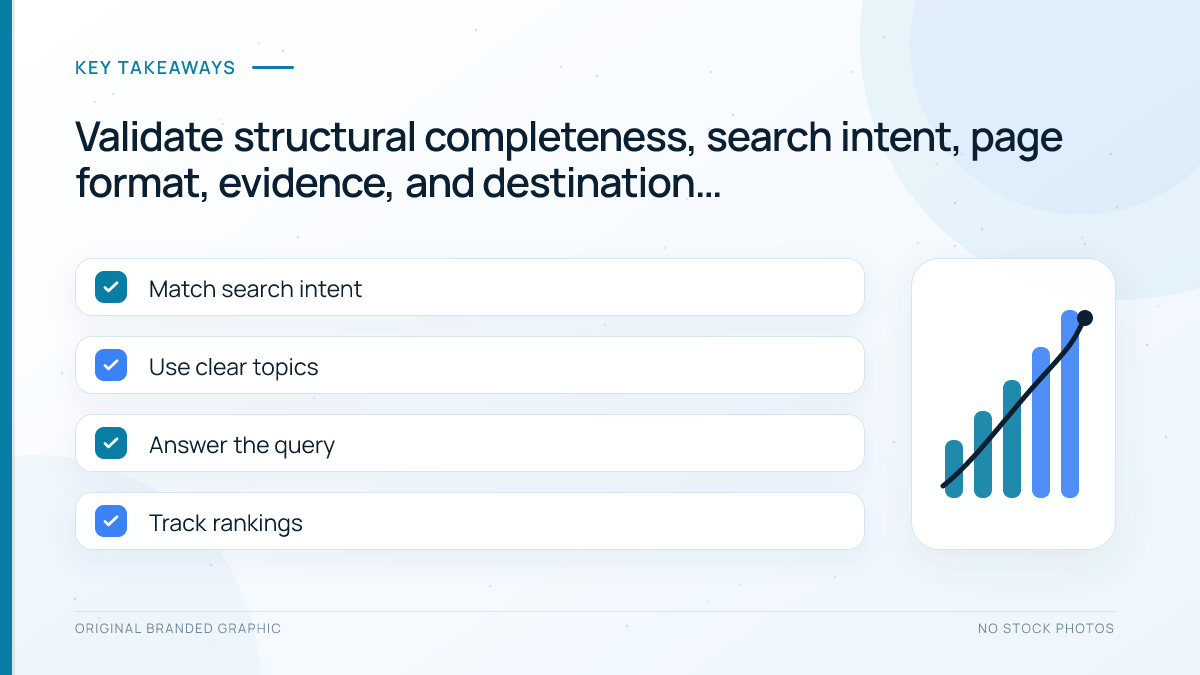
- A useful keyword cluster groups queries that share a dominant intent and can be answered well by one page; it is not merely a list of similar words.
- Permanent row IDs make omissions, duplicates, and changed keywords easy to detect.
- ChatGPT should classify only the data you provide. It should not invent search volume, keyword difficulty, live search results, or new keywords.
- Google Sheets remains the audit trail: preserve the raw tab, put model output in a new tab, and record human decisions separately.
- Manual search-result review is still necessary because a language model’s semantic grouping is not evidence that Google treats the queries identically.
What This Workflow Covers
- Prerequisites and sheet structure
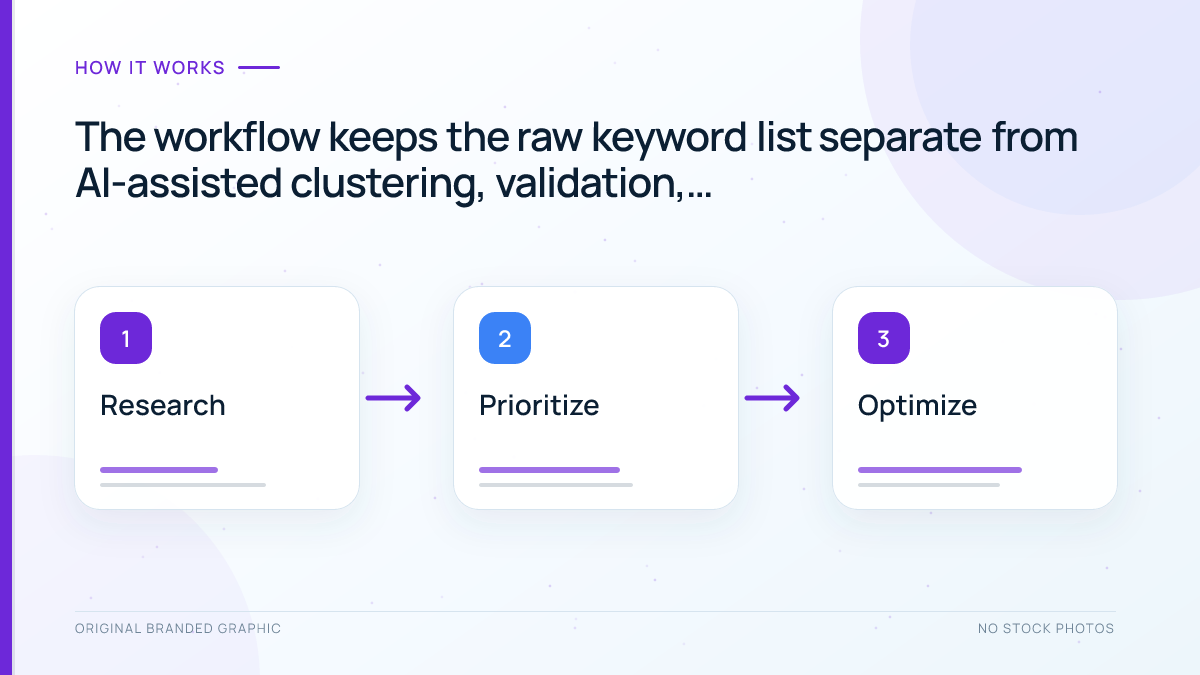
- The step-by-step clustering workflow
- An illustrative worked example
- Quality-control formulas and manual checks
- Troubleshooting and limitations
Before You Start: Prerequisites and Definitions
You need a Google Sheet, access to ChatGPT, a keyword list, and a clear target market. The keywords may come from your own research, Google Search Console, customer language, or another legitimate source. If you are still building the list, start with this beginner keyword-research workflow.
OpenAI’s official spreadsheet workflow recommends supplying the source exports, explicit keys, rules, and required outputs, then reviewing mismatches instead of allowing silent guesses. That same principle makes keyword clustering safer: preserve the source, define the grouping rule, and isolate ambiguous rows for review. See OpenAI’s spreadsheet workflow guidance.
What counts as a keyword cluster?
A keyword cluster is a group of queries whose searchers want substantially the same outcome and could be satisfied by one strong page. For example, “cluster keywords with ChatGPT” and “ChatGPT keyword grouping workflow” can reasonably support the same tutorial. “Keyword clustering tool comparison” signals a different task and may deserve a separate comparison page.
Do not confuse a keyword cluster with a sitewide topic cluster. Keyword clusters decide which queries belong on one page. Topic clusters organize multiple related pages around a broader subject.
Decide these rules before using ChatGPT
- Market: Record the target country and language. Do not mix markets unless that is deliberate.
- Page rule: Group keywords only when one page can satisfy the same dominant task without becoming unfocused.
- Intent labels: Use a small consistent set, such as informational, commercial investigation, navigational, and transactional.
- Uncertainty rule: Ambiguous keywords must receive low confidence and a review note, not a confident guess.
- Metric rule: Leave volume and difficulty blank unless you supply real, country-specific data from a named source.
ChatGPT Keyword Clustering Workflow in Google Sheets
Step 1: Create a raw-data tab that never gets overwritten
Name the first tab Raw. Use one keyword per row and keep the original wording intact. A practical column structure is:
| Column | Field | Purpose |
|---|---|---|
| A | row_id | A permanent identifier such as K001, K002, and K003 |
| B | keyword | The original keyword, unchanged |
| C | source | Where the keyword came from |
| D | country | The intended search market |
| E | monthly_searches | Optional verified country-specific data |
| F | current_url | An existing page already targeting the query, if any |
| G | normalized_keyword | A helper value used only for quality control |
| H | duplicate_check | Flags repeated normalized values |
Assign row IDs before sorting or filtering. The ID is more reliable than the row number because row numbers change when the sheet is reorganized.
Step 2: Normalize text and flag exact duplicates
In cell G2, enter =LOWER(TRIM(B2)) and fill it down. In H2, enter =IF(COUNTIF($G$2:G2,G2)>1,"Duplicate","Keep") and fill it down. Google documents LOWER, TRIM, and COUNTIF in its official Google Sheets function list.
This catches exact duplicates after basic case and spacing cleanup. It does not decide whether two different phrases belong in the same intent cluster. Keep one copy of an exact duplicate for analysis, but retain the removed row in the raw audit trail.
Step 3: Prepare a bounded batch
Create a second tab called Batch and copy only the columns ChatGPT needs: row_id, keyword, country, monthly_searches, and current_url. Use a manageable batch that the model can return completely. If the list is large, divide it by broad subject first, but keep the same instructions and never reuse a row ID.
You can copy the table directly or download the active tab as a CSV and attach it, depending on the capabilities available in your ChatGPT account. Do not include private client information, customer data, or credentials.
Step 4: Use a prompt that protects the input
Paste the following prompt with the batch. It defines the decision rule, blocks invented metrics, and requests an output that Google Sheets can parse.
You are classifying SEO keywords into page-level clusters.

Goal:
Group keywords only when they share the same dominant search intent
and one page could satisfy them fully.

Rules:
1. Use only the rows provided. Do not add keywords.
2. Preserve every row_id and keyword exactly as supplied.
3. Return exactly one output row for every input row.
4. Do not invent search volume, keyword difficulty, CPC, trends,
   live search results, rankings, or URLs.
5. Separate keywords when the required page type or reader task differs.
6. Choose a primary keyword for each cluster by clarity and intent fit.
   Use volume only when a verified value is present in the input.
7. Mark ambiguous decisions Low confidence and explain what needs review.
8. A current URL is evidence to review, not permission to force a match.

Return tab-separated text with this header:
row_id	keyword	cluster_id	cluster_name	primary_keyword	intent	page_action	confidence	review_note

Allowed page_action values:
Keep existing URL | Expand existing URL | Create new page | Manual review

After the rows, add a short cluster summary. Do not use a Markdown table.
Why be this strict? Without row preservation and a no-invention rule, a plausible-looking response can hide dropped phrases, rewritten wording, or unsupported metrics. The model’s role here is classification, not measurement.
Step 5: Paste the output into a separate results tab
Create a tab named Clusters and paste the tab-separated rows starting in A1. Keep ChatGPT’s cluster summary below the data or in a separate Notes tab so it cannot interfere with formulas.
Do not replace the Raw tab with the clustered output. The separation lets you compare the result with the source, rerun only disputed rows, and explain later why a URL received a particular cluster.
Step 6: Validate row parity before reviewing SEO decisions
First confirm that the output is structurally complete. If the Raw IDs are in Raw!A2:A and the returned IDs are in Clusters!A2:A, use these checks:
| Check | Formula or method | Pass condition |
|---|---|---|
| Input row count | =COUNTA(Raw!A2:A) | Matches the expected source count |
| Output row count | =COUNTA(Clusters!A2:A) | Equals the input count |
| Missing ID flag | =IF(COUNTIF(Clusters!A:A,A2)=0,"Missing","") in Raw | No Missing values |
| Repeated output ID | =IF(COUNTIF(Clusters!A:A,A2)>1,"Repeated","") in Raw | No Repeated values |
| Changed keyword | Compare the returned keyword against the row ID’s original value | Exact match |
If any structural check fails, do not review the clusters yet. Ask ChatGPT to correct only the missing, repeated, or changed rows, then run the checks again.
Step 7: Review intent, page type, and representative search results
Read each cluster as a human. Ask whether every phrase represents the same task and whether one page format can satisfy it. A tutorial, definition, template, tool comparison, and product page may share vocabulary while serving different intents. Use the site’s search-intent guide if the boundary is unclear.
Then manually search two or three representative queries in the intended market. Compare the dominant page types, content promises, and apparent interpretation of the query. Similar results strengthen the case for one page; meaningfully different results are a reason to split the cluster. There is no universal overlap percentage that removes the need for judgment.
Step 8: Map each approved cluster to one page
Add three human-review columns to the Clusters tab: approved_cluster, target_url, and decision_note. Prefer an existing relevant page when it already satisfies the intent; otherwise record a new-page opportunity. This is where clustering becomes keyword mapping.
Do not create several near-identical pages just because wording differs. Google recommends people-first content created to help readers, and its spam policies specifically warn against keyword stuffing. Review the current people-first content guidance and Google Search spam policies before turning clusters into briefs.
Illustrative Worked Example
The following example is deliberately small so you can audit every decision. It is illustrative, not a report of measured search volume, rankings, competition, or live SERP testing.
| Rows | Proposed cluster | Example keywords | Dominant task | Suggested action |
|---|---|---|---|---|
| K001–K003 | C01: ChatGPT keyword clustering | chatgpt keyword clustering; cluster keywords with chatgpt; google sheets keyword clustering | Complete a hands-on clustering workflow | Create one tutorial |
| K004–K006 | C02: Keyword mapping | keyword mapping template; map keywords to urls; keyword map for seo | Assign approved keywords to URLs | Expand an existing mapping guide |
| K007–K009 | C03: Keyword cannibalization | avoid keyword cannibalization; keyword cannibalization checker; pages competing for same keyword | Diagnose or prevent competing pages | Manual review before choosing format |
| K010–K012 | C04: Topic clusters | seo topic clusters; pillar page and cluster content; topic cluster example | Plan a multi-page content architecture | Keep separate from page-level clustering |
| K013–K015 | C05: Search intent | search intent examples; informational vs commercial intent; identify keyword intent | Understand or classify intent | Map to an intent guide |
The important decision is not that all 15 phrases concern keyword strategy. It is that they require five different reader outcomes. Combining them into one “SEO keywords” cluster would produce an unfocused page; splitting every wording variation would create overlapping pages.
Keyword-Cluster Quality-Control Checklist
- Source preserved: The Raw tab is unchanged and every keyword has a stable row ID.
- Complete return: Input and output counts match, with no missing or repeated IDs.
- No invented data: Unsupported volume, difficulty, CPC, rankings, and SERP claims are absent.
- Intent match: Every keyword in a cluster seeks the same dominant outcome.
- Format match: One page type can satisfy the whole cluster.
- Representative queries checked: Ambiguous clusters receive manual search-result review in the target market.
- Primary keyword justified: The choice is based on clarity and fit, or on supplied verified metrics.
- One destination: Each approved cluster has one target URL or one clearly defined new-page brief.
- Existing content considered: Relevant URLs are expanded before a competing page is proposed.
- Decision recorded: Splits, merges, and exceptions have a short human-written note.
Troubleshooting Common Clustering Problems
| Problem | Likely cause | Correction |
|---|---|---|
| One giant cluster | The prompt grouped by broad topic rather than page-level intent | Repeat the rule that one page must satisfy the same task and format |
| Too many tiny clusters | The model treated wording differences as different intents | Ask it to merge synonyms only when the page promise remains identical |
| Rows disappear | No stable ID or one-row-per-input requirement | Add IDs, require exact row parity, and run the missing-ID formula |
| Keywords are rewritten | The request emphasized cleanup instead of preservation | Keep a separate normalized helper column and demand exact original text |
| Results change between runs | The decision rules or batch context changed | Save the prompt, batch, date, and model output; rerun only flagged rows |
| Commercial and informational terms mix | Shared nouns outweighed different reader outcomes | Split by dominant task and validate page type in live search results |
Limitations You Should Record
ChatGPT can organize language and apply explicit classification rules, but it cannot turn an unverified list into verified market data. Unless you provide current country-specific measurements, the workflow does not establish monthly search volume, organic difficulty, traffic potential, or “low competition.” It also does not prove that Google will rank one URL for every query in a proposed cluster.
Outputs can vary when the prompt, batch, or model changes. Save the exact input and output, keep confidence labels, and let a human approve the final map. For sensitive projects, remove confidential data and follow your organization’s data-handling rules. Finally, clustering improves planning discipline; it does not guarantee rankings, AI citations, or traffic.
Frequently Asked Questions
How many keywords should I send to ChatGPT at once?
Use a batch small enough to return one complete, reviewable row for every input. There is no universal ideal number because account capabilities, keyword length, and required output detail vary. Start with a modest subject-based batch, verify row parity, and increase only while the output remains complete. Stable row IDs matter more than chasing the largest possible batch.
Can ChatGPT replace a dedicated keyword-clustering tool?
It can perform a useful semantic first pass, especially when you need transparent rules and a reviewable table. It does not automatically supply trustworthy live SERP overlap, country-specific search volume, or organic difficulty. A dedicated tool may add those data sources, but its output still needs intent and content review. Choose based on the evidence your decision actually requires.
Should I include search volume in the clustering prompt?
Include it only when the value comes from a known source, applies to the target country, and is current enough for your decision. Tell ChatGPT to use volume as a secondary signal for choosing a primary phrase, not as the rule for grouping intent. If the data is missing or unverified, leave the field blank rather than asking the model to estimate it.
What should I do when one keyword has mixed intent?
Mark it for manual review instead of forcing it into the nearest cluster. Search the phrase in the target market and inspect the dominant result types and page promises. If the results remain genuinely mixed, map the keyword to the page that best serves your audience’s likely task and record the uncertainty in the decision note.
How do I prevent keyword cannibalization after clustering?
Give each approved intent cluster one destination URL, compare it with existing content, and expand a relevant page before proposing another. Record the primary and supporting terms in a keyword map. If two URLs still target the same outcome, review their distinct value and internal links instead of publishing more near-duplicate pages.
How often should I rerun the keyword clusters?
Rerun a cluster when the keyword set, target market, business offer, existing URLs, or observed search intent materially changes. Do not rerun merely to obtain a preferred answer. Preserve the earlier input, output, prompt, and approval notes so you can compare decisions. For routine additions, process only the new or disputed rows and then review their relationship to approved clusters.
Conclusion
A reliable ChatGPT keyword clustering process is less about a clever prompt than about controlled inputs, explicit intent rules, and visible quality checks. Keep the raw keywords in Google Sheets, require exact row preservation, reject invented metrics, and manually validate ambiguous clusters before assigning URLs.
Once the clusters are approved, connect them to a documented keyword map and a deliberate internal-linking plan. That turns an AI-assisted classification exercise into a practical SEO workflow while keeping the final editorial decisions accountable to people.